
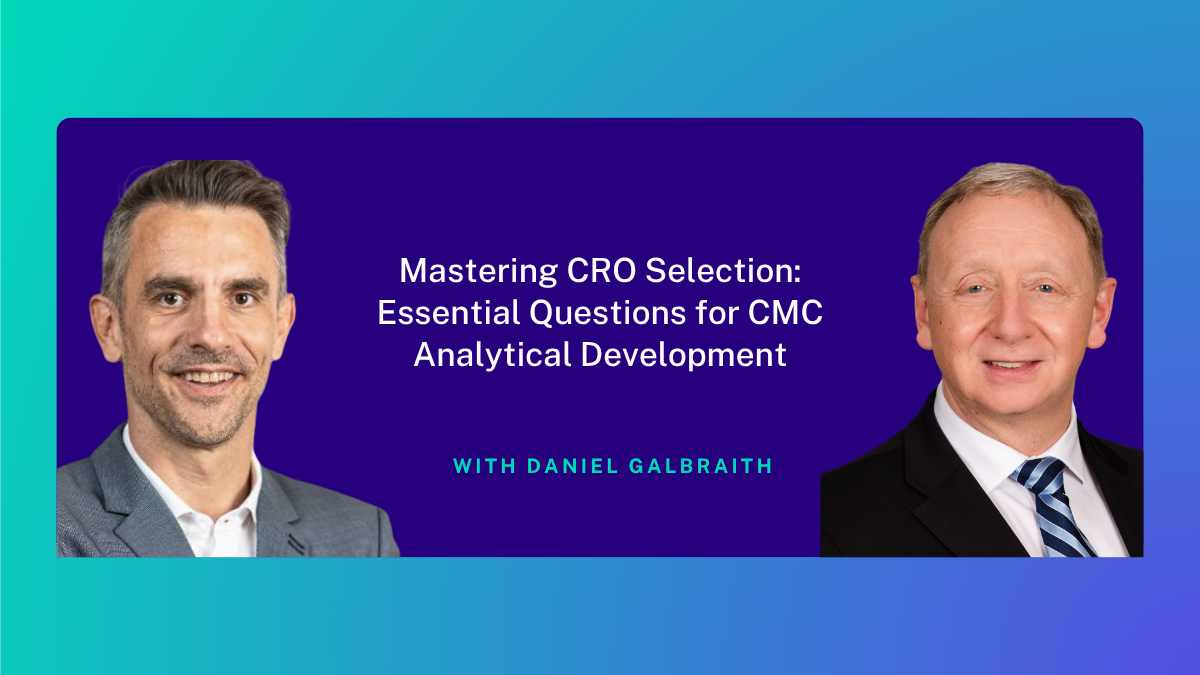
Cell and gene therapies have redefined what’s possible in modern medicine, but their road to market is anything but straightforward. Instead of a slow ramp-up, these therapies often leap from small early-stage trials to global commercialization at record speed—putting immense pressure on analytical workflows, supply chains, and every partnership in between. Staying ahead means making smart, sometimes tough choices about what to build internally and what to hand off to expert partners.
This is the second part of the conversation with Daniel Galbraith, Chief Scientific Officer at Solvias, a Swiss-based global CRO providing analytical services for small molecules, biologics, and cell and gene therapies. The discussion is part of the Smart Biotech Scientists podcast, hosted by David Brühlmann.
Key Topics Discussed
- What makes CGT collaborations fundamentally different from traditional drug development.
- Managing the transition from clinical batches to global commercial production in CGT.
- Improving scheduling, resource alignment, and communication between CROs and biotechs.
- Balancing internal expertise with external CRO support for complex modalities.
- Key skills and structures for effective coordination with CDMOs and CROs.
- Analytical challenges in developing and validating multi-modality therapeutics.
- Ensuring quality and regulatory consistency across international CGT testing sites.
- Evolving analytical methods and partnerships to enable next-generation combination therapies.
Episode Highlights
- How evolving cell and gene therapy timelines are driving the need for true CRO-drug developer partnerships [00:00]
- The unique challenges of scaling CMC analytics from early trials to global commercialization [02:51]
- Key pitfalls to avoid when outsourcing to CROs—especially around communication, scheduling, and troubleshooting [06:26]
- Deciding whether to build capabilities in-house or outsource to a CRO, and how to find the right balance for your team [09:51]
- The critical importance of strong project management for juggling relationships between developer, CRO, and CDMO [10:20]
- Daniel's perspective on the future of combination therapies and what the analytical landscape will demand of CROs [13:33]
- Practical advice for building transparent, open CRO partnerships that support your goals [15:21]
In Their Words
The development of these products, the cell and gene therapies, is so much faster that when you're working together, understanding where the endpoint is—where are we trying to get to?—and for everybody to be on that same race in parallel, working in step with each other, so that as each success of a clinical study goes, and success with the regulators, what does that mean? How are we going to staff that up? How are we going to enable that whole supply chain that you have to work on a global basis? And that's really where the partnership between a CRO and a drug developer in that CGT space becomes just a fundamentally different way of working together. It's a really true partnership.
Episode Transcript: Mastering CRO Selection: Essential Questions for CMC Analytical Development - Part 2
David Brühlmann [00:00:45]:
Welcome back to part two of Daniel Galbraith from Solvias. In the first half we explored his biotech journey and the seismic shifts in analytical development. Now we are getting tactical. Daniel will share the top analytical challenges that consistently derail bioprocessing teams and how to implement these phase appropriate strategies that actually speed up development and the critical factors for selecting the right CRO partner. Plus his predictions on which therapeutic modalities will dominate the next five years. Let's jump in.
Given the multiple technical and scientific challenges, how do you at Solvias or other CROs, how do you enable a successful commercialization of novel therapies? What is that thing that makes a project successful?
Daniel Galbraith [00:02:51]:
I think for us in the cell and gene therapy space, the thing that’s made it successful is the commitment and the partnership that you have to understand right from the start is needed to actually make these products successful. So if you think about cell and gene therapy, normally you start off with a very small number of patients or batches to treat — phase one clinical studies, all of that. So you’re investing a lot of time and effort to actually test and release quite a small number of batches of product for that early-stage clinical trial.
But with cell and gene therapy, especially in some of these conditions where there’s an abbreviated approval process — and you can read up about how the FDA does that — there are a number of ways that we can take these treatments that target rare conditions, where you can go from very early on in a phase one study to phase three and now approval, and that can be done in a relatively short period of time.
What you can find is that you’re going from actually testing a small number of products to testing quite a large number of products. You’re going through an approval process, validation of the systems, and all of the analytics around that. And then you’re in a commercial situation where you’re trying to release maybe hundreds or perhaps thousands of these products each year.
That scale-up is a challenge for everybody because you’re going from testing, I don’t know, one batch a month to maybe 100 batches a month. And from a CRO position, you need equipment, lab space, people, training, SOPs. Sometimes you want your testing to be done on another continent — so maybe you’re testing in Europe, and you need to do releasing in the U.S. So have you got a facility in the U.S.? Have you got them set up to be able to do that testing as well? The converse is true — from the U.S. to Europe, or then people want to set up in Japan, Korea, wherever.
That scaling — going from a small number to a global enterprise, as it were — to actually make these drugs available to a global population is much faster than any monoclonal or ADC or anything like that would be, where you would maybe have five or ten years to go from a phase one to a commercial sort of lab release of these products.
The cell and gene therapy development is so much faster that when you’re working together, understanding where the endpoint is — where are we trying to get to — and for everybody to be on that same race in parallel, working in step with each other, so that as each success of a clinical study goes and success with the regulators, what does that mean? How are we going to staff that up? How are we going to enable that whole supply chain that you have to work on a global basis?
And that’s really where the partnership between a CRO and a drug developer in that CGT space becomes just a fundamentally different way of working together. It’s a really true partnership. And I know people use that term partnership quite frequently, but I think when you really understand what you’re trying to do with cell and gene therapy products, that partnership just becomes more and more important.
David Brühlmann [00:05:57]:
Absolutely. I think it should be a partnership because it's. As a drug developer, I might have just one shot at my goal and it has to work out. So the partnership has to be perfect. It's not just a transaction. I think it's much more. And this leads me to another point, because since a lot can go wrong, what can we do to avoid pitfalls? And what are pitfalls you're seeing when working with a CRO?
Daniel Galbraith [00:06:26]:
In some ways, there is a choice that companies have. They can have the choice to sort of bring in the testing and actually do it themselves. And some companies do decide that they want to actually control all of these things, and they want to establish their own labs and do their own testing. That’s a perfectly valid way to approach the analytics. It’s an expensive way to do it, and it’s a time-consuming way to do it, but it’s a way to do it.
The pitfalls of working with a CRO are that sometimes you’re relying on them for scheduling the work and making sure that the work is done in a timely way so that you get the results when you need them. That can be quite a challenge if you’ve not made the CRO very aware of your timelines, and if your timelines are changing. It becomes particularly acute when there’s an issue.
Sometimes there’s a problem with the manufacturing — we’re getting unexpected results. Can the CRO provide resources to actually do that investigation as fast as you would like it done? That’s where having that good relationship, making sure they’re aware of what’s going on and what the implications of these results are, becomes really important. You need that really good working relationship.
But it’s a separate company — they have multiple customers, and they need to balance that. So a CRO can’t always be as reactive as maybe you would like them to be because they have other commitments they’ve made. So I think understanding what capacity the CRO is working at is important. You obviously want them to be successful — you want the CRO to be making money and all of that good stuff — but you also want to know they have a little bit of flexibility in their capacity.
If something does go wrong, can we jump in and get those resources? Because time costs money in the drug manufacturing world. And if you’re delaying things — delaying clinical trials and all of that — that’s a challenge financially and, obviously, for the patients. So you want to make sure your CRO is working, as I say, lock-and-step with you when these issues come up. I think most people would find that one of the main pitfalls when working with a CRO is that scheduling and resource issue.
David Brühlmann [00:08:32]:
So what I'm hearing, Daniel, it's number one, it's the communication is important, that you let your CRO know that this is highly critical. And then it's also the timely manner that you need to be able to have these results when you need them, especially to troubleshoot, right?
Daniel Galbraith [00:08:51]:
Yeah. I mean, you want to be sure that they can troubleshoot, so you challenge them. Do they understand the product? Do they understand the process? Do they understand the technical capabilities of the assays that you’re doing? You want to make sure they’ve got the competence — essentially, absolutely.
But I see that relationships become challenging when pressure is applied. And pressure is usually applied when there’s a crunch time — when it comes up to submissions and acquiring that data at the right time. That’s where these relationships become challenging, and it’s where the good CROs can pull through.
David Brühlmann [00:09:25]:
A big challenge in developing a drug is to decide what expertise or know how you're building inside of your company and what is the part you're outsourcing to your CRO to be faster. So there is a trade off, obviously. You outsource to your CRO, usually it's faster, but you will not have perhaps the knowledge inside your company. So what is a good way to find the sweet spot there?
Daniel Galbraith [00:09:51]:
There is a dynamic. You always have the drug developer, and then normally, well, if you look at cell and gene therapy, you would have a CDMO — someone that does the manufacturing. Some of the manufacturing will be done, and some of the testing and release of the product will actually be done by the CDMO. They will have a level of expertise — they’re right there, they have the samples available, they can do it very quickly.
And then there’s some part of that subset of the characterization that the CDMO usually doesn’t have the expertise to handle, so they would then outsource that to the CRO. And then there’s that dynamic between the drug developer, the CDMO, and the CRO — now managing that relationship. So, these three parties are in play.
From a drug developer point of view, you really need to — or I would advise you to — invest in that project management capability within your company, because there’s going to be a lot of things happening, a lot of decisions that need to be made, and they need to be made very quickly. You need to be able to focus on these and actually control them and manage them to your expectations.
So, the CDMO will do the manufacturing, they’ll then ship samples to the CRO, they’ll then get results, and then someone has to collate all of these results — usually your project management team and the people that are reviewing them: your quality team, regulatory, all of those people bringing them together.
There are so many moving parts in that relationship now. Everybody is experienced, they’ve done this before, they know how it’s done. It’s this manufacturing process, this product, this clinical trial. What you’re trying to do — you’re in control, you should be making the calls, making the decisions: where are things being done, what are the results, how are we analyzing the results, and all of that.
And that’s where investing in that, I think, would be the number one suggestion I would make — in that logistics and project management of the system. Let the CDMO and the CRO do what they know best — they know how to do a lot of these things. Don’t replicate what they do, because I think that’s a folly there. But definitely manage. And that management, that solid process, I think is something to invest in.
If there was something else that you wanted to invest in more, I think some of the characterization of your drug is probably something that should be outsourced, because that’s a once-and-done thing. So investing in that internally — I don’t see a return on investment from that.
I think if you have a drug that has a particular and very difficult way of measuring its activity, and maybe you can’t find a CRO that can actually help with that, that might be one other thing that you may want to spend a bit of time investing in. Either you work very closely with the CRO to actually put that in place, or you may want to do it yourself.
The issue tends to be that bringing things internally for just one or two analytical techniques tends to be quite an expensive thing to do, as you mentioned. So you would have to do a kind of return-on-investment assessment — is it worth investing in a CRO, getting them up to speed, and actually letting them do it, or is it something I really need to control myself?
Most people usually go down the CRO route, because it’s an added task that sometimes stretches the company a bit too far. So the CRO route is probably preferable. But sometimes we do see companies decide that, for very complicated drugs, bringing some testing internally makes sense. For most people, for most modalities, though, the CRO route is probably the best way to go.
David Brühlmann [00:13:25]:
Before we wrap up, Daniel, what burning question haven't I asked that you're eager to share with our biotech community?
Daniel Galbraith [00:13:33]:
I think the most common question I get is to try and predict the future — what’s going to be the next big thing, and all of those questions — and I think that sort of thing is quite entertaining. I don’t have a crystal ball; I can’t tell the future.
I think the only comment I would probably make in that respect is that, from what I’ve seen, not one single modality is going to win out. We’ve got so many different mechanisms of actually treating disease nowadays, and I think the most interesting thing is how these things can be used together to treat conditions.
Where I think the challenge from an analytical point of view lies is in how we actually look at how these drugs work together to treat a condition. Is there a way that we can actually look at an antibody-drug conjugate and a piece of mRNA together, in an analytical situation, to see how these things can be used in combination? That’s going to be the future.
I’m not too sure, as an industry, that the CROs are ready for that — to look at these combinations of therapies working in concert and how they can improve patient outcomes. But it’s definitely the way the industry is going: drugs are not going to be used in isolation; they’re going to be used much more often in combination.
And I’m not too sure we’ve really understood, from an analytical point of view, how these combinations work. So that would be the challenge for the future, I think. But it’s actually not that far away — people are already starting to ask these questions.
David Brühlmann [00:15:10]:
Yeah, let's see what the future holds. It's definitely going to be exciting. With all that we've covered today, Daniel, what is the most important takeaway from our conversation?
Daniel Galbraith [00:15:21]:
I think, from an analytical point of view, I would say that understanding how to really work with a CRO is probably what I’d like to get across. We — most of the CRO industry — definitely want to be a partner. We want to share in your success. The more open and transparent everybody is about how to work together, how to learn to work together, and having an optimistic mindset when establishing those relationships, I think, is probably the best takeaway I would suggest. With CROs, we want to share in your success.
David Brühlmann [00:15:57]:
Fantastic, Daniel. Thank you so much for sharing all the insights. I have greatly enjoyed our conversation. Where can people connect with you?
Daniel Galbraith [00:16:07]:
I'll share my email address: daniel.galbraith@solvias.com but we attend many conferences throughout the year. I'd be happy to discuss anybody's analytical questions, concerns, interests, anything excellent smart biotech scientists.
David Brühlmann [00:16:23]:
You will find the links down in the description. And Daniel, thank you once again for being on the show today and sharing all these amazing insights. Thank you so much.
Daniel Galbraith [00:16:34]:
Thank you. It's been a pleasure. Thanks again, David.
David Brühlmann [00:16:36]:
What an insightful conversation with Daniel Galbraith. From avoiding over engineering early methods to selecting the right CRO partner, his three decades of experience shine through every recommendation. These are battle tested strategies that can save your program months and millions. And don't forget to grab the notion CMC Dashboard from the show notes. It also includes the proven map roadmap that consistently hits IND timelines and you will see you can use that to visualize your timelines, your task, your risks in a very convenient way. You will get the exact step by step process that eliminates months of trial and error saving your time and costly mistakes. And if Daniel's insights resonated with you, please leave us a review on Apple Podcast or on your favorite podcast platform. And I thank you so much for tuning in today and I will see you next time. Keep making biotech smart.
Disclaimer: This transcript was generated with the assistance of artificial intelligence. While efforts have been made to ensure accuracy, it may contain errors, omissions, or misinterpretations. The text has been lightly edited and optimized for readability and flow. Please do not rely on it as a verbatim record.
Next Step
Book a free consultation to help you get started on any questions you may have about bioprocess development: https://bruehlmann-consulting.com/call
🧬 De-risk CMC development and get decision-making guidance with a new AI platform that transforms CMC overwhelm into predictable development success (launching early 2026). Join the waitlist here: https://david-jkhjdoje.scoreapp.com
About Daniel Galbraith

Daniel Galbraith, Ph.D. serves as the Chief Technology Officer for Large Molecules and Advanced Therapies at Solvias, where he leverages more than 25 years of experience across the life science and biopharmaceutical sectors. Throughout his career, Daniel has held key leadership positions at Merck Life Science, BioReliance, and Sartorius Stedim BioOutsource, driving progress in analytical science, product characterization, and advanced therapeutic development. His earlier roles at Covance Laboratories, MedImmune Vaccines, and Q-One Biotech reflect a strong foundation in virology and biosafety.

Daniel earned his Ph.D. in Immunology from the University of Abertay, along with an M.Sc. in Forensic Science from the University of Strathclyde and a B.Sc. (Hons) in Microbiology from the University of Glasgow. Renowned for his scientific insight and collaborative approach, he is deeply committed to advancing analytical excellence and innovation in next-generation biotherapies.

Connect with Daniel Galbraith on LinkedIn.
David Brühlmann is a strategic advisor who helps C-level biotech leaders reduce development and manufacturing costs to make life-saving therapies accessible to more patients worldwide.
He is also a biotech technology innovation coach, technology transfer leader, and host of the Smart Biotech Scientist podcast—the go-to podcast for biotech scientists who want to master biopharma CMC development and biomanufacturing.
Hear It From The Horse’s Mouth
Want to listen to the full interview? Go to Smart Biotech Scientist Podcast.
Want to hear more? Do visit the podcast page and check out other episodes.
Do you wish to simplify your biologics drug development project? Contact Us

