
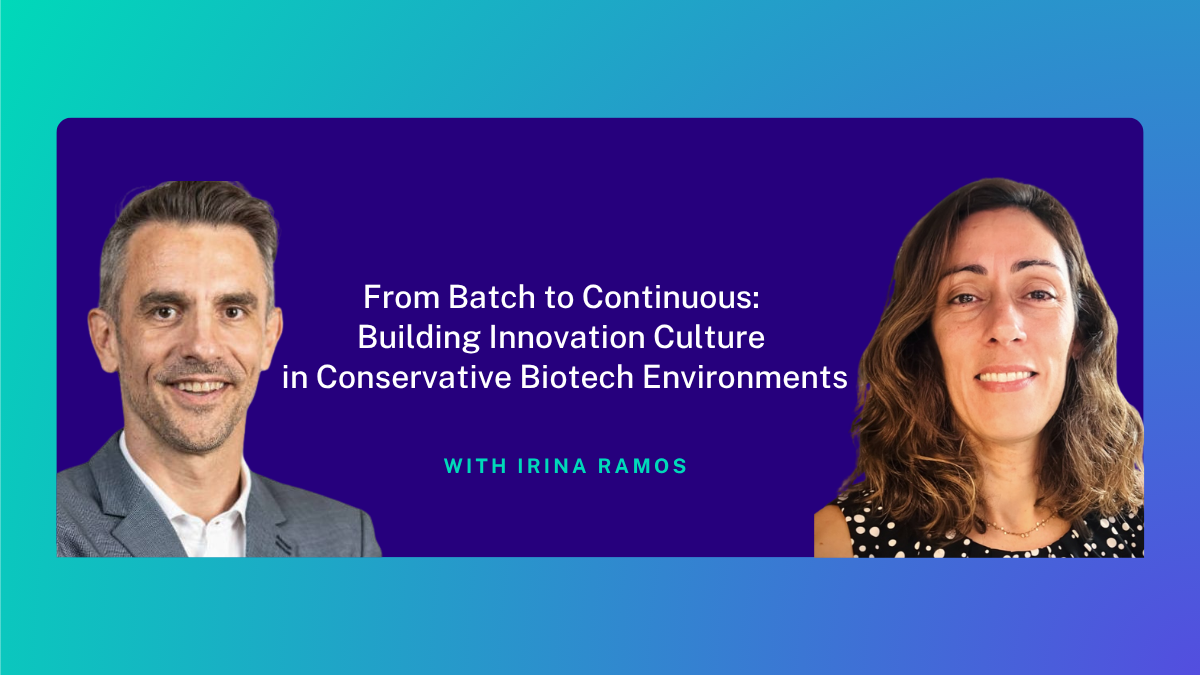
The biotech community is in continuous transformation. The landscape we navigate today will be dramatically different a decade from now, just as it was a decade ago. At the forefront of this evolution are advances in continuous manufacturing, artificial intelligence (AI), and the drive toward personalized medicine.
The recent episode of the Smart Biotech Scientist Podcast with David Brühlmann and Irina Ramos dives deep into these game-changing trends, offering a blueprint for scientists and leaders aiming to thrive in this high-stakes, high-impact field.
In this episode from the Smart Biotech Scientist Podcast, David Brühlmann interviews Irina Ramos, a chemical engineer who has worked across the spectrum of biopharma—from early lab research to global regulatory submissions—and contributed significantly to AstraZeneca’s global COVID-19 vaccine deployment.
Key Topics Discussed
- How the biotech community is evolving—from the landscape a decade ago to the innovation-, learning-, and complexity-driven future ahead.
- How continuous manufacturing fits into a modern CMC roadmap, and how startups decide between hybrid, intensified, or phase-appropriate approaches.
- When and why companies transition from batch to continuous processes, and how perfusion and step-integration shape bioprocess design.
- What an end-to-end bioprocessing vision looks like when drug substance and drug product teams are aligned from cell line development to final dosage form.
- How the global COVID-19 vaccine effort revealed the power of mission-driven collaboration, rapid technical decision-making, and strong regulatory partnerships.
- What the industry learned post-pandemic about manufacturing bottlenecks, risk mitigation, next-generation vaccine delivery, and accelerated regulatory pathways.
- How AI will integrate into bioprocessing, including distinctions between development vs. GMP use cases and the need for informed human oversight.
- What scientific, technical, and interpersonal skills the future biotech workforce needs—and how generational perspectives and mentorship shape innovation.
Episode Highlights
- How the biotech community is constantly changing, and the importance of adaptability for future scientists [00:00]
- What to focus on in early clinical phases and which decisions set the foundation for compliance [02:36]
- Scenarios for switching from batch to continuous process, including barriers and benefits for early-stage vs. established products [02:58]
- Lessons from leading AstraZeneca’s COVID-19 vaccine technology transfer: Collaboration, rapid regulatory communication, and mission-driven teams [05:20]
- Adapting lessons from the pandemic for ongoing drug development—balancing speed and risk while maintaining quality [08:24]
- Realistic perspectives on integrating AI in bioprocessing: demystifying its applications, emphasizing human-critical oversight, and practical use cases in manufacturing [10:40]
- Key skills for scientists in a biotech world shaped by AI—why foundational understanding and strong mentorship matter [13:51]
- How to foster collaboration and creativity between new and established professionals in regulated environments [15:45]
- Final takeaway: Start small, remain mission-driven, and remember that one size does not fit all in continuous manufacturing [17:15]
In Their Words
I think we need to understand that the biotech community of today will not look the same in the next decade. Just like 10 years ago, this biotech community did not look like it does today.
I would emphasize that we are always learning, always studying, and always seeking solutions that meet the needs of these extraordinary products — products that are bringing us closer to personalized medicine.
We now have cell and gene therapies that can be customized for you, for your genome, for your specific conditions. So how can we, as manufacturers, envision that complexity and utilize innovation today that will solve the problems of tomorrow?
Episode Transcript: From Batch to Continuous: Building Innovation Culture in Conservative Biotech Environments - Part 2
David Brühlmann [00:00:50]:
Welcome back to part two with Irina Ramos. We're continuing our conversation on continuous manufacturing implementation and moving into the broader topic of bioprocessing strategy. How do you build a CMC roadmap that won’t come back to bite you later?
And here’s the big one: How should teams prepare for AI integration without losing the human expertise that makes great process development possible? We’ll cover all that and more. Let’s jump back in.
So, Irina, in the spirit of keeping things simple — what phase-appropriate approach would you suggest? What should absolutely be done in Phase I? What can wait until later? And what are the critical decisions, for instance, that a startup founder has to make very early on to remain compliant as they grow — especially if they’re considering a hybrid or intensified bioprocessing approach?
Irina Ramos [00:02:58]:
Here’s an interesting exercise from the Nimble Consortium looking at different scenarios. One scenario is: what if you take an already approved product and convert that fed-batch process into a continuous one? Another scenario is: let’s use new, early-stage programs to feed into a continuous platform — and if they succeed, then you have a commercial need to scale up.
Both approaches are valid. What I hear from the community, though, is that it’s much harder to change an already approved program. The drivers are different. Perhaps the cost of goods (COGs) or manufacturing efficiency becomes a critical factor — and if you can transition to continuous processing, you might have an opportunity to lower costs.
But what I observe is that if your portfolio is large and you start implementing at the early stage, you typically need to demonstrate fed-batch versus intensified perfusion or steady-state perfusion. Perfusion almost always wins. If you can achieve that higher productivity, it feeds directly into your upstream cost of goods, and then downstream follows like a domino effect.
If you integrate capture next — which I think is the smart thing to do because you’re decreasing volume and concentrating your feed — you might then connect the low pH viral inactivation step afterward. Maybe you use a detergent ahead of capture; there are many possible configurations. You start realizing, “Oh, we already have this part — why not add a little piece here?”
Then you need to decide how you’ll control the end concentration and the diafiltration. Because our drug product colleagues — and if it’s not obvious, I’m more on the drug substance side — already have end-to-end solutions in place for fill-finish, dilution, and compounding.
So when we talk about end-to-end biomanufacturing, we should truly think end-to-end: from cell line development all the way to the drug product vial or even the combination product device.
David Brühlmann [00:05:03]:
Yeah, that’s a great point — thinking truly end-to-end. And what I also hear in what you’re saying is that there are different approaches: you can start small and expand. It’s not an all-or-nothing or one-time approach — it’s a process.
Irina Ramos [00:05:18]:
Yep, that’s exactly right.
David Brühlmann [00:05:20]:
Let’s circle back to your story — specifically your time at AstraZeneca. You led the technology transfer of the AstraZeneca COVID-19 vaccine. I’m curious — what did you learn in that high-pressure, fast-paced environment? What were your biggest experiences and takeaways?
Irina Ramos [00:05:39]:
We worked in a wonderful community of experts who truly wore the mission on their sleeves. We didn’t care how many hours we worked — we cared that we were helping save lives.
At the end of the day, the technical part — while complex and guided by a sort of “playbook” — was only one piece. What truly made it possible were the relationships, the conversations, and the willingness to go the extra mile.
It allowed us to envision a world that was fully connected across continents, where we could manage raw material suppliers and maintain as much order as possible — even with all the constraints we faced at that time: single-use components, supply shortages, and logistical hurdles. We worked together to accelerate wherever we could.
That’s the overarching view, but when you look deeper into the incredibly complex network that AstraZeneca built — and there were some extraordinary colleagues who made it happen — you start to see the cultural and operational constraints that had to be overcome. We really had to appeal to the mission to unite everyone’s efforts.
Regulatory agencies were incredibly responsive — much more than in normal circumstances. Normally, communication takes weeks or even months. But during this time, it was almost like having them on speed dial. We worked together because we shared the same goal: to save lives.
This wasn’t about filing a product for a niche indication — this was about everyone.
We also learned that many technical activities that would normally be done sequentially could, in fact, be run in parallel — at risk. Normally, you would complete one unit operation, validate it, and then start the next. Instead, we ran multiple streams simultaneously — filtration development, unit operations, validation studies — and then consolidated the data later.
Of course, we can’t expect to do this in normal circumstances — it requires immense resources, time, and global alignment — and the world won’t stop again to serve us in the same way. But it showed what’s possible when the mission is clear and everyone is aligned.
David Brühlmann [00:08:05]:
Now that the pandemic is behind us, we’ve all learned a lot — and the industry has changed. There are new ways of seeing and doing things. From your perspective, what are the lessons we should keep today? And what are the things we still need to implement to make drug development faster, better, and more reliable?
Irina Ramos [00:08:24]:
One of the main lessons is about productivity — and it’s not a question of if, but when we’ll face another pandemic. I hope it’s not during my lifetime, but there will be one. And during COVID, we learned that manufacturing was the bottleneck to getting products out to patients.
We also learned how critical product stability and distribution logistics were — remember the extreme temperature requirements for some vaccines? That’s why they couldn’t reach certain parts of the world where cold chain infrastructure was limited.
So how do we ensure that next time we can do better? There are already some smart, scalable solutions emerging — for example, modular or portable manufacturing units, where you can produce a vaccine in a single-use system or closed device, purify it, and administer it safely, all in one contained setup.
We also learned that we can take calculated risks without compromising product quality or patient safety — provided those risks are well understood and mitigated using tools we already have.
Another big takeaway was that by moving fast, we created templates and new ways of working. Now we know what we can continue doing efficiently — and where we need to scale back, because we no longer have the same level of funding or resources. It’s like we stretched the balloon during the pandemic, and now that balloon gives us more space — more knowledge, more flexibility, more understanding.
We also learned from what didn’t work — but we learned fast. And just as importantly, we saw a real cultural shift with regulators. Many of us no longer view them as “the police.” We now recognize that they play a crucial role and share our desire to see new technologies implemented. They want fewer manufacturing bottlenecks and better process control and capability.
So today, we have a much better two-way communication with regulatory agencies. We leverage industry consortiums and regulatory innovation programs, such as the Emerging Technology Program (ETP) at the FDA. And in Europe and other regions, there are similar initiatives — programs where regulators actively want to learn about your technology and provide feedback early on, even before it’s linked to a specific product. That’s a huge shift in how we collaborate.
David Brühlmann [00:10:40]:
Speaking of learning and adapting fast — we can’t ignore AI. It’s no longer the future; it’s already here. And AI in manufacturing is becoming a central part of bioprocessing conversations. How should teams prepare for AI integration, and what’s the biggest mindset shift they need to make?
Irina Ramos [00:11:04]:
We cannot simply trust the computer. Let me emphasize that again — AI is not about pressing a button and accepting whatever answer it gives.
AI is not entirely new — we’ve been using it for years under different names. Think about machine learning, predictive modeling, or computational process simulation — all of that is AI. It’s just that the buzzword has caught up with the tools.
Now, we need to demystify AI in bioprocessing. Is it a process development tool, or is it something that can take us all the way into GMP manufacturing? That’s a crucial distinction. Is it meant to predict outcomes, or to provide real-time insights? Is it product-specific, or more of a platform-level tool?
At the end of the day, we still need human critical thinking — someone who can connect the math to the physics, the model to the process. Without that, we risk running faster than we can control.
There are already some incredibly advanced labs, both in academia and industry, using a mix of existing, new, and modified AI tools — often connected directly to continuous manufacturing systems.
Imagine this: you’re running a chromatography column for 200 cycles. You already know what those chromatograms should look like from your historical data. When your operator is monitoring cycle 80, the AI model predicts that its profile resembles what cycle 150 used to look like — indicating resin degradation. So the system recommends planning a column replacement in 48 hours. Instead of reacting to a failure, you act proactively.
That’s a simple example, but the same applies to bioreactors, contamination detection, or filtration system monitoring.
Ultimately, the value of AI is defined by the problem you’re trying to solve — or prevent. If it’s a predictive tool, it’s only as good as the people interpreting it. That’s why we need to ensure new scientists coming from universities still understand the fundamentals — why we run things the way we do. That foundational knowledge becomes the input that trains AI tools, and it’s what enables teams to interpret the output in a meaningful, safe, and effective way.
David Brühlmann [00:13:51]:
What are the most important skills a scientist listening today needs to develop?
Irina Ramos [00:13:56]:
They need to truly understand the fundamentals — the scientific and engineering principles behind what we do. We’re still teaching those in schools, and for good reason.
I also teach at the university level, and we’re now dealing with students using tools like ChatGPT, Copilot, and other AI assistants to complete assignments. I strongly recommend: don’t use these tools to pass a class — use them to learn faster and understand better.
Back in my day, we had to spend half an hour in the library just to find a single book. Today, you can use AI to contextualize information and find patterns much faster. That’s the right way to use it — as an accelerator for learning, not a shortcut.
Professors are now reshaping how they teach, so students can use these tools responsibly and enter the workforce at a higher level of understanding.
Remember: you’re building your personal brand from the very beginning. Earlier, I mentioned the importance of trust, competence, and commitment — those apply here too. If your understanding is shallow, even if your grades look great, it won’t take you far. You’ll end up disappointed and frustrated, because your foundation will be weak — and once that’s set, it’s very hard to rebuild.
So, focus on your fundamentals. Find good mentors. Surround yourself with colleagues who are curious and willing to go deep into the principles. This isn’t an easy field — biochemical engineering can be tough, and sometimes it feels overwhelming. But keep at it. Work hard, stay curious, and one day you’ll look back and realize you’re helping change the world — one step at a time.
David Brühlmann [00:15:38]:
Before we wrap up, Irina — what burning question haven’t I asked that you’d like to share with our biotech community?
Irina Ramos [00:15:45]:
That’s a great question. I think we need to understand that the biotech community of today will look very different in the next decade — just as it looks completely different from ten years ago.
We’re always learning, studying, and searching for new solutions to meet the needs of increasingly complex and personalized therapies — like cell and gene therapies tailored to an individual’s DNA or specific condition.
The question I would pose is this: How can we, in manufacturing, anticipate that complexity and use innovation today to solve the problems of tomorrow? And beyond that — how can we bring together the new workforce and the experienced workforce in a truly collaborative way?
We need a “happy marriage” between creativity and experience. Younger scientists should never feel there’s a ceiling limiting their innovation, while more seasoned experts shouldn’t feel threatened by new ideas or technologies. We’re a highly regulated industry, and yes, many of our systems already “work.” But that doesn’t mean we can’t evolve. It’s a continuous effort built on goodwill, mutual respect, and always keeping the patient at the center of what we do.
David Brühlmann [00:17:09]:
This has been great, Irina. What’s the single most important takeaway from our conversation?
Irina Ramos [00:17:15]:
That in continuous manufacturing, one size does not fit all.
If you think it’s too complex, too expensive, or too big of a transformation — start small. Take incremental steps. Get together with your colleagues, run the numbers, and envision the possibilities.
Also, recognize that the workforce of the future will look very different because of AI. Let’s focus on how to get the best out of these tools — using them to enhance, not replace, human expertise.
And above all, stay passionate. This work has to make sense to you personally. You need to be driven by something bigger than yourself. I often remind my teams — when we’re deep in the details of a process or experiment — to zoom out. Ask yourself, Why are we here?
We’re not just in a gray lab doing routine work. We’re part of something transformative. And every so often, someone needs to step back and make sure we’re still focused on what truly matters. I hope that message came through in our conversation today.
David Brühlmann [00:18:19]:
Excellent. Thank you so much, Irina, for joining us and sharing your insights and passion. Where can people find you?
Irina Ramos [00:18:28]:
The easiest way is on LinkedIn — feel free to reach out there.
David Brühlmann [00:18:31]:
Perfect. Smart Biotech Scientists, I’ll include Irina’s link in the show notes. Please do connect with her. And once again, Irina, thank you so much — it’s been a real pleasure.
Irina Ramos [00:18:41]:
Thank you so much, David, for the opportunity.
David Brühlmann [00:18:45]:
There you have it — from continuous processing to AI readiness, Irina Ramos just gave us a masterclass in forward-thinking CMC leadership.
If this episode helped you see your challenges differently, please leave a review on Apple Podcasts or wherever you listen. It really helps other biotech professionals find us. Thank you so much for tuning in today. And remember: science may give you headaches, but biologic drug development shouldn’t. See you next time — and let’s keep smartening up biotech together.
Disclaimer: This transcript was generated with the assistance of artificial intelligence. While efforts have been made to ensure accuracy, it may contain errors, omissions, or misinterpretations. The text has been lightly edited and optimized for readability and flow. Please do not rely on it as a verbatim record.
Next Step
Book a free consultation to help you get started on any questions you may have about bioprocess development: https://bruehlmann-consulting.com/call
About Irina Ramos

Irina Ramos is a downstream bioprocessing expert with more than 15 years of experience advancing biologics from early development through regulatory milestones. She has led teams across process development, scalability, technology transfer, and validation, and has been a key contributor to innovations in platform technologies—especially in continuous manufacturing.

Irina also led the technology transfer of AstraZeneca’s COVID-19 vaccine process to an international manufacturing partner.

For over a decade, she has taught graduate-level biotechnology courses at UMBC. She holds a B.S. in Chemical Engineering from the University of Porto and a Ph.D. in Chemical & Biochemical Engineering from UMBC. She is deeply committed to mentorship and to creating tools that help scientists communicate more effectively.

Connect with Irina Ramos on LinkedIn.
David Brühlmann is a strategic advisor who helps C-level biotech leaders reduce development and manufacturing costs to make life-saving therapies accessible to more patients worldwide.
He is also a biotech technology innovation coach, technology transfer leader, and host of the Smart Biotech Scientist podcast—the go-to podcast for biotech scientists who want to master biopharma CMC development and biomanufacturing.
Hear It From The Horse’s Mouth
Want to listen to the full interview? Go to Smart Biotech Scientist Podcast.
Want to hear more? Do visit the podcast page and check out other episodes.
Do you wish to simplify your biologics drug development project? Contact Us

