
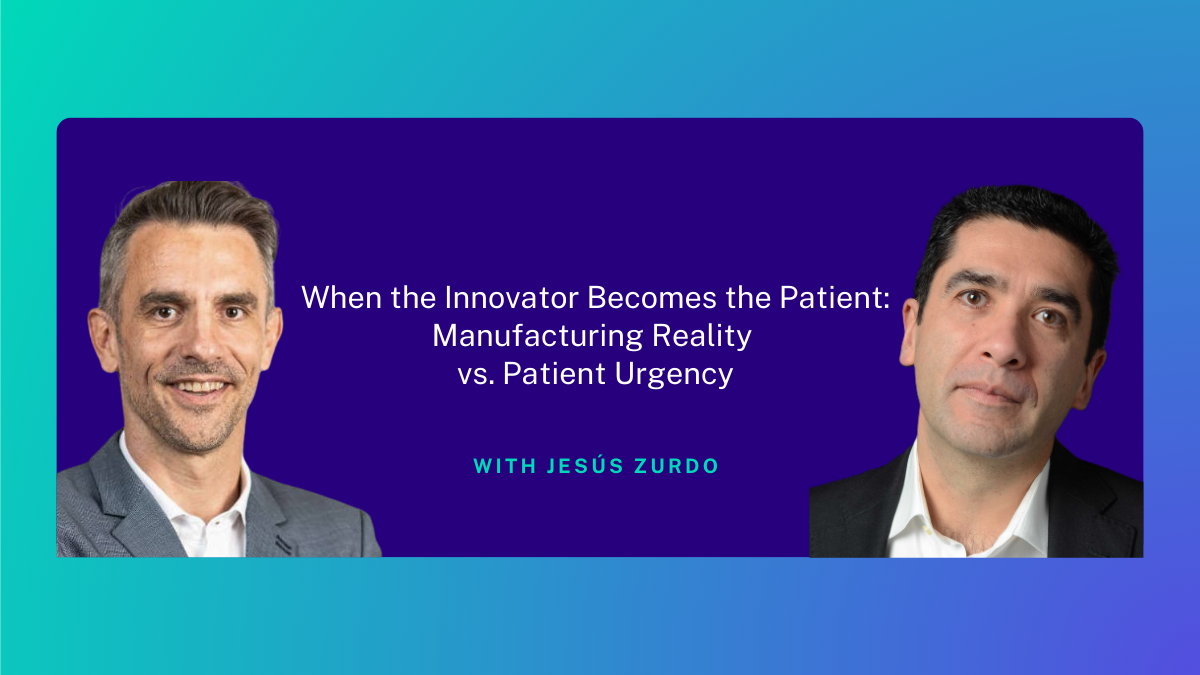
The biggest breakthroughs in cell and gene therapy may not come solely from innovation at the bench, but from successfully delivering those advances to the people who need them.
In this episode from the Smart Biotech Scientist Podcast, David Brühlmann sits down with Jesús Zurdo, a scientist who’s spent three decades engineering life-changing biotechnologies—but whose outlook on the field shifted dramatically after becoming a leukemia patient himself. With experience on both sides of the system, Jesús Zurdo brings a rare, unfiltered perspective to the persistent gap between scientific promise and real-world patient access.
Key Topics Discussed
- Jesús' journey from academic researcher to industry leader—and later as a leukemia patient—gave him a deeper understanding of clinical complexity and patient needs.
- True urgency means ensuring therapies are safe, reliable, and accessible, not simply accelerating timelines or obsessing over automation and cost of goods.
- Scaling should focus on bringing therapies to more patients, including those in local or low-resource settings, rather than merely increasing manufacturing output.
- Manufacturing quality isn’t about maximal cleanliness or sophistication; it’s about understanding which quality attributes truly affect patient safety and therapeutic impact.
- Lowering manufacturing costs doesn’t automatically reduce therapy prices due to value-based pricing models, creating ethical tensions around equitable access.
- New therapies often receive outsized attention, but long-term outcomes, quality of life, and real-world patient data are what truly matter.
- Future progress depends on new manufacturing paradigms, point-of-care models, and closer integration of patient perspectives to make advanced therapies broadly available.
Episode Highlights
- The challenges of scaling up advanced therapies beyond just volume: shifting from “how much can we make” to “how many patients can we reach?” [00:21]
- Jesús Zurdo’s personal journey—from biotech innovator to patient—and how it reshaped his thinking on product design and patient needs [04:12]
- The importance of designing products and manufacturing processes with patients’ lived experience in mind—not just clinical metrics [05:43]
- How the biotech industry often overemphasizes automation, cost of goods, and new technologies at the expense of true patient access [08:02]
- Lessons from point-of-care manufacturing and real-world delivery of cell therapies—speed versus perfection [09:11]
- Why the business model and value proposition of therapies may need to change to address the high cost and limited accessibility of new treatments [12:09]
- How patient involvement in both development and long-term outcome tracking could drive better treatments and wider adoption [15:10]
- The limitations of current clinical trial endpoints and the need to integrate patient-reported outcomes and new data sources like wearables [17:10]
In Their Words
For me, patient urgency does not mean to cut corners. Again, manufacturing is critical. But and this is where I think I'm starting to disagree with some people. I think we are particularly in advanced therapies putting far too much emphasis in cost of goods, in automation, in sexy technologies, but not enough on how we can scale up.
And scale up is not just number of liters or grams or kilograms of number of cells we can make. It's more how many patients we can reach. How is going to be for them to access this treatment? Do we need to bring them to a city where treatment will happen or would they be able to access it close to their homes? And also how affordable these treatments could be. And this is where things start to become more complex.
Episode Transcript: When the Innovator Becomes the Patient: Manufacturing Reality vs. Patient Urgency - Part 1
David Brühlmann [00:00:52]:
Welcome to the Smart Biotech Scientist. Today's guest brings a perspective few can match. 30 years driving innovation in cell and gene therapies, then becoming the patient on the receiving end. Jesús Zurdo isn't just a drug discovery and technology development veteran. He's a leukemia survivor who has experienced firsthand the gap between groundbreaking science and actual patient access. This dual lens, innovator and patient, gives him urgent insights into why promising therapies aren't reaching those who desperately them. Let's dive in. Welcome, Jesús. It's good to have you on today.
Jesús Zurdo [00:02:48]:
Hello. Good morning. Thank you, David. It's a pleasure for me to be here.
David Brühlmann [00:02:52]:
Absolutely. I'm thrilled to have you on and to talk about an extremely important topic. Jesús, to start us off, share something that you believe about bioprocess development that most people disagree with.
Jesús Zurdo [00:03:07]:
As a tricky one I've been saying, you know, for many, many years now, is that you cannot turn a dog into a star. By this I mean you could define or develop the perfect process, but if your product is poorly designed or conceived, then you won't be able to solve the problems you will encounter later. And then something I lived myself, you had a difficult product, you managed to turn it around to produce it, but then it crashed in clinical development or the patient is not able to use it eventually. Start with the end in mind. Design a good product is always important.
David Brühlmann [00:03:40]:
This is such an important reminder. Start with the end in mind and the end is the patient. And to dive into today's topic, draw us first into your story, Jesús. Because you have 30 years in biotech as an innovator and you also have seen the other side. You have been a leukemia patient yourself and that's quite a profound plot twist. So take us to the very beginning. What got you started in biotech? What drew you in? And then how did that experience, this personal experience, change everything?
Jesús Zurdo [00:04:12]:
Oh gosh, I can go back in time. I'm in love with biology. Actually, like I'm saying now, as a patient, I just find biology is unbelievable. I'm completely in love with it. So from the start for me, be able to translate the biological knowledge into benefits to the life of people was something that intrigued me. And the key thing for me making the move from academia to the biotech industry was when I was at Oxford just realizing that we could design products that would have much better performance.
We had at that point in time, everybody was discovering target and then we realized that we could modify the product so it would have effect in impact in efficacy, of viability, half-life, route of administration. And that to me was like, well, this is something maybe I could help with. So that was the kick in the bum, if you will, just to make transition to the industry.
Your second part of your question, what was the impact of becoming a patient? And I think for me was a cure of humility. It's first of all realizing that what we've been told and we've seen as scientists, that we can develop a magic bullet that will cure this and that, a chimera and that the clinical reality is so complex. I admire physicians, the complexity of issues they had to deal with, but also realizing that every patient is a complete different universe. We cannot generalize not only from the manifestation of the disease, but also how the patient lives with the disease.
That second part is realizing there's a disconnect between the clinical metrics we use to develop therapeutics and the lived experience of patients. What is that patients are dealing with, what is important to them. And that, as I said, it was a bit as a scientist was quite humbling. Realizing gosh, I know so little but at the same time it's been a call for action realizing this is something that people have to hear more. And I think I can bring in my two hats. I can somehow hopefully help in bridging the gap in between these worlds.
David Brühlmann [00:06:15]:
Yeah, and it's so important to bring the two hats and to raise awareness because what I have noticed in my own career, but also talking to a lot of brilliant scientists, especially when you're in CMC, the patient seems very far. Yes, we always say we're developing for the patient, but then in reality you're so focused on your technical bioprocessing problem that actually you forget the patient at the end of the day. So I'm curious because from your perspective now as both a developer and a patient, what does patient urgency really mean and what does that look like? How do we involve a patient early on in this whole process?
Jesús Zurdo [00:07:00]:
I'm guilty of that because I started more discovery. I thought I was, you know, manufacturing probably is not that important. And I had to eat my words because manufacturing is crucial, is central. You cannot make your product, the patient will never be able to receive it if your product is not able to sustain the conditions in which you are going to use it, then the patient will never be able to use it. So your question: for me, patient urgency does not mean to cut corners. And this is the thing, a misconception when people aren't guilty as charged developing new therapeutics, we can go quickly with this product.
In the end we want to test efficacy and that is amenable. But you need to also keep in mind if we have a response, then we need to be able to scale. But also product has to be safe. And this means that you need to be able to have confidence in what you're making. So again, manufacturing is critical. But and this is where I think I'm starting to disagree with some people. I think we are particularly in advanced therapies putting far too much emphasis in cost of goods, in automation, in sexy technologies, but not enough on how we can scale up.
And scale up is not just number of liters or grams or kilograms of number of cells we can make, it's more how many patients we can reach. How easy is going to be for them to access this treatment? Do we need to bring them to a city where treatment will happen or would they be able to access it close to their homes and also how affordable these treatments could be. And this is where things start to become more complex. I think for me, urgency means also how quickly this treatment can be accessible by general population.
And this is where I think probably we spend far too much emphasis. I'm sure we will talk more about it in „I know better or this is slightly better or optimal” or rather than „can we make as an industry an impact in treating this particular condition and what needs to happen?” I mean, I can give you an example that for me has been quite enlightening. I work in manufacturing for many years. I know how much relevance we put into controlling the process, into robustness, etc. But coming across how point-of-care manufacturing is being rolled out by stem cell registers in practice for many years has been enlightening. And for me, and you know how complex some of these products can be. My donor had an apheresis in the US and in 48 hours I had the products by my bedside. I was given my cells. These were living cells, you know, no frozen, no preservation.
This happens every day. This happens across the world in many countries that have limited infrastructure. But it works really well. And to me this is the key thing. Urgency means we can deploy solutions at scale, not we have the best ever perfect solution that is super sophisticated. So it's a compromise between safety, efficacy and the right technologies and doesn't mean that we can do it dirty. It cannot be dirty. It has to be fit for purpose.
David Brühlmann [00:10:15]:
It seems to be that it's also a question of not overdoing or like to have too much quality, I think. Obviously, yes, they need to be safe, yes. And they have to be efficacious. But then don't do too much because finally it's a risk–reward balance at the end of the day.
Jesús Zurdo [00:10:33]:
You touch a very important point and it's quality. Quality doesn't mean cleanest ever, super-measured. It is understanding what the product is. For me, another example is viral vectors. We have developed over the last 20, 30 years much better processes, much better, higher titers, et cetera. But we have missed essential quality attributes and now we are realizing probably these things are behind some of the safety issues we experience in the clinic. I mean we had to increase the doses, but because the active ingredient is such a small proportion of the viral vector we are giving to the patient, then the patient actually receiving a sub-par product is looking at the real critical quality attribute and working on those in ways of addressing those rather than getting the perfect solution, which will never happen.
David Brühlmann [00:11:23]:
Absolutely. I totally align with that. It reminds me of some conversations I had with some quality colleagues. Typically this kind of conversation. I want to touch upon a different part of it because you said, well, we shouldn't focus too much on cost of goods, but we need to talk about cost because that's actually a tragedy. And you mentioned the word accessible. And I think we have an accessibility tragedy because we have this amazing cell and gene therapies now that can treat diseases we have never seen before and instantly and forever. But the problem is they cost everywhere north of $1 million, $2 million, even $3 million. So how are we bringing down the costs of these medicines? And is that the only solution or are there other things we should work on?
Jesús Zurdo [00:12:09]:
I'm going to get in trouble. I'm not a health economist. I want to say that. And I have a biased view, which could be wrong in many respects. This is my point of view. So I'm not saying that cost of goods are not important, particularly with advanced therapies — they are super important and we need to really strive at improving our processes and improving the skills, improving the robustness of how we manufacture. And anything we do there is going to help. But I think it's been an excuse or I don't know if it's an excuse or because it's what is evident. Everybody goes there, „oh, we need to bring down cost of goods and that will bring down the prices”.
And one big argument is that if we do that, then the prices will follow. And I disagree because there are products in clinic that have relatively low cost of goods, but actually have very, very high price. And I think that is how the pharma business model operates. But the issue is that we somehow are treating healthcare, as somebody told me, like a luxury item. And then this value pricing means that if we claim this treatment can cure a person, then why would you not pay for gaining your life?
And okay, valid argument, but to me it has several flaws. One, no treatment out there cures — very few things cure. I mean, you can cure an infection, but you don't cure cancer. And I could argue for hours about this. And many of these curative treatments, actually they are at best managing the disease, which is brilliant. But this is the thing. Then a very different prospect is saying to patients or payers, okay, we manage the disease, the patient can sustain an acceptable quality of life. That is great. We just delete it — didn't happen.
The other thing is that not everybody is able to pay the price that somebody with good economic situation would pay for gaining their lives or whatever. If you go to different countries or you go to people that don't have the right cover, then what happens to them? For me it's a question of humanity, it cannot be economic power. For me, healthcare should be a universal right, not a status symbol. And this means that we need to look at different business models. I mean there are examples even in the States about cost-plus pricing, which is how many businesses operate. It's not so common in pharma but I think in the end everybody has to make a living.
Every business has to be sustainable. And this is where we just look at different ways of pricing these products that capture the value to the patient but actually look at numbers of patients treated rather than margin I can make in a single patient. Maybe we are in the right track. Of course there are many solutions, many options people could explore. But there's something that also you touch on. You know, some of these treatments are multimillion and not necessarily the price that is the obstacle sometimes. I mean I give the example of Casgevy, for example.
There are several other treatments that have been developed for sickle cell disease. Casgevy is unique, it's unique in that it involved patients in understanding the value and impacting the quality of life. This happened in the UK by the way, and this proved to the payers that actually it made financial sense for them. If the cost of managing the disease over a number of years is X, Y, Z and patients can actually have a profound improvement in how their lives happen, then it could work. And the result has been super fast approval.
But also compared to other — won't name names — other similar treatments, the adoption has been far quicker. Is it perfect? No. I mean we are talking about, last time I checked it was 50, 60 patients and sickle cell disease, particularly in Africa, is endemic. So can we treat patients in Africa — 2.5 million — whatever is the price tag? No. So we need to come up with new business models. But for me it's important that the two things are considered. The business model has to be adequate, but also the value to the patient has to be properly reflected.
David Brühlmann [00:16:05]:
Absolutely. And I think there are probably some creative — co-creative — ways to manage that. What comes into my mind, I came across a clinic in India, if I remember well, it's a heart surgeon and they had a similar problem. What they came up with is, as you said, there shouldn't be a two-speed, you know, medicine. So everybody needs to have state-of-the-art treatment. But they came up with kind of a cross-financing system. And at the end of the day, the surgeons were able to do more surgeries a day and became even better. So they finally attracted the best-paying clients. So there are ways to manage that. I'm just wondering about — since you mentioned the sickle cell disease — we hear amazing stories in the news. Does this correspond to the clinical reality or is there a hype or what is your impression?
Jesús Zurdo [00:16:50]:
Oh, I think it's too early. And this is another problem the industry faces. We hear now answers. And there is no coincidence that most of the products in development are to treat cancer. So you can look at remission in weeks, you can look at sometimes survival in months. But are we looking at the right metrics? And I would argue that even for cancer, we are missing the target big time. Because I keep arguing this — for me, and I'll speak now, this is my personal perspective as a cancer patient — I don't care about two, three, four months more of life if my quality of life is not adequate, if I had to be bedridden. So when people say, „oh, we just have this minimal survival”, it's minimalist. If you're telling me now I can keep working, I can keep doing the activities that I find fulfilling, we're talking.
But this is something that is missing. Hence patient perspective is very important. But also this links to cell therapies that have been developed. Short-term remission — yeah, I mean it's impressive. Now when you look at long-term sustained effect and disease-free survival and symptom-free survival, it's a different story. And it's only when you go through two, three years of that you start understanding what is the impact of these treatments. And I think that is the problem. I mean, are we prepared to wait for three years? But also we need to treat quite a few patients in order to really compare this with the standard of care.
And this is a challenge. And this is cancer, by the way. If we go now into other diseases where it's subject to having a crisis or is progressive like in degenerative diseases or autoimmune or in organ degeneration, then it's far more complex because you need to keep monitoring patients for a long time. And I've heard we go into how we price and we price based on outcomes, but that means that you need to monitor patients. And that is actually expensive and a big effort. I think that is the challenge we need to face. How do we monitor efficacy of treatment? From the industry side, I think that's where many companies are struggling, is that this is very difficult to do at scale. It's only, I think, if we bring patients as a partner that actually they can opt in.
And again, Casgevy for me has been a good example. Patients started to say, actually this could be transformational in my life. And then you can measure the right way. You could have more emphasis these days into patient-reported efficacy of treatments. There are, even in the age of wearables, things that you can obtain, you can measure without the patient having to do anything, being at home. There are conditions that involve fatigue, that involve, I don't know, the ability to move, to walk. And this is something that you can measure without the patient noticing.
And you don't need to bring the patient to the clinic and then do all these complicated tests — that maybe they had a bad day, maybe they didn't sleep enough, and you have lots of noise — when you just monitor every day real-life functioning that can be objective but also very powerful. Now, it's not that wearables can solve the problem, but I think there are other angles that definitely we should explore as a society to really assess the value of treatment.
David Brühlmann [00:20:03]:
That wraps up Part One, where Jesús Zurdo shared how his own patient journey reshaped his mission, and we explored the frustrating disconnect between clinical-trial promises and real-world adoption.
In Part Two, we’ll dive deeper into manufacturing paradigms, point-of-care models, and the innovations that could truly help bridge the access gap. If you found value in today’s episode, please consider leaving a review on Apple Podcasts or your favorite platform—it genuinely helps other scientists discover the show. I’ll see you next time.
All right, smart scientists—that’s all for today on the Smart Biotech Scientist podcast. Thank you for tuning in and joining us on your journey toward bioprocess mastery. If you enjoyed this episode, please leave a review on Apple Podcasts or your preferred podcast platform. Your support helps us empower more scientists like you.
For additional bioprocessing insights, visit www.bruehlmann-consulting.com. Stay tuned for more inspiring biotech conversations in our next episode. Until then, let’s continue to smarten up biotech.
Disclaimer: This transcript was generated with the assistance of artificial intelligence. While efforts have been made to ensure accuracy, it may contain errors, omissions, or misinterpretations. The text has been lightly edited and optimized for readability and flow. Please do not rely on it as a verbatim record.
Next Step
Book a free consultation to help you get started on any questions you may have about bioprocess development: https://bruehlmann-consulting.com/call
About Jesús Zurdo

With over 20 years of industry experience, Jesús Zurdo is a Director and patient advocate dedicated to advancing therapeutic development and patient access. His expertise spans cell and gene therapy, cancer immunotherapy, and executive coaching, informed by his own experience as a leukemia survivor.

He serves as a Non-Executive Director at Telomere Therapeutics and as an Expert Jury Member for the EIC Accelerator Program, working with organizations to drive progress in advanced therapies. Guided by a strong commitment to meaningful, patient-centered healthcare, he applies both scientific and personal insight to support innovations that truly benefit patients.

Connect with Jesús Zurdo on LinkedIn.
David Brühlmann is a strategic advisor who helps C-level biotech leaders reduce development and manufacturing costs to make life-saving therapies accessible to more patients worldwide.
He is also a biotech technology innovation coach, technology transfer leader, and host of the Smart Biotech Scientist podcast—the go-to podcast for biotech scientists who want to master biopharma CMC development and biomanufacturing.
Hear It From The Horse’s Mouth
Want to listen to the full interview? Go to Smart Biotech Scientist Podcast.
Want to hear more? Do visit the podcast page and check out other episodes.
Do you wish to simplify your biologics drug development project? Contact Us

