
Our food systems face a monumental challenge: by 2050, the global population could reach 10 billion, demanding at least 60% more food than we produce today. This stark reality is one of the main drivers for innovation in agri-biotech. Traditional agriculture alone is unlikely to shoulder the burden, especially under the shadow of climate change, deforestation, and depleted resources.
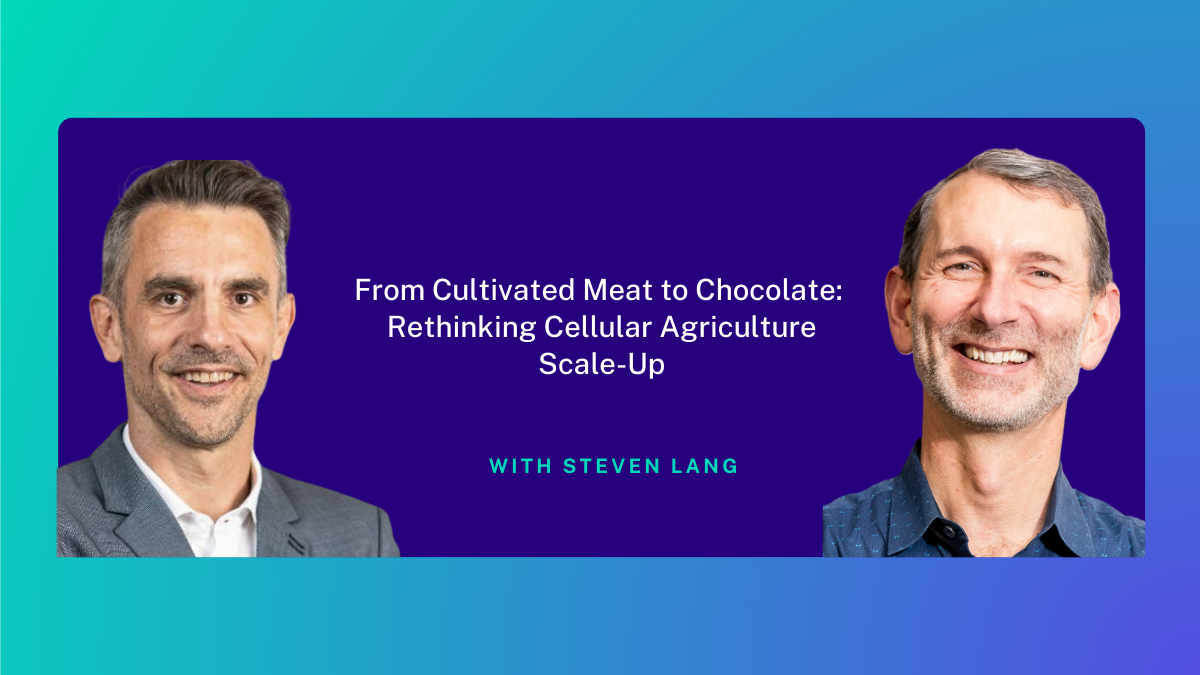
In this episode of Smart Biotech Scientist Podcast, David Brühlmann steps into the lab with Steven Lang, Chief Technology Officer of California Culture. A veteran of both biopharma (and a former leader at Upside Foods), Steven is at the forefront of scaling plant cell culture for real-world impact.
Key Topics Discussed
- Comparing cacao fermentation, drying, and roasting with plant cell–based cocoa production.
- The scientific challenge of recreating complex chocolate flavors and reducing astringency in cell-cultured cocoa.
- Why commercialization and manufacturing scale currently take priority over flavor optimization.
- Core processes, minimal analytics, and key quality metrics used in lab-grown cocoa production.
- Using controlled cell culture to address contaminants like heavy metals while preserving nutrition and flavanols.
- Reducing deforestation, climate impact, and environmental strain through lab-based food production.
- Expanding cellular agriculture to rare, high-value products like saffron, ginseng, and even wood.
- Building diverse teams, strong data foundations, and new entry points to advance cellular agriculture.
Episode Highlights
- How plant cell culture differs from conventional farming and its advantages for safety and scalability [03:03]
- The challenge of replicating chocolate’s taste and fermentation in the lab [02:39]
- Analytical methods and equipment needed for consistent, safe, and high-quality cultured cocoa products [05:05]
- The potential for cell-based food to minimize heavy metals and other contaminants in chocolate [06:09]
- Environmental implications: tackling climate change, deforestation, and the realistic timeline for widespread adoption of lab-grown foods [06:50]
- Emerging opportunities beyond cocoa and coffee—saffron, ginseng, echinacea, and even lab-grown wood [08:40]
- Key advice for scientists and entrepreneurs interested in entering the cellular agriculture field [10:12]
- Building successful teams and robust data foundations in biotech startups [11:43]
- Takeaways on expanding the possibilities of cell culture for food and sustainability [13:06]
In Their Words
Our future food systems have to incorporate new technologies because our population is growing. We're going to be 9 to 10 billion people on this globe relatively soon. And there are projections that we need to produce 60% more food than we're producing today by 2050 to support that population.
So what I like to say is that we need to continue with our conventional agriculture and supplement and add to it new technologies like what we're doing with plant cell culture and cellular agriculture, because there have to be multiple shots on goal to be able to feed our population. The alternative is malnutrition and starvation. To me, that's unacceptable.
Episode Transcript: From Cultivated Meat to Chocolate: Rethinking Cellular Agriculture Scale-Up - Part 2
David Brühlmann [00:00:46]:
Welcome back to Part Two of our conversation with Steven Lang from California Cultured. In Part One, we explored how plant cell culture works and the bioprocessing fundamentals behind cultured cacao. Now we're tackling the hard questions: Can this actually scale? What's the economic reality? And how do we move cellular agriculture from laboratory curiosity to commercial production? Whether you're in biopharma, considering a career pivot, or simply curious about the future of sustainable food, this conversation will change how you think about biomanufacturing.
On the taste part, because that's an important part for me. As a Swiss, I must say I'm pretty critical when it comes to chocolate. Producing cocoa that tastes well is quite a complex process because it's not just a plant. There is a complex fermentation process going on. How do you reproduce that in the lab to get as close as possible to natural cacao?
Steven Lang [00:03:03]:
That is a really important question. And I’d like to set the stage by basically giving a synopsis of how chocolate is made. The cacao pods are opened up on the forest floor at these small farms that grow cacao, and the beans are removed from the pod and then spread out on the floor to ferment. That develops some of the flavors. Then they dry those beans and go into the roasting process, followed by all the processing that goes into creating the cocoa nibs and extracting the cocoa butter to then recreate chocolate.
We’re starting with a different starting material because our cells are not analogous to the cocoa bean that's extracted from the pod, fermented, and roasted. So we have to take a food science approach and really think about how we can ferment our cocoa powder as well as roast it to achieve those flavors. The nice thing is that we can do that. In that process, we degrade some of the flavanols, so the astringent taste is decreased, and you can bring out some of the chocolate flavors.
Let me say to that developing great-tasting chocolate isn’t our primary goal right now, but it will be in the future—that’s where we’re heading toward the commodity market. Right now, we’re focused on scaling and commercializing, aiming to get onto the market in 2026 with our high-flavanol cocoa. Once we get there, we’ll have more time and bandwidth to build processes that allow us to pull levers to improve the sensory attributes of the cocoa powder to create really fantastic chocolate.
Once you understand the biology of those sensory attributes in the cell culture process, you can start building different varietals of tastes and flavors in chocolate. That’s really the exciting biology I’m looking forward to. And I think that will require, based on what we know about plant cell culture media optimization as well as improvements in bioreactors,…
David Brühlmann [00:05:05]:
What are the technologies you need to produce such high-quality cocoa products. Because you have the cell culture, and then you have the whole sensory area, which is highly complex—what do you need, and what kind of equipment do you need to use to make sure you get this high-quality product?
Steven Lang [00:05:24]:
That’s where I like to think that for cellular agriculture to be successful, we need to change people’s minds about it, not just overcome the technical challenges. We can take simpler processes like coffee or cacao cell culture to help explain the processes to people, which will create more consumer demand and actually pull the products from us.
With plant cell culture, we don’t use a lot of process analytical technologies. So we don’t control pH, there is no temperature control, and that’s essentially it. What we really need is macronutrient profiling at the end, flavanol concentrations at the end, and that’s essentially it.
Anything else relates to safety—microbial testing, for example. Speaking of safety, many people know there’s a heavy metal concern with most chocolates. Consumer Reports released a report showing that about one-third of chocolate products contain heavy metals above safe limits. The great thing about our cocoa powder is that because we can control all raw materials, we can produce products with essentially zero heavy metals. That’s a huge step forward when thinking about food safety and convincing consumers to try these products. Not only are they nutritious and healthy, but they’re also safer than conventional products.
David Brühlmann [00:06:50]:
This leads me to the bigger picture, because when we talk about cultivated meat or lab-grown coffee or chocolate, we hear a lot about climate change, deforestation, and environmental challenges, and you and other companies are trying to solve or at least alleviate these problems. How realistic is it that, maybe in five to ten years, we can produce enough in labs to reduce this burden? Or is this not realistic at all?
Steven Lang [00:07:22]:
No, I think this has to be the future. Our future food systems have to incorporate new technologies because our population is growing. We're going to be 9 to 10 billion people on this globe relatively soon. There are projections that we need to produce 60% more food than we produce today by 2050 to support that population.
What I like to say is that we need to continue with conventional farming and agriculture, and supplement it with new technologies like what we’re doing with plant cell culture and cellular agriculture. There have to be multiple shots on goal to feed our population. The alternative is malnutrition and starvation, which to me is unacceptable.
I am very motivated by using my cell culture background and everything I’ve learned in biopharma and at upstream biomanufacturing to really push the envelope. We need to ensure we’re improving human health, food security, and sustainability with the foods we eat in the future, rather than assuming that conventional industrialized farming will solve all our issues. Because frankly, that assumption distracts from the negative aspects of conventional agriculture.
David Brühlmann [00:08:40]:
And if we keep this future-focused lens, zooming out beyond coffee and cacao, what other lab-grown products do you see emerging? What are the hot technologies coming into this space?
Steven Lang [00:08:53]:
I think a lot of supplements as well as other food products could benefit. For example, one of my colleagues just started a saffron company using plant cell culture. Saffron is hugely expensive and difficult to produce, so if we can produce it in cell culture, it really reduces demand on the industry and also produces a higher-quality product. Other interesting products include ginseng, echinacea, and there’s even a startup trying to make cell-cultured wood. That one just blows my mind—it must be premium.
David Brühlmann [00:09:27]:
Wood must be very complex to make. I would imagine—you probably produce some cells in a bioreactor, and then you would need to assemble them to get your finished product at the end, right?
Steven Lang [00:09:43]:
Exactly. Very much like cultured meat. Wood probably has a lot of different components you need to recreate the structure. That’s where the complexity comes in. That’s why we need to start with simpler processes like cocoa or even cell-cultured wood—to build a foundation from which we can later be successful with cultivated meat and allow that technology to mature.
David Brühlmann [00:10:12]:
If one of our listeners thinks, “Well, this is interesting—cellular agriculture is great, you’re solving a big problem,” what advice would you give them as they transition into this exciting field?
Steven Lang [00:10:27]:
First and foremost, look for cell culture work outside of cultivated meat and biopharma. There are startups and companies using this technology—start thinking about where you can get involved. If you’re an entrepreneur, look for products that can be produced from plant cells, because those probably have the fastest route to market and are likely the most consumer-accepted.
The other thing to think about—and we discussed this back in 2023 for people coming from cell culture and biopharmaceutical backgrounds—is that you really need a safety and efficacy mindset. All the products we produce must be safe, and that’s paramount.
Next is efficacy. In drugs, we understand what an efficacious drug is. In foodstuffs or other products, it comes down to things scientists and engineers often overlook: texture, mouthfeel, aftertaste, packaging, and many other factors that are critical to consumers. If you build these considerations into your product intelligently, you can significantly increase your chances of success.
David Brühlmann [00:11:35]:
Before we wrap up, Steven, what burning question haven’t I asked that you’re eager to share with our biotech community?
Steven Lang [00:11:43]:
I’d like to highlight the collaborative aspect. One question I haven’t heard yet is: What does a team look like that can make this successful? I want to call out my technical team. They’ve done amazing work not only with cocoa, but also coffee and cocoa butter. With a small startup over a short period, they’ve developed cell lines capable of producing high-quality products.
We also recently brought in someone to help set up our data foundation. That’s near and dear to my heart. As a startup, setting up a data foundation and capturing all data in a way that can be used in the future is paramount. Many pharmaceutical or mature companies have siloed data systems, which prevents the use of machine learning or AI.
I really want to recognize my technical team, not only for their technical achievements, but also for how we’re building a foundation to implement advanced analytics—the kind of AI-driven insights that are rapidly transforming the industry.
David Brühlmann [00:13:02]:
What is the most important takeaway from all that we’ve discussed today?
Steven Lang [00:13:06]:
David, the most important takeaway is that cellular agriculture is much more than cultivated meat, and we need to start thinking about other processes using plant cell culture to produce products. I really encourage all of your listeners to explore opportunities where you’re doing non-traditional work and don’t be afraid, because cells and these technologies can be evolved to suit our purposes as we develop new products.
I really think about pressure-testing your systems and your assumptions about cells and what they’re capable of. I’ve been surprised throughout my 20-plus years working in cell culture at how far you can push a cell, and it’s amazing what they can do. So I encourage people to continue pushing and look for additional opportunities to help food security, human health, and sustainability.
David Brühlmann [00:14:02]:
This has been great, Steven. Thank you so much for helping us expand our horizons beyond traditional cell culture. It’s exciting what’s happening in that space. Where can people get a hold of you and also potentially taste this high-flavanol product or your coffee?
Steven Lang [00:14:22]:
Certainly reach out through LinkedIn. We’re hoping to be selling our product by the middle to late part of next year. We’re a B2B company, so we’ll be partnering with chocolatiers and hopefully co-branding, but that’s yet to be determined. I’d say definitely look for us in end-2026 or early 2027 in some chocolate products.
David Brühlmann [00:14:46]:
Fantastic. I’m also looking forward to that.
Steven Lang [00:14:51]:
As a Swiss, I’m sure you are.
David Brühlmann [00:14:52]:
Absolutely. Well, thank you, Steven, for these great insights, for expanding our vision, and thank you for being on the show today.
Steven Lang [00:15:02]:
David, I really appreciate what you do here on this podcast. It’s all about scientific communication and bringing people along with what we’re doing, which is very exciting and impactful. We just need more people to understand and get involved, so I truly appreciate the opportunity. Always good talking with you.
David Brühlmann [00:15:21]:
Steven Lang has given us a compelling vision of cellular agriculture’s potential to reshape food production while addressing real sustainability challenges. The bioprocessing fundamentals we discussed today apply far beyond chocolate—they’re principles you can use in your own CMC development work. If this conversation sparked new ideas, share it with a colleague and leave a review on Apple Podcasts or wherever you listen. Until next time, thank you so much for tuning in today and keep doing biotech the smart way. For additional bioprocessing tips, visit us at smartbiotechscientist.com. Stay tuned for more inspiring biotech insights in our next episode. Until then, let’s continue to smarten up biotech.
Disclaimer: This transcript was generated with the assistance of artificial intelligence. While efforts have been made to ensure accuracy, it may contain errors, omissions, or misinterpretations. The text has been lightly edited and optimized for readability and flow. Please do not rely on it as a verbatim record.
Next Step
Book a free consultation to help you get started on any questions you may have about bioprocess development: https://bruehlmann-consulting.com/call
About Steven Lang

Steven Lang is a biopharmaceutical executive with more than 20 years of experience across large pharma, CROs, and startups. As Head of R&D, Bioprocess, and Analytics at California Cultured, he leads CMC-driven development of plant-cell-derived cocoa and coffee products.

His expertise spans cell line development, process optimization, analytics, and regulatory strategy, with prior leadership roles at Genentech and Johnson & Johnson.

Connect with Steven Lang on LinkedIn.
David Brühlmann is a strategic advisor who helps C-level biotech leaders reduce development and manufacturing costs to make life-saving therapies accessible to more patients worldwide.
He is also a biotech technology innovation coach, technology transfer leader, and host of the Smart Biotech Scientist podcast—the go-to podcast for biotech scientists who want to master biopharma CMC development and biomanufacturing.
Hear It From The Horse’s Mouth
Want to listen to the full interview? Go to Smart Biotech Scientist Podcast.
Want to hear more? Do visit the podcast page and check out other episodes.
Do you wish to simplify your biologics drug development project? Contact Us

