
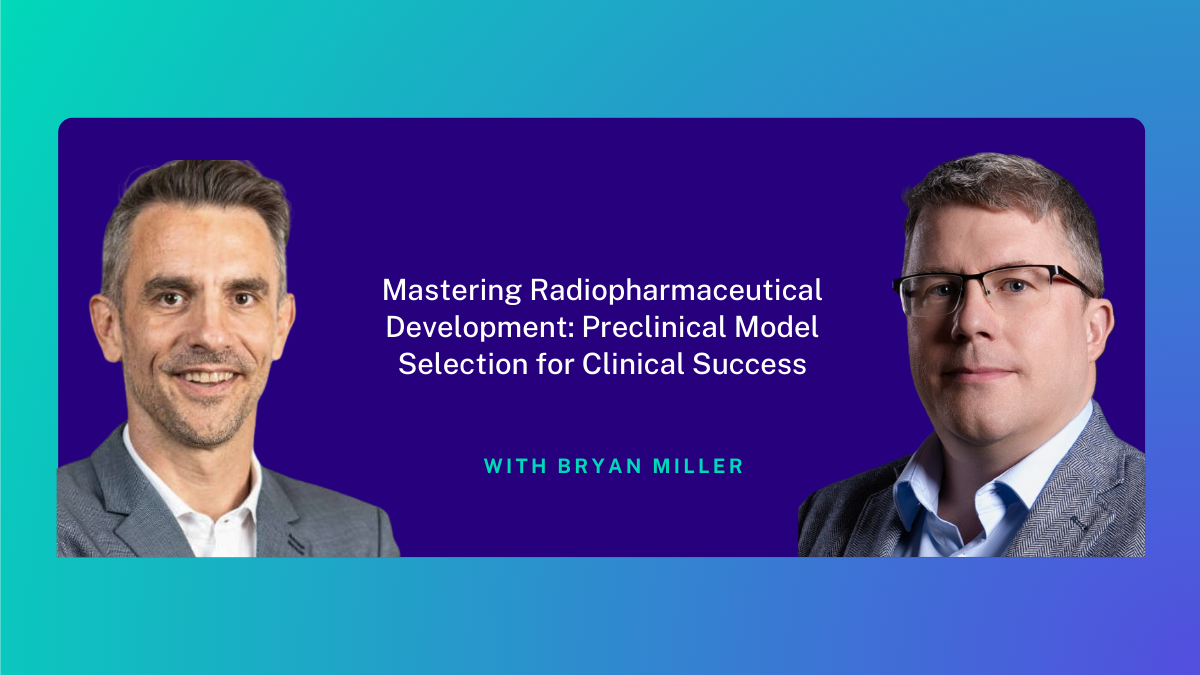
A new era is emerging in cancer diagnosis and therapy—one that extends beyond common indications like prostate cancer to address notoriously difficult-to-treat tumors that have long challenged oncologists. Radiopharmaceuticals, with their unique ability to both detect and destroy disease, are rapidly redefining what is possible in clinical research.
In this episode of the Smart Biotech Scientist Podcast, David Brühlmann speaks with Bryan Miller, Director of Scientific and Technical Operations at Crown Bioscience UK, about how advanced preclinical models are used to help clients advance innovative cancer therapies toward the clinic.
Key Topics Discussed
- The new era of radiopharmaceutical innovation and the rise of diagnostic and theranostic applications
- Benefits of theranostics for patient stratification and faster clinical translation
- Crown Bioscience’s preclinical model platforms and progression from basic to clinically relevant systems
- Key differences between CDX and PDX models and their role in predictive oncology research
- Strategies to improve translational value using organoids and PDX models
- Radiopharmaceutical breakthroughs and future potential for hard-to-treat cancers
- Balancing speed, quality, and regulatory rigor through strong scientific partnerships
- Practical guidance on CRO selection and building effective, long-term collaborations
Episode Highlights
- The promise and practical implications of theragnostics—agents used for both diagnosis and treatment [03:13]
- Definitions and distinctions between CDX (cell line derived xenograft) and PDX (patient derived xenograft) models, and their value in preclinical studies [05:11]
- Strategies for building more predictive, clinically relevant research models [06:09]
- Industry and regulatory challenges—balancing rapid innovation with quality standards, and the importance of strategic partnerships [08:01]
- Key advice for scientists entering radiopharmaceutical development, including how to choose the right research partners [09:53]
- Why effective collaboration between biotech companies and CROs/CDMOs is akin to a well-chosen partnership [10:50]
- The future outlook for radiopharmaceuticals and their impact on hard-to-treat cancers [12:21]
In Their Words
I think we are also seeing radiopharmaceuticals developed for a wider range of cancers. We do have therapies available for prostate cancer and neuroendocrine cancer, but we are seeing this expanding—and this will further expand over the coming years, which I think is a really exciting prospect. I think particularly the value that Crown Bioscience brings is what we touched on before in terms of the value of the models that Crown has in the radiopharmaceutical field. We can now offer our platforms of preclinical models to our clients to run radiopharmaceutical studies.
Episode Transcript: Mastering Radiopharmaceutical Development: Preclinical Model Selection for Clinical Success - Part 2
David Brühlmann [00:00:34]:
Welcome back. In Part One, Bryan Miller walked usthrough his journey from cancer research toradiopharmaceutical development and explained why this therapeutic class is capturing the attention of oncology researchers worldwide. Now we’re shifting gears to explore how Crown Bioscience is scaling its preclinical capabilities to meet exploding demand, the strategic partnerships shaping the field, and the technological innovations that could define radiopharmaceutical development over the next five years. Let’s dive back in.
Now I’d like to touch upon a different part of the technology. There’s a lot of innovation happening. Many are saying that we’re entering a new era for radiopharmaceutical innovation. What makes this moment or season different, and how are you as a company positioned to help shape that evolution as this field scales?
Bryan Miller [00:02:44]:
Yeah, I completely agree. I think we are entering a new era for it. It’s quite exciting what we’re starting to see, and one of the things that is most exciting to me—I touched on it a little before—is the development of diagnostics. We’re certainly seeing increasing interest and excitement about the potential of radiopharmaceuticals.
We’re also seeing increased interest in the theranostic use of radiopharmaceuticals—this idea that you can use the same material as both a diagnostic agent and a therapeutic agent. There’s huge potential here, particularly for patient stratification and rapid movement from diagnosis to treatment.
We’re also seeing radiopharmaceuticals developed for a wider range of cancers. We do have therapies available for prostate cancer and neuroendocrine cancer, but this is expanding and will continue to expand over the coming years, which is very exciting.
I think particularly the value that Crown Bioscience brings is in the preclinical models we offer for radiopharmaceutical studies. Our platforms give clients the opportunity to run studies using very advanced, well-characterized models, which opens up a lot of possibilities for research and development in this field.
David Brühlmann [00:04:14]:
What kind of limits do these models have, and where do you see the development going? What kinds of limitations are we likely to overcome very shortly?
Bryan Miller [00:04:26]:
I wouldn’t suggest there are strict limitations as such. As mentioned, we have a number of different platforms, so we can literally take a study from two-dimensional (2D) cell lines to three-dimensional (3D) organoids, then into CDX in vivo or PDX in vivo. That gives a very strong workflow in terms of maturing a study over time. By the time you’re running a study in a PDX model, you’re working with a model that recapitulates the heterogeneity of human tumors and provides highly clinically relevant information, which can generate very powerful data.
David Brühlmann [00:05:04]:
Perhaps give a definition once again of PDX and CDX. What does CDX mean?
Bryan Miller [00:05:11]:
CDX is a cell line-derived xenograft. These are xenograft models where a human cell line is implanted into a mouse to form a tumor, either subcutaneously or orthotopically.
For PDX, that’s a patient-derived xenograft. These models are set up from patient tumor samples—they’ve never been cultured in vitro. The tissue is grown in animals, then cryopreserved from the animal tumors. This approach retains many features of the original tumor, so it provides a more physiologically and clinically relevant output than a CDX, where the cells have undergone selection and adaptation to culture. PDX models retain much more of the tumor’s original characteristics.
David Brühlmann [00:05:51]:
The power of using models, as you highlighted before, is that you can move faster. But another purpose is to have more predictive models to get closer to your targets. What strategies do you use to achieve that?
Bryan Miller [00:06:09]:
I would say there are two main strategies, depending on whether you’re at the in vitro or in vivo stage.
Our organoid models are incredibly valuable. They form 3D structures that begin to recapitulate features you would see in an organ. That gives a much more clinically relevant output than a traditional 2D cell culture model.
With PDX models, the key is that they retain many features of the original tumor. Crucially, they maintain heterogeneity, unlike a tumor grown from a cell line. This intrinsic heterogeneity means that the model’s response to therapy better reflects what we would see in a clinical context.
David Brühlmann [00:07:04]:
I’m curious, Bryan. What I’m hearing is that there’s a lot happening in the space—innovation, changes, breakthroughs. What breakthroughs are you most excited about?
Bryan Miller [00:07:17]:
For me, it’s theranostics. That’s something I find very exciting, particularly their applicability to treating cancers. Take PDAC (pancreatic ductal adenocarcinoma)—very difficult to treat. Current treatment options are limited, and the five-year survival rate is still very low.
What excites me is the development of radiopharmaceuticals with theranostic applications for these hard-to-treat cancers. I see a lot of potential here, and we are already starting to see more development in this space. I expect it will continue to advance significantly in the coming years.
David Brühlmann [00:08:01]:
And how do you balance, in your role, moving fast and innovating quickly while also working in an industry where everything will eventually be regulated? Even at early stages, how do you factor in regulatory considerations and ensure that patients will ultimately receive what’s being developed? How do you manage these two worlds?
Bryan Miller [00:08:26]:
Well, what I would say is that robust quality standards are always absolutely crucial. At Crown Bioscience, we’re dedicated to delivering scientific studies of the highest possible quality. In setting up our strategic collaboration with Medicines Discovery Catapult (MDC), we partnered with an organization that shares our values and commitment to quality.
Having these robust quality systems in place allows our teams to perform work rapidly to meet essential timelines while maintaining extremely high standards. There’s no conflict between high-quality research and speed. If you conduct a low-quality study, that will set your timelines back—poor quality prevents you from getting the answers you need and delays the entire research program.
It’s crucial to work with partners who uphold very high standards of quality and QC, and this is ingrained in the culture at Crown. Our clients know the standards we work to, and we consistently deliver on timelines while maintaining the highest quality.
David Brühlmann [00:09:35]:
Let’s make this practical. What advice would you give a smart biotech scientist who’s curious about radiopharmaceutical development? Where should they start, and what can wait until later?
Bryan Miller [00:09:53]:
I would suggest working with the right partners. Developing a robust strategy for your study is critical—how you’re going to target the tumor, construct your therapeutic, and select preclinical models. Drawing on the knowledge of experienced people in the industry is crucial, and that’s a lot of the value a CRO can bring.
At Crown, we have extensive experience helping clients in the preclinical space. We can advise on study development, help design your study, guide model selection, and assist with isotope choice and labeling strategy for your test material. Partnering with the right experts early on ensures you have a strong strategy to deliver a successful study.
David Brühlmann [00:10:48]:
How do you make a partnership like this successful? Entering into a relationship with a CRO—or later, a CDMO—is sometimes like a marriage. It's very similar. You have to select very well your partner. What is your approach there? Because I'd say not every company fits every CRO. There are differences and it doesn't always make sense for a company to go to one because it's the best or whatever reason everybody recommends. Sometimes it makes sense to go to another. Right.
Bryan Miller [00:11:19]:
I think people choose CROs on different criteria. At Crown, we do work a very wide array of clients with different needs and different interests. And we can always tailor a study to the individual client. One of the things that we always try to do is we do like to see ourselves as an extension of that client's lab. We work in close collaboration in the design of the study. And there's very open communication during the progress of the study as well. I think the success is seen by the amount of repeat business that we get. And we do form these close collaborations with our clients because we are really dedicated to helping them achieve the objectives of their studies. And we've had the feedback time and again that they start to see us as part of their team. They almost see us as part of the research team and they collaborate very closely with us in terms of delivering the study successfully.
David Brühlmann [00:12:14]:
Now I would like to look forward into the future, since there’s a lot of innovation going on. What is your picture? Where do you see this field in five years?
Bryan Miller [00:12:26]:
It’s a dynamic field at the moment. There’s already a lot of exciting progress, and there’s more to come. We’re certainly seeing rapid growth in interest in radiopharmaceuticals, and I expect this to continue in the coming years.
What excites me is the prospect of increasing the number of cancer indications for which radiopharmaceuticals are a viable option—for diagnosis and therapy. This is particularly important for hard-to-treat cancers, where current treatment options are limited. I think radiopharmaceuticals offer the potential to really advance new treatments in these areas. So I anticipate we will see a significant impact of radiopharmaceuticals in treating these challenging cancers in the years ahead.
David Brühlmann [00:13:18]:
Bryan, what is the most important takeaway from our conversation?
Bryan Miller [00:13:24]:
I think the most important takeaway is the level of excitement and potential in radiopharmaceuticals, especially for oncology. Radiopharmaceuticals also have applications beyond oncology in other disease areas.
As I’ve mentioned, Crown Bioscience is a strong partner for these types of studies. We have a fantastic library of models, both in vitro and in vivo, available for radiopharmaceutical research. In partnership with Medicines Discovery Catapult (MDC), we have the expertise to help design and deliver highly successful radiopharmaceutical programs.
David Brühlmann [00:14:09]:
Where can people get a hold of you and further have a conversation about your work?
Bryan Miller [00:14:15]:
People can contact me through LinkedIn and I'd be delighted to give them any more information that they need on breeder pharmaceutical programs at Crown or indeed any other services that Crown offers.
David Brühlmann [00:14:25]:
Fantastic. I’ll leave the links in the show notes on Smart Biotech Scientist. Bryan, thank you so much for coming on the show today.
Bryan Miller [00:14:33]:
Thank you, David.
David Brühlmann [00:14:34]:
And that wraps up our conversation with Bryan Miller.
The radiopharmaceutical revolution is just getting started, and the preclinical strategies we discussed today could reshape how these therapies move from concept to clinic. If you are navigating the complexities of biotech development—whether in radiopharmaceuticals or beyond—I hope this conversation sparked some new ideas.
If it did, take 30 seconds to leave a review on Apple Podcasts or wherever you’re listening. Your feedback helps us bring more insights to the biotech community.
Thank you for tuning in. Until next time.
For additional bioprocessing tips, visit www.bruehlmann-consulting.com. Stay tuned for more inspiring biotech insights in our next episode. Until then, let’s continue to smarten up biotech.
Disclaimer: This transcript was generated with the assistance of artificial intelligence. While efforts have been made to ensure accuracy, it may contain errors, omissions, or misinterpretations. The text has been lightly edited and optimized for readability and flow. Please do not rely on it as a verbatim record.
Next Step
Book a free consultation to help you get started on any questions you may have about bioprocess development: https://bruehlmann-consulting.com/call
About Bryan Miller

Bryan Miller is Director of Scientific and Technical Operations at Crown Bioscience, with over a decade of experience in oncology research and preclinical drug development. He earned his PhD in Biochemistry from the University of Leicester and completed postdoctoral training at the University of Toronto and the Beatson Institute, specializing in in vivo and in vitro models of colorectal and pancreatic cancer.

After moving into the CRO field in 2015, Bryan has focused on translating strong science into effective preclinical strategies for oncology programs. Since joining Crown Bioscience UK in 2019, he has played a key role in guiding scientific operations and supporting clients across diverse cancer indications and therapeutic approaches.

Connect with Bryan Miller on LinkedIn.
David Brühlmann is a strategic advisor who helps C-level biotech leaders reduce development and manufacturing costs to make life-saving therapies accessible to more patients worldwide.
He is also a biotech technology innovation coach, technology transfer leader, and host of the Smart Biotech Scientist podcast—the go-to podcast for biotech scientists who want to master biopharma CMC development and biomanufacturing.
Hear It From The Horse’s Mouth
Want to listen to the full interview? Go to Smart Biotech Scientist Podcast.
Want to hear more? Do visit the podcast page and check out other episodes.
Do you wish to simplify your biologics drug development project? Contact Us

