
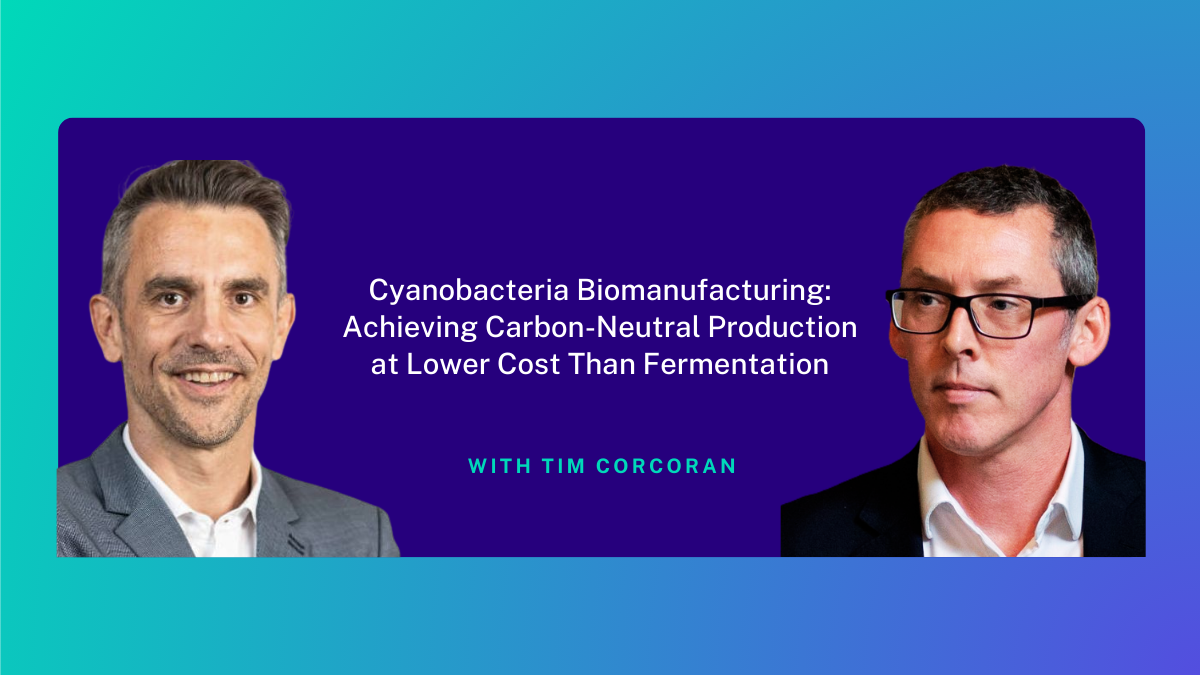
If biotech had a “cheat code” for sustainable manufacturing, what would it look like? Imagine harnessing sunlight and seawater to create valuable molecules—no fermentation tanks, minimal waste, virtually carbon neutral.
In this episode of Smart Biotech Scientist Podcast, David Brühlmann speaks with Tim Corcoran, CEO and Co-Founder of Deep Blue Biotech. Tim is on a mission to transform cyanobacteria from scientific curiosity into a foundation for commercially viable, carbon-neutral specialty chemicals.
Key Topics Discussed
- Deep Blue Biotech’s technological edge with ocean-derived cyanobacteria and secreted molecule production
- Photosynthetic production as a competitive advantage over traditional fermentation methods
- Initial product and market selection: high-value vs. high-volume opportunities
- Go-to-market strategy: B2B focus, targeting personal care manufacturers, and leveraging distributors
- Scaling up production: photobioreactor challenges, pilot facilities, and CRO/CMO partnerships
- Transition to industrial scale and licensing model for broader adoption
- Facility location and operational considerations: light, labor, infrastructure, and energy efficiency
- Lab-to-market success factors and advice for aspiring biotech entrepreneurs
Episode Highlights
- The strategic advantage of B2B commercialization in consumer care biotech [02:46]
- Overcoming infrastructure limitations for photobioreactor scale-up and partnering with specialized CMOs [04:50]
- Building a pilot facility and moving toward technology licensing for global reach [05:33]
- Location choices for production facilities—comparing natural light, skilled labor, and electricity costs in Portugal and Iceland [08:57]
- Impact of electricity usage for LED-supported photosynthesis on business viability [10:45]
- What distinguishes successful laboratory-to-market biotech companies from those that fail, especially in challenging financial environments [11:53]
- Practical advice for scientists considering entrepreneurship, including partnering with business-minded collaborators and exploring university innovation programs [14:08]
- Speculation on the broader applications and future of synthetic biology, from biofuels to biodegradable materials and CO₂-absorbing products [15:27]
- The importance of aligning technical innovation with commercial expertise to create enduring impact [16:38]
In Their Words
One of the very first pieces of research we did was to look at what our cyanobacteria were predisposed to make. Because if all you're doing is giving it a little nudge and encouraging it and joining up a pathway here and there, it's akin to pushing a car down a hill as opposed to pushing a car up a hill. Again, I'm always wary of making it sound easy because it's definitely not, but it's a much more efficient R&D process when you do it that way. And so again, it comes back to looking at what are we able to make, but also how does that suit the market? And when you join all of those things up together, hopefully you get a much more viable company.
Cyanobacteria Biomanufacturing: Achieving Carbon-Neutral Production at Lower Cost Than Fermentation - Part 2
David Brühlmann [00:00:34]:
Welcome back! In part 1, Tim Corcoran explained how Deep Blue Biotech’s ocean-derived cyanobacteria produce molecules through photosynthesis while secreting them directly into the media — a game-changing advantage. Now, we tackle the hard questions: How do you choose your first product when hyaluronic acid sells for $2,000 per kilogram but your ultimate target biofuel sells for $2 per liter? How do you scale photobioreactors when the infrastructure barely exists? And what separates technologies that commercialize from those that die in the valley of death? Let's find out.
We're going to get to the scale-up and the huge scale in a minute. I just want to focus a bit more on your deliberate choice to go into the consumer care market. This is quite a competitive market. You have all these big players out there. How do you compete against these players, especially with a limited budget?
Tim Corcoran [00:02:46]:
I guess one of the key factors is what we're doing is B2B rather than B2C. So that means things like marketing costs are less of a worry. If you try and produce a consumer product, the cost — I think Amyris is a good example. They're a synthetic biology company who got themselves into a bit of trouble. I think they've bounced back now, but they tried to launch consumer products and they spent an enormous amount of money on marketing. So being a B2B model helps. It means, for example, if you target the 10 biggest personal care manufacturers in the world, that's relatively achievable through a few conversations, a few emails, a few meetings. Then you've got distributors who are seeking an advantage over their competitors. You know, they want to be able to sell their hyaluronic acid at the expense of their competitors.
So being able to offer a distributor a unique product with significant advantages that we've already discussed over existing products, potentially that gives you the opportunity to tap into quite a large distribution network.Now the other factor is the actual amount that you can supply. If you speak to one of the large personal care companies, potentially they want tonnes of the product, and it will take a little while to scale up to that. So initially you need to engage with some of the smaller, more agile personal care companies as well, who might only want a few kilograms of the product so that they can do a product launch and get it out there. That serves a number of advantages. It means you've got products in other products that are on the market now. It means you're generating revenue quickly, and you're able to do that before you've scaled up to significant industrial scale. And it gives you some really useful case studies. People can see how these products perform.
David Brühlmann [00:04:17]:
Moving on to the scale-up aspects, what I see, Tim, is you have a promising technology — it's novel, you have a tremendous market, you have a great business model, and potentially you will have a huge demand and you will need to scale up not just to 20,000 liters, probably to 100,000 liters or beyond. What is your strategy there? Because the reason I'm asking this question is you have a novel technology and not many CDMOs have photobioreactors for photosynthetic organisms. What are you going to do, or what is the best strategy from your point of view?
Tim Corcoran [00:04:50]:
It is the flip side of a novel technology, as you say, that the infrastructure isn't abundant, shall we say. Now, fortunately, there are companies like A4F – Algae for Future in Portugal, for example, who can act as both a CRO and a CMO. They have very large-scale photobioreactors, so we're working with them at the moment. Plans to initially scale up one of our strains to about a 1,000-liter photobioreactor scale. But they don't have the downstream processing capabilities that you need. So you then need to take what comes out of that and find a suitable downstream processing CMO. So in the very first instance, our first commercial sales will be working with probably two different CMOs, one to grow it, one to process it. And that gets us that commercial revenue, which is an important stepping stone in the development of a company.
Now, our goal then is to build our own pilot facility so that we can refine the process. And the pilot facility, because of the sort of highly efficient process and the profitability profile that we have, that pilot will be profitable. It will make the company self-sustaining from a research point of view. And it will prove the technology at a reasonable scale, and it will provide you with enough samples and small volumes to generate regular commercial quantities, and for the big companies to be able to do all the testing they need to do in their formulations.At that point, potentially you can secure pre-sale agreements, which then you take to the bank against building an industrial facility. Now, whenever you speak to investors in particular, the idea of building a large industrial facility is a concern. But if you can show that you've got pre-sales from these big companies, then it becomes much more viable.
Now, our plan is to build one industrial facility. We don't want to build loads and loads of them. If we can build one, show that it's profitable, show that it's working, show that it's doing all the things that it should be doing, at that point, the intention is to move to a sort of technology licensing model because you can scale and reach the market much faster that way. So working with other chemical companies, licensing the technology to them, supporting them to scale it up. A lot of them will have much of the downstream processing side of things in-house already. So the bit that they will need to invest in will be the photobioreactor side.
And the interesting thing is one of the fringe benefits of this is as they do that, the photobioreactor technology and the industry as a whole will grow and it will develop and more efficiencies will be built in. But yeah, once you start licensing, obviously you're able to scale. You do leave a bit of profit on the table. I think it's not as profitable long-term as building multiple facilities, but I think it is a faster way to reach the entire market.
And because of the CO₂ aspect, because of the cost of production aspect, I think our method for hyaluronic acid will become the default mechanism for making hyaluronic acid. Much in the same way as precision fermentation took over from extraction from rooster combs about 25 years ago. This will be a substantial change in the industry. And just the cold logic of, well, it's carbon-neutral and it's cheaper, why wouldn't I do it this way, will lead it to become the dominant method.
David Brühlmann [00:07:42]:
Since you're going to build a facility, do you also have in mind becoming a CDMO at one stage or renting part of your capacity to other developers?
Tim Corcoran [00:07:51]:
We have a strong interest in helping the industry develop, but we are not particularly thinking at the moment of becoming a CMO or CRO, partly because we have so much additional research we want to do for ourselves. When you look at, as I say, the number of other chemicals we can make is in the hundreds. And so there's a lot of additional research. Now, potentially what we can do is take that pilot facility and take that industrial facility down the line and repurpose them to focus on these second-, third-, fourth-generation chemicals, proving it each time and then licensing them out and then moving on to the next one. The goal ultimately is that we have a full spectrum of chemical solutions — carbon-neutral, cost-efficient — you start to, when I'm sort of daydreaming, you start to think about the potential scale of the company as a whole and you think it could rival some of the really, really big chemical manufacturers.
David Brühlmann [00:08:38]:
Yeah, definitely. What comes into my mind, Tim, is your technology needs a lot of light. So where is the best location to build your facility? Because not only do you need a lot of light, you need skilled labor, which is probably quite difficult to find right now. So where are you going to build your facility?
Tim Corcoran [00:08:57]:
We're based in Sheffield, and from a skilled labor point of view, we've been very fortunate. The University of Sheffield is brilliant at cyanobacteria. They have two separate labs working on it. So we've been able to tap into, from an R&D perspective, we've been able to tap into that. Now, as you scale, that engineering side of things becomes more and more important. Again, actually the University of Sheffield is very, very strong at that. So that gives us a good starting point.But when you think about where you're going to get your light from, there are two main sources. One is natural light and the other is LEDs. Now if you want natural light, obviously moving somewhere where that is abundant helps. My feeling is probably it'll be natural light supported by LEDs, but time will tell.
So Portugal has a thriving and growing ecosystem around photosynthetic production, around photobioreactors and cyanobacteria and microalgae. So there's expertise and there's a degree of infrastructure and there's natural light there. They have relatively cheap electricity. Portugal is really attractive. Plus I'm a big fan of Lisbon. I think it's a lovely city.But the other end of the spectrum, interestingly, is Iceland. Iceland is developing a photobioreactor industry built around cheap, extremely clean geothermal electricity. So the cost of electricity and the CO₂ footprint of the electricity there are very favorable. So at that point you're not going to be relying on natural light — obviously Iceland being where it is — it's going to be LEDs. But if the LEDs are powered by geothermal electricity, it's cheap and it's carbon-neutral.
Now, obviously Iceland is a little bit further away, it's a bit colder, but there are companies operating there now who are working with microalgae in particular. And when you speak to them, they say, no, we have absolutely no problems attracting people to come and work here. People who want to work on this will travel. So that's another interesting location for us.
David Brühlmann [00:10:38]:
And how does the business case change as you're factoring in the additional electricity costs for LED lighting?
Tim Corcoran [00:10:45]:
It does make a difference. I think if you go somewhere like Iceland where the cost of electricity is, I think it's less than a quarter of what it is in the UK, then it becomes much less of a factor. But certainly I think if you're using artificial light, then your electricity profile is going to change quite substantially. So you do have to think about that. One of the advantages of Portugal is if you can get sensors which detect the intensity of the light, you can potentially say, okay, it's a cloudy day, we'll dial up the LEDs, or it's a particularly bright day, we can turn the LEDs off. And then you're using LEDs sparingly, you're using them as and when. The other factor is to look at which wavelength and intensity of light the cyanobacteria most respond to because you can make it a much more efficient process if you understand the mix of wavelengths and the intensity of light that benefits them, and you can calibrate it really quite precisely.
David Brühlmann [00:11:32]:
I'd like to focus on the lab-to-market journey. You have seen a lot of companies succeed, a lot of companies fail. From your perspective, what makes a company succeed in that? Because finally, we have great technology in the lab, but if we fail to transfer it into a commercial setting, it will be of no use to society.
Tim Corcoran [00:11:53]:
I agree. I think one of the big factors — one side in particular — as I alluded to earlier, around 2023, money tightened up substantially. A lot of synthetic biology companies had grown up and developed based upon access to easy, cheap money. And when that stopped, a lot of them suddenly struggled, and they'd got these long timeframes for their research and development and all of a sudden they couldn't afford that.
At the same time, because they thought they had access to all this money and all this time, they were targeting commodity products — for good reasons: big markets, potentially the biggest environmental impact. But it meant that to get to a point where they were economically and financially viable, where they could compete with the products they were replacing, required an enormous amount of research. And again, that made it very hard for them. And a lot of them ran out of money and went bust. And some of them have since bounced back, I'm pleased to say.
I think the synthetic biology industry has grown a lot leaner and a lot cleverer about how it works. So it has improved. It's learned from that. That pressure has forced the evolution of the industry as a whole, and it's in much better shape now than it was.I mentioned, I think it was Amyris who launched consumer brands. That is a real challenge. As I say, things like marketing costs can drain your resources very quickly. My preference — I come from a B2B background — would always be to operate in a B2B fashion because generally it's easier from a commercial point of view. The sales and marketing process is simpler.
And then the other one that I think ties in — and it probably particularly relates to the earlier stages of synthetic biology — was people would choose their favourite microbe and they would try and make their favourite product — oversimplification. But what it meant was there was a lot of genetic engineering to make whatever it might be — Escherichia coli, yeast, whatever — produce this product.
Now, as I mentioned earlier, one of the very first pieces of research we did was to look at what our cyanobacteria were predisposed to make. Because if all you're doing is giving them a little nudge and encouraging them and joining up a pathway here and there, it's akin to pushing a car down a hill as opposed to pushing a car up a hill. Again, I'm always wary of making it sound easy because it's definitely not, but it's a much more efficient R&D process when you do it that way.
And so again, it comes back to looking at what we're able to make, but also how does that suit the market? And when you join all of those things up together, hopefully you get a much more viable company.
David Brühlmann [00:14:02]:
What piece of advice would you give to a brilliant scientist sitting on the fence about starting their own company?
Tim Corcoran [00:14:08]:
I would 100% encourage them to do it. There are so many good ideas that don't get exploited, and it bothers me that there are all these brilliant things that may never see the light of day. Now, the scientists can do the technical bit. The other side of it, the commercial, the corporate bit, that's where they're going to need help. And there are, I would say, depending upon their context, there are three ways they can go about it.
One, if they're at a university, go and speak to your commercialization department or technology transfer office. They will have people who have expertise and knowledge about how to do this. Often you can get funding from the university to help you achieve that.
The second, people like me, like I used to be — business development consultants who will work with early-stage companies. They might work with you as a consultant, they might join you as a business partner. They can take care of that side of things, and that works.
And then the last one, I would always recommend it to anyone that wants to try it, is Carbon13 Venture Builder. Their concept is all about bringing technically minded people together with commercially minded people, putting the two in a room and seeing what comes out. So as I said, that's how I met my co-founder. It was a brilliant process. We weren't the only ones. A lot of good companies have come out of that. I'm sure there are other venture builder programmes. That's just the one that we worked on. But I thought Carbon13 did a brilliant job of creating the opportunity for these ideas to be realised.
David Brühlmann [00:15:19]:
Before we wrap up, Tim, what burning question haven't I asked that you're eager to share with our biotech community?
Tim Corcoran [00:15:27]:
Oh goodness. If I was thinking about it, the thing that I always ponder when I'm sort of looking at it is where can synthetic biology go? What is its ceiling? Because it's a relatively young industry. It's learning from its mistakes and it's improving.
Generally speaking, you see synthetic biology focusing on fuels and plastics and materials and that sort of thing. But what else could it do? Certainly I think there is potential in biodegrading products and dealing with issues like microplastics potentially. There is a lot of scope for it.
There's a cyanobacteria company I came across a little while ago who were developing a cyanobacteria-based paint which would be photosynthetic. So you'd paint it on a building and it would capture CO₂ and fix it. There's all sorts of areas it can potentially go. And frankly, I'd like imagination to give the answer to it. But I think the potential is enormous and it's worth anyone with either a commercial or a technical perspective thinking, I wonder if it could do this. Hopefully over time it becomes a significant part of the answer to the challenges we face with climate change.
David Brühlmann [00:16:28]:
This has been great, Tim. What is the most important takeaway from our conversation?
Tim Corcoran [00:16:34]:
A: I love cyanobacteria. And B: science has enormous potential, but it needs to be aligned with commercial expertise. If you take the two and they work together, I think you can achieve great things.
David Brühlmann [00:16:51]:
And that's the way forward, I think. Thank you so much, Tim, for sharing your passion, letting us into the world of cyanobacteria. Where can people get a hold of you?
Tim Corcoran [00:17:01]:
You can reach us — I'm on LinkedIn. I discovered actually there is more than one Tim Corcoran on LinkedIn. Or you can email me. My email address is tim@deepbluebiotech.com. Or you can visit our website, deepbluebiotech.com. I'm always happy to talk. It's one of my philosophies. I'll try and talk to anyone with an interesting idea or question, because sometimes you get some really interesting opportunities as a consequence.
David Brühlmann [00:17:21]:
Smart biotech scientists, use this opportunity. You'll find the links in the show notes. And thank you once again, Tim, for being on the show today.
Tim Corcoran [00:17:30]:
Thank you very much for having me, David.
David Brühlmann [00:17:31]:
It's been a pleasure. Tim's journey from three decades in commercial and leadership roles to founding Deep Blue Biotech reveals a critical truth: breakthrough science needs disciplined commercialization strategy. Start with high-value products, prove the case, move down the value chain, build one factory, then license broadly. And balance organism health with yield optimization. These principles separate innovations that reach market from those that don't.
All right, smart scientists. That's all for today on the Smart Biotech Scientist Podcast. Thank you for tuning in and joining us on your journey to bioprocess mastery. If you enjoyed this episode, please leave a review on Apple Podcasts or your favorite podcast platform. By doing so, we can empower more scientists like you. For additional bioprocessing tips, visit us at smartbiotechscientist.com. Stay tuned for more inspiring biotech insights in our next episode. Until then, let's continue to smarten up biotech.
Disclaimer: This transcript was generated with the assistance of artificial intelligence. While efforts have been made to ensure accuracy, it may contain errors, omissions, or misinterpretations. The text has been lightly edited and optimized for readability and flow. Please do not rely on it as a verbatim record.
Next Step
Book a free consultation to help you get started on any questions you may have about bioprocess development: https://bruehlmann-consulting.com/call
About Tim Corcoran

Tim Corcoran, Co-Founder and CEO of Deep Blue Biotech, brings more than 25 years of commercial and leadership experience across multiple sectors. He has a proven track record in designing growth strategies, advising start-ups and scale-ups from early stages to successful exits, and building robust networks of investors, partners, and clients.

Tim’s experience spans both established international corporations and entrepreneurial ventures, giving him a unique perspective on driving innovation and creating long-term business value.

Connect with Tim Corcoran on LinkedIn.
David Brühlmann is a strategic advisor who helps C-level biotech leaders reduce development and manufacturing costs to make life-saving therapies accessible to more patients worldwide.
He is also a biotech technology innovation coach, technology transfer leader, and host of the Smart Biotech Scientist podcast—the go-to podcast for biotech scientists who want to master biopharma CMC development and biomanufacturing.
Hear It From The Horse’s Mouth
Want to listen to the full interview? Go to Smart Biotech Scientist Podcast.
Want to hear more? Do visit the podcast page and check out other episodes.
Do you wish to simplify your biologics drug development project? Contact Us

