
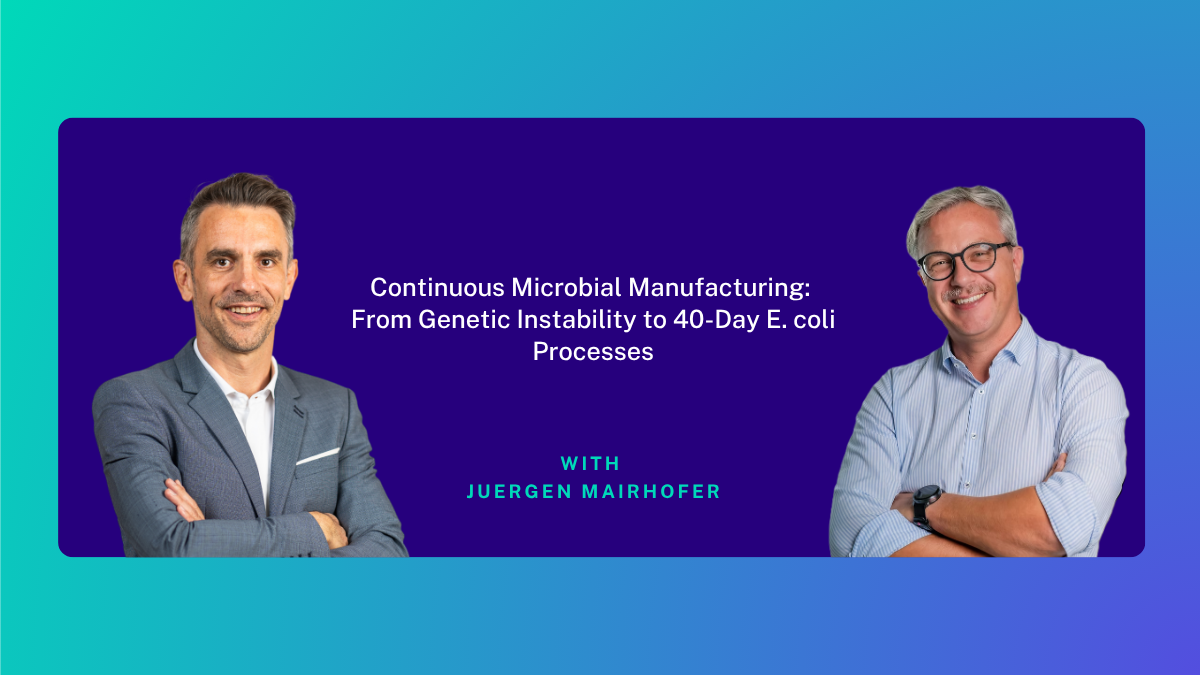
For decades, contract development and manufacturing organizations (CDMOs) have grown by building bigger stainless-steel facilities and squeezing ever-tighter margins. But as global overcapacity bites, price wars with Asia intensify, and big pharma pulls production back in-house, the rules of the game are shifting—and standing still might just put you out of business.
This episode, David Brühlmann is joined by Juergen Mairhofer, CEO of enGenes Biotech GmbH, who’s built a career—and a company—around challenging bioprocessing orthodoxy. From developing E. coli strains for single-pot antivenom antibodies to helping major players vertically integrate their supply chains, Juergen Mairhofer’s perspective spans the laboratory, the boardroom, and the demands of a biomanufacturing landscape in flux.
Key Topics Discussed
- Bioprocessing innovation is essential as CDMOs face industry skepticism, regulatory barriers, and growing competitive pressure.
- Overcapacity and margin compression are driving consolidation, especially among smaller European CDMOs.
- Continuous manufacturing offers a strategic advantage by differentiating technology leaders from low-cost providers.
- Successful adoption of continuous processing requires a cultural mindset shift and gradual implementation via pilot projects.
- The industry will operate in parallel systems, with legacy batch processes coexisting alongside emerging continuous technologies.
- Building a biotech company requires balancing scientific excellence with market focus, strong teams, and disciplined cash management.
- Big Pharma is reversing outsourcing trends by reintegrating manufacturing, highlighting its strategic importance.
- Future biotech success depends on embracing innovation, adapting to global shifts, and continuously learning and collaborating.
Episode Highlights
- The need for innovation to stay competitive against lower-cost regions, and why outdated models are unsustainable [03:08]
- How continuous manufacturing creates a competitive edge for CDMOs in high-cost regions [05:49]
- Practical advice for piloting continuous processing, building partnerships, and embracing risk [06:36]
- The “parallel universe” of batch versus continuous manufacturing, and how this duality will shape the industry’s next decade [08:24]
- What scientists should know before spinning out technology companies—beyond the science: customer focus, cash flow, and building strong teams [09:49]
- Big pharma’s surprising return to in-house manufacturing and vertical supply chain integration [12:12]
- Resources, publications, and upcoming opportunities to connect with Juergen and learn more [15:28]
In Their Words
I think the current new Five-Year Plan has been putting bioprocessing at the top next to semiconductors. I think they are going to pull out the same business model as they have been using for the automotive industry, steel industry, and photovoltaics. I think that we will see a replication of that for the bioprocessing industry, and I think the only way out here is to innovate.
And I think also the Chinese industry has understood that they need innovation to become more profitable because currently they are extracting a lot of revenue from Europe and the United States, but they are having a hard time becoming profitable because I think currently they have just been replicating what the industry has been doing over the last 20 years in Europe and the US.
Continuous Microbial Manufacturing: From Genetic Instability to 40-Day E. coli Processes - Part 2
David Brühlmann [00:00:50]:
Welcome back to Part 2 of our conversation with Juergen Mairhofer, who is the CEO of enGenes Biotech. In Part 1, we explored the science behind continuous microbial manufacturing and what makes E. coli such a powerful production platform.
Now we zoom out. In a world of CDMO overcapacity, margin pressure, and shifting geopolitics, does advanced bioprocessing actually become a competitive weapon? And what does it take to build a biotech company from the ground up? Let's find out.
I would come back now to your comments where you said we must innovate. That's a very important point because we live in an industry where we have seen a lot of changes.
And you also said, for instance, synthetic biology — a lot of things have happened since you started. To what extent can the continuous processing you have developed be a competitive advantage, but also a way to lead the way in this evolving industry and finally secure the business and also become an attractive CDMO?
Juergen Mairhofer [00:03:08]:
I think what I can say here is that if you wait for the technology to be completely mature, you will wait for your competitor to pass you. I think this is the point. I see a lot of skepticism when I talk to people. One of the arguments is sometimes: We haven't done that in the past — why should we do that in the future? It's so complicated. And there are all these regulatory aspects that we have to overcome. But at the same time, we also know that the business model in the CDMO space that we are currently seeing cannot go on like it used to.
I think this model is somehow broken, and I think there will be a lot of consolidation in the upcoming months and years. Because in Europe, most of the CDMOs are below €100 million in revenue, so they will have a hard time staying alive at some point. And there is also a lot of pressure from Asia, especially from China. I think the current new Five-Year Plan has been putting bioprocessing at the top next to semiconductors. I think they are going to pull out the same business model they have been using for the automotive industry, steel industry, and photovoltaics.
I think we will see a replication of that model for the bioprocessing industry. And I think the only way out here is to innovate. And I think the Chinese industry has also understood that they need innovation to become more profitable. Because currently they are extracting a lot of revenue from Europe and the United States, but they are having a hard time becoming profitable. I think this is because they have been replicating what the industry has been doing for the last 20 years in Europe and the US.
So they are working with outdated processes, the same outdated processes that US and European CDMOs are still working with. And they have realized that they have to innovate their way out. I think we have to understand that also in Europe and the US the only way forward is innovation, because through innovation we can overcome the cost advantage that countries have where energy and labor are cheaper.
With that understanding, I think the only way forward is to be as innovative as possible, while at the same time trying to overcome the regulatory hurdles as quickly as possible. This will probably not be an easy task, but I think it is a task that is worth working on.
David Brühlmann [00:05:49]:
So what I'm hearing, Juergen, is that the way to stay competitive would be on the technology side, on the bioprocess side, not necessarily on the cost side or the geography, because it's very difficult to compete with that and it's a race to the bottom.
So I'm just trying to wrap my mind around that because we hear about overcapacity in CDMOs, we hear about intense price pressure, and there are a lot of things moving right now. And there are not so many CDMOs that have continuous capacity, for instance. So help us understand how this technological innovation can create a competitive advantage, especially for European or American CDMOs, where the cost of labor is much higher.
Juergen Mairhofer [00:06:36]:
As I said, I think the only solution is to innovate ourselves out of this situation, rather than investing in outdated approaches and trying to extract the last euro or dollar from large-scale stainless steel facilities using outdated technology that doesn't bring any advantage to the customer. Because if you just sell capacity, you are not doing anyone any good. I think this is maybe the major problem we are currently seeing.
By being at the forefront of innovation, you can attract more customers and become more successful. But you have to take some risks. You have to invest in implementing new technologies. You also have to work on a change in mindset, because thinking in terms of a continuous process is not an easy task. I have seen this in my own organization. People have to learn it. But once this learning is accomplished, you unlock many things, because people start to think in a completely different way and become capable of solving problems with less complexity.
That's why I would say: don't be afraid. Push forward into this new landscape and try to adapt before it's too late. Start with a pilot project. Maybe don't start with your most important product, but with a project where you can learn. Find partners like enGenes who master the technology and can enable knowledge transfer, and start now. Because the companies that master continuous processing in the coming years will be the ones that stay competitive. That is what I can say here.
David Brühlmann [00:08:24]:
To what extent, Juergen, will continuous manufacturing become the industry standard in the future?
Juergen Mairhofer [00:08:31]:
I think we will be living in a parallel universe for the next decade, I would assume. I mean, I don't have to tell you what has been built in the past around us. People have been building large-scale stainless steel facilities for CHO, for example, and I think they won't go away. They will stay with us for a long time until they are fully depreciated and the products are probably shifted somewhere else. So they will stay and they will be reutilized.
At the same time, we will see small-footprint continuous manufacturing coming up. So there will be a parallel universe that we have to live and work with. But I think in the long-term future, we will see more and more continuous processes arising on the horizon. Because if we can master the complexity, we unlock so many cost savings and so much increase in productivity that it is worth pursuing that path.
David Brühlmann [00:09:27]:
In this last part of our conversation, Juergen, I would like to talk about your experience and learnings as a company leader. What advice would you give to brilliant scientists who are considering, like yourself, spinning off their technology into a company? What do they need to know about that science alone won't teach them?
Juergen Mairhofer [00:09:49]:
That's a very good question. If you think about it, the honest answer is that your technology doesn't sell itself, no matter how good it is. I think technology excellence is necessary — this is the most important point — but it is not sufficient on its own. The best technology often loses to better-marketed technology. This is something we also had to learn the hard way. There are always people who scream louder, although they don't have superior technology. At the end of the day, they get the financing.
You also have to think from a customer perspective, not just from a scientific one. I think this is a difficult lesson for someone coming from an academic mindset, where you always think: My solution is so brilliant — why don't people care about it? So you really have to try to remove your ego from that perspective.
Another thing I want to mention is that cash is like oxygen. If you run out of cash, it's game over. So this is also something you always have to consider. We have been building the company on revenue, so we always try to onboard new projects. Another point that is relevant: it's not the hard times that are the focus point. You can go through hard times — and you have to — but you have to make the right decisions during the good times. I think this is something people — including me — often forget.
You run through hard times, then you enter good times again, and you think: Okay, let's breathe again. But this is exactly the tipping point where you have to say: Now I have to make the right decisions. And last but not least, I would say the team is everything. I remember writing a quote in my PhD thesis from Joe Strummer, the frontman of The Clash, saying: “Without people, you are nothing.” I think this is one of the most valid quotes for building a company. You can be a brilliant mind as a CEO, but if you don't have a team that is playing the same ball game, you are lost. So focus on the team and treat your people well.
David Brühlmann [00:11:59]:
Yeah, excellent. That's really good advice. Thank you for sharing your experience. Before we wrap up, Juergen, what burning question haven't I asked that you're eager to share with our biotech community?
Juergen Mairhofer [00:12:12]:
I think we could quickly speak about what shifts in the bioprocessing landscape have surprised me most. My answer would be that big pharma is trying to vertically integrate again. When I founded enGenes 12 years ago, the narrative was clear: big pharma outsourced and CDMOs were growing. But I think this is starting to fundamentally reverse. If you think about companies like Pfizer, Eli Lilly and Company, and Novo Nordisk, they are building their own capabilities at massive scale. In-house production is growing again, and the compound annual growth rate is around 10%. Big companies have understood that manufacturing is a strategic asset, not just a cost center. I think this is something they have learned during the last couple of years.
I was just talking to colleagues who came back from a cell and gene therapy conference in the US, and they were saying that big pharma companies have acquired a lot of small innovative companies and are now looking to vertically integrate the supply chain again. When you think about Adeno‑associated virus (AAV) manufacturing, for example, people had been outsourcing the production of raw materials like plasmid DNA. Now they are looking to vertically integrate that again, because these raw materials have been sold at very high prices.
The same is true for Moderna or BioNTech. They also built their own capabilities for producing raw materials for their processes because of the supply-chain issues we saw during COVID‑19 pandemic. I think this is a very big opportunity for enGenes, for example, because we are not directly competing with CDMOs for fermentation capacity. We develop the technology and processes that these companies need, and we can help them vertically integrate and do things on their own again without being dependent on third parties and without incurring very high costs. I think this is a very interesting aspect — that things are going back to where we were 20 years ago.
David Brühlmann [00:14:18]:
We have covered a lot of ground today. What is the most important takeaway from our conversation?
Juergen Mairhofer [00:14:26]:
Don't be afraid, I would say.
David Brühlmann [00:14:29]:
Excellent. Don't be afraid.
Juergen Mairhofer [00:14:31]:
Don't be afraid, and let's innovate our way out. I think all of us in the biotech industry have had a hard time over the last two years or more. The COVID period was tough, and now we see geopolitical shifts, the uncertainties we are confronted with, and all these reshoring initiatives that are ongoing — like the Biosecurity Act, for example. To get back to normal and to stay ahead of the competition, we have to be innovative. Otherwise — as I said before — we will become irrelevant, because the rest of the world is not sleeping. Quite the opposite. Only innovation can help us stay ahead of the competition. That would be my wrap-up of our very nice discussion today.
David Brühlmann [00:15:19]:
Where can a smart biotech scientist who wants to learn more about your E. coli strain and your continuous manufacturing capabilities get in touch with you?
Juergen Mairhofer [00:15:28]:
We have a lot of peer-reviewed publications out there. If you're interested in the technological details, you can dig into those. We currently have an accepted publication in Trends in Biotechnology, together with the Technical University of Denmark, specifically with Andreas Hougaard Laustsen-Kiel’s group. I want to mention that project because it's a very nice one. We have been producing snake antivenom single-domain antibodies in a one-pot bioreactor, significantly reducing the cost using E. coli to produce antivenom therapies for people who are bitten by snakes. Every minute someone somewhere in the world is bitten by a snake, and this approach could help save lives. That’s why we are very proud of this project.
You can also find me at different conferences. For example, I will be in Barcelona at the Bioprocessing Summit, and later in Dublin at the conference of the International Society for Cell & Gene Therapy. If you are close to Vienna, feel free to reach out. I’m always happy to talk with people. I also enjoy helping young entrepreneurs, because I’ve been doing this for 12 years now — growing quite a few gray hairs along the way. I’ve seen many problems, made many mistakes, and I’m happy to share that knowledge if someone needs help.
David Brühlmann [00:16:58]:
There you have it, smart biotech scientists — please take advantage of it. I will also leave the company links in the show notes. And Juergen, thank you very much for sharing your passion and for giving us a wake-up call about innovation. It has been a huge pleasure having this conversation with you today.
Juergen Mairhofer [00:17:18]:
David, thanks a lot for having me. It was a real pleasure discussing with you today. I'm looking forward to feedback from the community about what they think.
David Brühlmann [00:17:28]:
From strain engineering to supply-chain geopolitics to the raw realities of building a biotech company, Juergen Mairhofer brought a perspective you don't hear every day. If this episode made you think differently about where bioprocessing is headed, share it with a colleague and leave a review on Apple Podcasts or wherever you listen. It helps other scientists like you discover the show.
Thank you for tuning in. Until next time — do biotech the smart way. For additional bioprocessing tips, visit www.smartbiotechscientist.com. Stay tuned for more inspiring biotech insights in our next episode. Until then, let's continue to smarten up biotech.
Disclaimer: This transcript was generated with the assistance of artificial intelligence. While efforts have been made to ensure accuracy, it may contain errors, omissions, or misinterpretations. The text has been lightly edited and optimized for readability and flow. Please do not rely on it as a verbatim record.
Next Step
Book a free consultation to help you get started on any questions you may have about bioprocess development: https://bruehlmann-consulting.com/call
About Juergen Mairhofer

Juergen Mairhofer is a biotech entrepreneur and scientist with deep expertise in genetic and bioprocess engineering. Before co-founding enGenes Biotech, he conducted research at BOKU University and the Austrian Centre of Industrial Biotechnology, where he worked on engineering microbial systems for efficient protein production.

He earned his PhD in Biotechnology in Vienna and has contributed to the field through numerous publications, as well as advanced training in systems biology and microbial genomics. He is particularly focused on driving innovation in microbial manufacturing and next-generation bioprocesses.

Connect with Juergen Mairhofer on LinkedIn.
Further Listening
If you’re interested in exploring more breakthroughs in continuous bioprocessing and the future of biotech manufacturing, check out these past episodes from the Smart Biotech Scientist Podcast:
Episodes 85 - 86: Bioprocess 4.0: Integrated Continuous Biomanufacturing with Massimo Morbidelli
Episodes 153 - 154: The Future of Bioprocessing: Industry 4.0, Digital Twins, and Continuous Manufacturing Strategies with Tiago Matos
Episode 155: From Process Bottlenecks to Seamless Production: How Continuous Bioprocessing Changes Everything
Episode 156: The Hidden Economics of Continuous Processing That Most Biotech Companies Overlook
Episodes 181 - 182: Innovating Continuous Bioprocessing with Vibrating Membrane Filtration with Jarno Robin
Episodes 209 - 210: From Batch to Continuous: Building Innovation Culture in Conservative Biotech Environments with Irina Ramos
David Brühlmann is a strategic advisor who helps C-level biotech leaders reduce development and manufacturing costs to make life-saving therapies accessible to more patients worldwide.
He is also a biotech technology innovation coach, technology transfer leader, and host of the Smart Biotech Scientist podcast—the go-to podcast for biotech scientists who want to master biopharma CMC development and biomanufacturing.
Hear It From The Horse’s Mouth
Want to listen to the full interview? Go to Smart Biotech Scientist Podcast.
Want to hear more? Do visit the podcast page and check out other episodes.
Do you wish to simplify your biologics drug development project? Contact Us

