
Can aging be fundamentally slowed or even reversed—not by science fiction, but by harnessing the unassuming power of super-early stem cells?
For years, the conversation around extending healthspan has been filled with dead-ends and hype. Yet, beneath the surface of the stem cell world lies a unique source: pre-placental tissue obtained only from non-viable ectopic pregnancies.
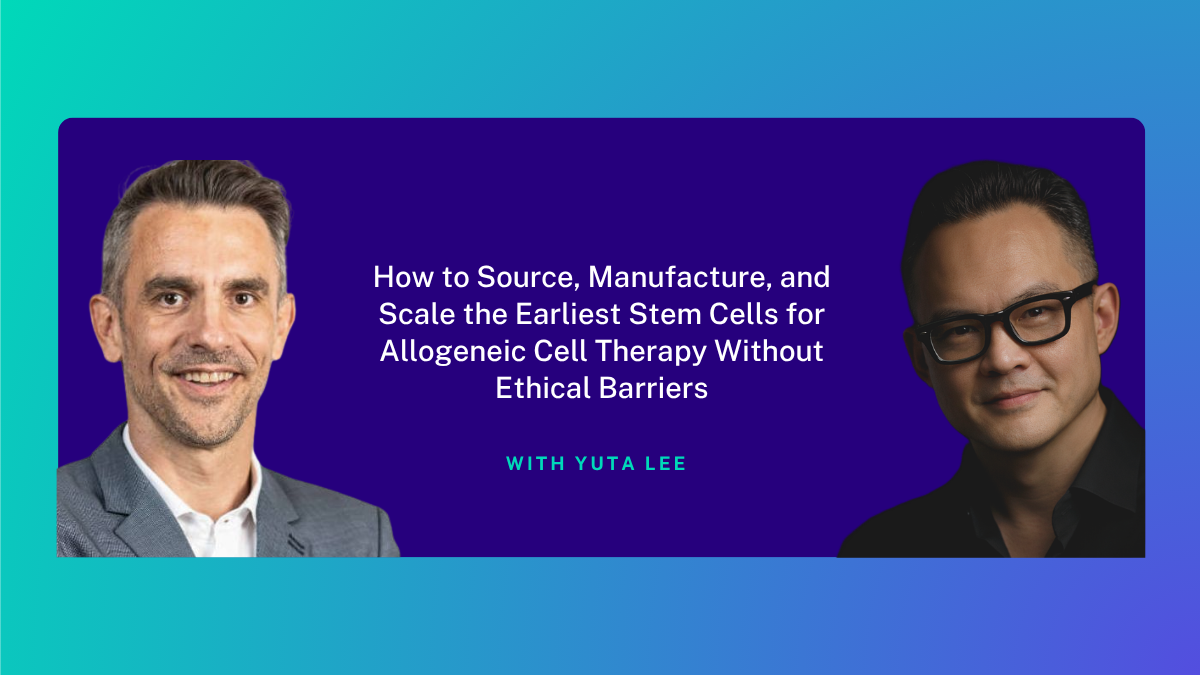
In this episode of The Smart Scientist Podcast, David Brühlmann talks with Yuta Lee, CEO of Accelerated Bio about the groundbreaking advances in stem cell technology and their potential to revolutionize healthspan and longevity.
Key Topics Discussed
- Human trophoblast stem cells are positioned as a platform not only for treating disease, but also for preventing age-related decline.
- Ethical sourcing is central to the technology, using non-viable ectopic pregnancies and only pre-placental tissue.
- Early-stage stem cells demonstrate greater programmability and differentiation potential than MSCs and iPSCs.
- Epigenetic advantages such as hypomethylation may enable faster and more efficient cell engineering.
- Youth-associated proteins and stem cell secretomes could help reduce inflammation and support tissue regeneration.
- The long-term vision is scalable preventive therapies that maintain youthful biological function before disease develops.
- Clinical trials are needed to determine whether regenerative therapies require single or repeated dosing over time.
- Cell and gene therapies are expected to replace many toxic chemical-based treatments and potentially cure major diseases in coming decades.
Episode Highlights
- The science and ethics of sourcing stem cells from ectopic pregnancies [03:02]
- Differences in differentiation potential between very early-stage cells and traditional MSCs or iPSCs [05:09]
- The origins of the research focus, driven by NIH/NIA inquiry and lessons from Stanford parabiosis studies [07:27]
- Explanation of senescent cells, inflammation, and disease connections [08:51]
- Potential therapeutic scope, from neurodegeneration to autoimmune diseases, and systemic anti-inflammatory applications [09:26]
- Vision for aging prevention—possibility of maintaining young biological age through regular secretome therapy [10:21]
- Challenges and global differences in regulation, access, and clinical adoption [12:05]
- The realistic limits and potential for reversing versus preventing age-related damage [13:20]
- The future landscape of cell and gene therapy in medicine [14:20]
- Why more investment is needed in longevity science and therapeutics [16:25]
- Practical takeaways for listeners about improving healthspan and longevity today [18:07]
In Their Words
That means now you can actually rejuvenate an old mouse purely by function of proteins coming off the blood of the young mouse. And his idea was, well, if you can do that, I wonder what happens if you take the earliest stem cells and all of the secretome or proteins coming off of it and put it towards senescent cells. Senescent cells are these cells in our body that stop dividing, but they're sitting around and refuse to die and they're putting out a lot of inflammatory messages that are now connected to a lot of aging diseases we have today. And so we went through that whole study in vitro and in vivo and we discovered that using these super early secretome, we're able to systemically downregulate all the inflammation.
How to Source, Manufacture, and Scale the Earliest Stem Cells for Allogeneic Cell Therapy Without Ethical Barriers - Part 2
David Brühlmann [00:00:46]:
Welcome back. In part one, Yuta Lee, CEO of Accelerated Bio, walked us through the foundational biology of human trophoblast style stem cells. What makes them distinctive, how they are sourced, and what their manufacturing profile enables. Now we turn to the larger ambition, aging itself. What does the science of biological decline actually tell us? And where does a stem cell platform fit into a vision that goes beyond treating disease to preventing it altogether? Let's find out.
I just like to backtrack a little bit because I mean cover quite a lot of different concepts and I just want to make sure that everybody understands. So you alluded to it during the introduction that we are getting the cells from an ectopic pregnancy. Tell us a bit more just what happens there. Why is this ethical source? Because it's still coming from a pregnancy. I want smart Biotech scientists listening to understand why this is an ethical sourcing.
Yuta Lee [00:03:02]:
That's a really, really great question. And we get asked that by everybody. Okay, so what happens is this just to repeat some of the basic stuff though. The embryo gets stuck in a fallopian tube and it'll grow until it bursts the tube. So, so if you don't perform the salpingectomy, which is a surgery to remove that mass, then the mother may die of internal bleeding. And so what happens is we get a call from the hospital that we're working with and they say, hey, a woman came in with an ectopic pregnancy. We went through the consenting process already. They signed all the forms, you can come and get it. And so we go and we wait outside the operating room and we wait for them to take it out. And so what happens is in the salpingectomy, they ablate or they burn both sides of the tube and remove the mass.
Once they remove the mass, all they have to do is scrape off the pre placental tissue and hand the rest of the mass back to a secondary, usually a pathologist who will double check the epidemic topic and throw it away. They hand us the pre placental tissue called the chorionic villi. We put it in an ice box and we take it back to our lab for processing. How we pass all of the ethical reasons are three main key points.
One, you absolutely have to perform the salpingectomy to save the mother, because if it bursts internal bleeding, the mother may die.
Two, the fetus is already non viable. So a normal embryo needs to implant by day seven, day eight, but we don't discover until four to eight weeks. So all obgyns understand the fetus to be non viable. And so all they have to do when they take it out is give it to pathologists to check and they can throw it away.
And the three, we only take the pre placental tissue. We don't even touch the rest of the embryo, the fetal part. So if you add all those threes together, we have the perfect clearance for ethics. No problems at all.
David Brühlmann [00:04:46]:
Fantastic. Yeah, this was simple and clear. And it's great that we have now such a new type of stem cells at our disposal. That solves the whole accessibility or manufacturability issue. Besides the sheer numbers, are there some other differentiation power capabilities that much earlier cells have versus MSCs or IPSCs?
Yuta Lee [00:05:09]:
Yes, they do. So I always go back to fetal development. Remember, the first eight weeks is embryonic, and then during a fetal period, what happens is the inner cell mass, which is the lump in the middle that turns into a baby, starts to divide in various types. Ectoderm, mesoderm, and endoderm. Three different layers. And each of those layers will turn into different types of cells in our body, ecto being the external part, our skin, our brain, our eyes. The endoderm is everything from our mouth to our anus, everything connected to the gut tube as endoderm. And then you have mesoderm, everything that fills in between the bones, the blood, the muscles. And so by that fetal period, all the cells dividing, differentiating. And so what you want to think about is if you're getting cells from a much later stage, that means these cells have been quite fully differentiated. But if you're getting cells from a very, very early stage, think about all of that information that's about to explode and turn into a baby. But it's still encapsulated, so it's going to be very biologically active.
Also, the differences between the cells really are all about methylation. So if you know about the epigenetic layer, so at the epigenome is the turning of the genes on and off to kind of define what that cells will turn into. And so at the early stage, they're going to be very hypomethylated. So there's not much information on it. So it's very, very primitive, very early on, so there's not much information. So as an example, if you were to take an IPSC and differentiate it into a neuron, it might take upwards of 16 days, maybe a couple of weeks or more to take out IPSC and turn it into a neuron. Our cells takes one day and one protocol step turns into a neural progenitor that is th positive. That means you tested positive for dopamine. We also can do the same thing with pancreatic progenitor cells also. One day and one protocol step. And when you put sugar on it, insulin will come out very unusual. And so that's our evidence that the earlier cells are more easily programmable. Pretty cool.
David Brühlmann [00:07:19]:
So what are now the therapeutic areas that you have in mind with your novel platform?
Yuta Lee [00:07:27]:
It was actually not my idea. It was actually the National Institute on Aging or part of the NIH. So I'm going to tell you the story, if you don't mind. So about three years ago, a researcher from the National Institute on Aging, which is part of the NIH in Baltimore, calls me up and says, Yutta, we saw one of your presentations in Seattle, and we hear that you have the earliest stem cells without any ethical issues. I said that we do. And in fact we've just done an engineering run headed towards GMP. And he says, can you send me all of your conditioned media, your spent media? So we packaged up 6 liters of spent media, we sent it to Baltimore. Then I call them up and I'm like, hey, what are you doing with this stuff? And he proceeds to tell me one of the craziest stories I've ever heard. He says, have you ever heard of the heteroconic parabiosis studies done at Stanford about 20 years ago? I said no. He goes, okay, these two researchers at Stanford took two mice and stitched them together like Siamese twins so they would have one circuit blood system, one old mouse and one young mouse. And it turns out that the old mouse is biologically getting younger and the young mouse is biologically getting older. They're like, whoa. Second experiment, they did not stitch them together but did a plasma transfer and the same thing was happening.
So what does that mean? That means now you can actually rejuvenate an old mouse purely by function of proteins coming off the blood of the young mouse. And his idea was, well, if you can do that, I wonder what happens if you take the earliest stem cells and all of the secretome or proteins coming off of it and put it towards senescent cells. Senescent cells are these cells in our body that stop dividing, but they're sitting around, refuse to die, and they're putting out a lot of inflammatory messages that are now connected to a lot of aging diseases we have today. And so we went through that whole study in vitro and in vivo and we discovered that using these super early secretome, we're able to systemically downregulate all the inflammation. So this is incredible. And so what I'm doing now is taking this material, we're going to manufacture GMP and provide it as a source material for people to go after any indication based on inflammation. So that hits on a lot of neuro diseases, it hits on a lot of autoimmune diseases. Anything that has to do with inflammation we could probably solve systemically, which is pretty cool.
David Brühlmann [00:09:50]:
How would that therapy work? Would that be a one time treatment and then it's solved
or would that be a long or several year treatment
Yuta Lee [00:09:59]:
That is to be discovered by the PIs, but we need to figure out the dosing and the frequency to do that and it takes human clinical trials to get that done. We're very, very excited about what we can do. And if you don't mind. I'm just gonna do a natal extension of that.
Unfortunately, the regulatory bodies around the world are designed around sick care. So if you don't get sick, basically no one pays to help you. I really do believe in prevention. And so in prevention, what I actually think can happen is imagine that we're sending the earliest messages from these early cel into your body that can now communicate with your existing cells to be young again, be regenerative again. And let's assume that we can either slow down, stop or reverse biological aging in your body. So this is different than your chronological age, like 54 this year, next year I'll be 55. Nothing to stop that.
But if you were to take biopsies of every organ in my body, it'll come in at a different age, at a standard deviation off of your chronological age. So we actually believe that from the parabiosis studies, the two mice being stitched together, that you can actively reverse that. So if you can do that systemically, that means imagine you were 25 and you start injecting this material as a prevention. When you're a hundred years old, you still have internal organs of a 25 year old. I believe that's the proper way to push ourselves beyond 150. That's very exciting to me.
David Brühlmann [00:11:20]:
Wow, that's exciting. What I like is, well, I'm totally on your page. We should focus a lot more on prevention. And it reminds me when I read Peter Attia's book and he said, well, we are waiting way too long until everything falls off the cliff, so we should start way earlier, whether it's cancer, whether it's diabetes, obesity and all these diseases. So I'm just thinking about this blood and the mice story and the potential of the cells. So would that mean in the near future that we would have some kind of product our disposal? We can take that as a one time dose or several dose or whatever at a regular rhythm and we would get younger or we would at least maintain our age. So how far away actually are we from that?
Yuta Lee [00:12:05]:
I think very, very soon. That's a jurisdictional issue. Meaning in the US and in Europe it's going to be a lot more strict, but in other places around the world it's probably a little more relaxed. And so we're a clinical company, so we actually want to properly do it and get it through human clinical trials and bring this product officially to the world. And so I actually think that within five years we can have this product properly made for people at the scale where everybody can afford it. So in some of my keynotes that I go out and do sometimes, what I like to say is, with our scale of the cells and how much it can grow, we're the only platform that I believe we can safely deliver this material as a prevention for everybody to use, no matter what kind of socioeconomic condition you are. And at that scale, you can drive the cost down almost nothing. And so how do we stay healthier longer and start pushing on longevity? How we can live longer? That's exciting to me.
David Brühlmann [00:12:59]:
That's definitely very exciting. And what do you think are the limits of this technology? Because you mentioned the senescent cells, they become more frequent, especially as people are aging or made some poor lifestyle choices. Could you even reverse the damage that was created, or would there still be a limit?
Yuta Lee [00:13:20]:
Somehow I actually think we can reverse a lot of damage. But what you said earlier was actually quite true, is that once your body is dysregulated, so you fall off of homeostasis, it's actually really hard to bring it back. And I have this conversation with Brian Kennedy all the time, which is one of the topical longevity scientists or aging gerontologists. So what we want to do is prevent ourselves from falling off that cliff in the first place. But I believe that whatever damage we have already done, if you start early enough, you could probably reverse it or fix it, because our bodies are actually quite resilient. We just need to give it a chance. And if you start early enough, you can probably avoid a lot of damage in your later years.
David Brühlmann [00:14:01]:
We've already talked about the future, the near future, but I'd love just to open it a bit more to get your thoughts on how you envision the future of stem cells in general. And if I may add, stem cells and cell therapy in general. What are the new technologies that are coming?
Yuta Lee [00:14:20]:
I am such a big proponent of cell and gene therapy. So there are two sides. It is you can use the cells, you can genetically fix things with gene therapy. That, to me, I think, is the most exciting field going forward in healthcare and in medicine, I think gene therapies, everybody knows, go in and fix the gene that's wrong, and you can put your body back to being normal. Cell therapies are very exciting, too. You can do replacement. You can reprogramming. Believe it or not, there are already 43 - last count that I did - cell and gene therapies already approved by the FDA. Most people don't know that.
And more and more coming literally every year for the last 200 years we've been living through an era of chemical drugs. We designed drugs to put it in our body to literally block certain protein cascades or processes so that we won't suffer the symptoms anymore. And that's been largely very, very effective. But when you use chemicals, obviously you take the hits with your kidney and your liver, because these things your body doesn't know how to deal with. So maybe that's correlated to increased liver and kidney disease. But, you know, in the new era in cell and gene therapy, I believe that we are now addressing the core problem at its root, cells are going wrong. Let's send some new ones in there to fix it. From the very beginning, if your genes are wrong from mutation and whatnot, let's go and edit it out.
These are things that we are actively seeing almost on a weekly basis, success at different clinical stages, which is, I think, going to create a lot of miracles in the next five, 10 years. And I believe that through cell and gene therapy in the next 10 to 15 years, we're going to see a lot of things properly cured, including cancers. I mean, if you think about CAR-T therapies, which is heavily engineered, so it's engineered cell therapy, I actually believe that we'll see a lot of our current diseases literally wipe off the face of the earth very, very soon.
David Brühlmann [00:16:10]:
Yeah, definitely an exciting future, especially at the pace we're moving these days. A lot of things can happen. As we are wrapping up, what is the question I should have asked?
Yuta Lee [00:16:25]:
The question that maybe you could have asked or that we actually in longevity ask all the time, is there are a lot of billionaires out there, especially today, and a lot of these billionaires would love to live forever, I'm sure, or live much longer, healthier, and they have the means to do it. So why is it that they don't put more of their assets to invest in cell and gene therapy, invest in longevity, or even invest in biotech? That, to me is a big mystery. And the reason why I think it's a mystery is because as you get older, especially if you're over 50 like me, I mean, what does beating the S&P500 for another 10, 15 years mean to you? Absolutely zero. You're going to die.
So unless you do something about it, something's going to go wrong and then you're going to die. So I would highly urge the listeners out there, especially if you have some means, pick your lane, like pick your longevity investment, pick your cell and gene therapy investment and invest in a future of our own health. I'm agnostic about it. I think as long as you pick the topics that are exciting to you or that you're particularly interested in, or maybe a disease that you have in your family lineage, that's all going to help. Because it takes, unfortunately, a lot of money to get through the FDA and the EMA in Europe. And so not only just longevity sector, but the cell and gene therapy sector. We need a lot more focused investment to come in and help. And so your health is the last thing that you can compound, so why not do that? Right? Making more money makes zero sense to me when we're so close.
David Brühlmann [00:17:55]:
Fantastic. Thank you so much for making this case, Yutta. What is the most important takeaway from our conversation you want our listeners to walk away with?
Yuta Lee [00:18:07]:
I want everybody to think about their own health span and their own longevity. I think if we do nothing on longevity, which is how long you actually live, then at least we have to make a big change to health span, how long we are healthy while we're alive. The goal is always live very healthily for a very long time and die very suddenly, because right now, on average, everybody is stuck in bed sick for nine years. And that is a very big price on the healthcare system and only the economics or even the emotional wear and tear on your family. And so we should all be thinking about that and think the easiest things to do are the lifestyle aspects. You always see a lot of influencers out there talking about it. Exercise more and eat better, sleep better. These are cheap things that you can do right now and stay healthy for at least the next five to 10 years.
And I believe that in the next 12 to 15 years, we're going to reach what we call longevity escape velocity. And that just means that you are actively reversing your age by more than one year against your chronological age. So you're technically going backwards. And if you can do that for next five years, you'll probably live another five years. And if you live those five years, there's a really good chance we'll live a very, very, very long and healthy life. So for the listeners out there, start thinking about that. Start easy, do the lifestyle changes. Be healthy, and try and live as long as you possibly can. And you know the big rule that we have in longevity? Don't get hit by a car. No matter how long you could possibly live. You walk in front of a car, you're still going to die, right? Yeah.
David Brühlmann [00:19:49]:
All right, Yuta, let's plan another podcast interview in 50 years from now. And it would be awesome to look back on all the advances.
Yuta Lee [00:19:57]:
That's right. That's very good.
David Brühlmann [00:19:59]:
Well, this has been fantastic. I love your vision. Thank you so much, Juta, for moving the needle in this very important field. Now we have stem cells that are ethically sourced and are very early and this opens so many avenues now and for greater health span and even longevity. It has been fantastic. Thank you so much for coming on the podcast today. Yuta, where can people get a hold of you, learn more about your technology?
Yuta Lee [00:20:27]:
Our website is www.acceleratedbio.com and if you search me on YouTube, if you search me on LinkedIn, you can find me and just get in touch. We are happy to work with everybody because I believe this not only just cell and gene therapy, but longevity is really a community effort and we got to try and bring more and more people into this and be aware of developments. And of course, the more people that know, the more people can stay healthier longer and be happy with their family. So that's the goal.
David Brühlmann [00:20:59]:
Excellent. Thank you so much once again. It was a huge pleasure to have you on today.
Yuta Lee [00:21:05]:
Thank you, David. It was a really, really wonderful time.
David Brühlmann [00:21:08]:
Extending healthspan is one of the most consequential scientific challenges of our time. And today's conversation gave us a grounded look at what that pursuit looks like from the inside. The biology, the strategy, and the long arc of the work. If you found this episode valuable, please leave a review on Apple Podcasts or your platform of choice. It will help other scientists like you discover the show. Thank you so much for joining, tuning in, and I'll see you next time.
Disclaimer: This transcript was generated with the assistance of artificial intelligence. While efforts have been made to ensure accuracy, it may contain errors, omissions, or misinterpretations. The text has been lightly edited and optimized for readability and flow. Please do not rely on it as a verbatim record.
Next Step
If you found value in today’s episode, take a moment to like, follow, and leave a review on Apple Podcasts or your favorite platform—it helps us reach and support more scientists like you.
Thanks for tuning in to the Smart Biotech Scientist podcast and being part of this journey toward bioprocess mastery. For more insights and practical tips, visit www.smartbiotechscientist.com.
About Yuta Lee

Yuta Lee is a biotech entrepreneur and regenerative medicine innovator leading Accelerated Bio. His company commercializes human Trophoblast Stem Cells (hTSCs), a patented platform with strong expansion capacity and natural immune privilege for next-generation cell and gene therapies targeting Parkinson’s disease, Type 1 diabetes, and healthy longevity. Yuta holds degrees from University of California, Berkeley and China Europe International Business School.

Yuta’s background combines biotechnology, business strategy, and intellectual property development, enabling him to bridge scientific innovation with commercialization. His focus is on building scalable regenerative medicine platforms that can support off-the-shelf therapies and help accelerate the transition from personalized medicine to broadly accessible longevity therapeutics.

Connect with Yuta Lee on LinkedIn.
Further Listening
If you’re interested in exploring further the concepts we touched on—such as cell therapy manufacturing, process control, and scaling living therapies—take a look at these related discussions:
Episodes 105 - 106: From Proteins to Cell Therapy: Why ATMPs Aren’t Just Complex Biologics with Oliver Kraemer
Episodes 147 - 148: Lab-Grown Blood: How Stem Cells Transform Transfusions with Ari Gargir
Episodes 179 - 180: How Mesenchymal Stromal Cells Are Transforming Care for Diabetes and Autoimmune Diseases with Lindsay Davies
Episodes 211 - 212: When the Innovator Becomes the Patient: Manufacturing Reality vs. Patient Urgency with Jesús Zurdo
David Brühlmann is a strategic advisor who helps C-level biotech leaders reduce development and manufacturing costs to make life-saving therapies accessible to more patients worldwide.
He is also a biotech technology innovation coach, technology transfer leader, and host of the Smart Biotech Scientist podcast—the go-to podcast for biotech scientists who want to master biopharma CMC development and biomanufacturing.
Hear It From The Horse’s Mouth
Want to listen to the full interview? Go to Smart Biotech Scientist Podcast.
Want to hear more? Do visit the podcast page and check out other episodes.
Do you wish to simplify your biologics drug development project? Contact Us

