
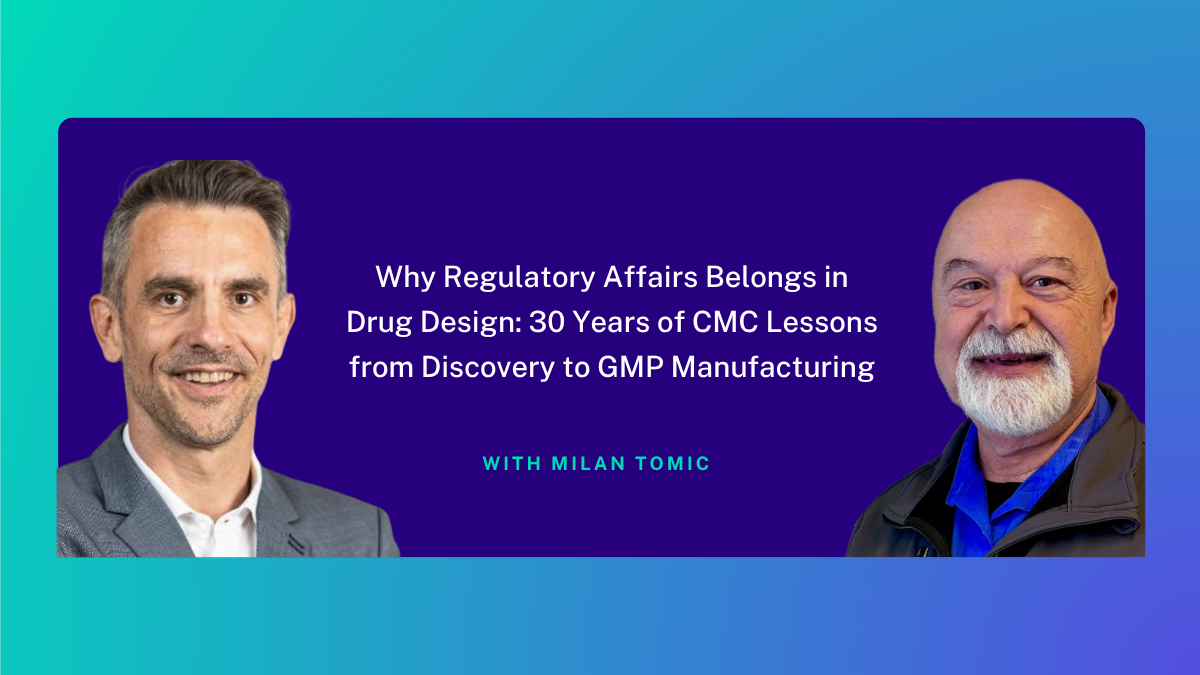
Picture the difference between a "drug" and a true "product". Hidden in that distinction is the reason so many promising therapies never reach patients. It’s not just about discovery or process—it’s about stitching together everything from regulatory wisdom to the practical realities of manufacturing, and doing it early enough to matter.
Meet Milan Tomic, a scientist whose career defies a straight line. With three decades in biotech, five antibody products shepherded from DNA to phase one, and hard-won insights building a 2,000-liter GMP manufacturing facility, Milan brings the perspective of someone who’s turned scientific curiosity into operational muscle. Now the founder of Albrem Biopharma, he’s uniquely positioned at the intersection of science, business, and execution.
Key Topics Discussed
- Early integration of regulatory and medical affairs improves drug development strategy and patient-focused outcomes.
- Milan Tomic’s biotech career spans antibody co-mixture development, GMP manufacturing, and founding Albrem.
- Regulatory affairs should function as a strategic development partner, not merely a compliance checkpoint.
- Curiosity, interdisciplinary learning, and "connecting the dots" shaped Milan Tomic’s scientific career path.
- Founding a company was driven by a desire for scientific exploration, flexibility, and integrating diverse experiences.
- Transitioning to entrepreneurship revealed the importance of salesmanship alongside scientific expertise.
- Diverse research experiences and setbacks helped broaden scientific perspective and adaptability in biotech innovation.
- Operational leadership in redesigning a 2,000L GMP facility highlighted process efficiency and manufacturing optimization.
- Successful biotech CMC strategies require scalable, GMP-ready process design aligned with investor and production expectations.
Episode Highlights
- Milan’s path from curiosity-driven research in molecular biology to biotech industry leadership [05:24]
- The importance of integrating work-life factors into career decisions, and balancing scientific depth with operational and business responsibilities [08:22]
- The unexpected role that salesmanship plays for scientists moving into entrepreneurship [10:40]
- Lessons from transitioning between scientific disciplines, including dealing with setbacks like unpublished graduate work [12:57]
- How curiosity led Milan to oversee the redesign of a 2,000-liter GMP manufacturing facility [16:16]
- Key advice for scientists on process design and scaling up, especially for those involved in CMC [20:18]
In Their Words
One of the key aspects that I would put squarely in this area is the involvement of both Regulatory Affairs and Medical Affairs. At a very early point in drug development, when I make the distinction between, "oh, here's a drug and here's a product", our desire would be to make products that are effective, that are helpful, that are meaningful in terms of patients and conditions or treatment of patients. But really understanding how to link the science to the application of the drug and where it fills the gap in what is necessary is important in the design of your drug and the design of your drug's development process.
Transcript: Why Regulatory Affairs Belongs in Drug Design: 30 Years of CMC Lessons from Discovery to GMP Manufacturing - Part 1
David Brühlmann [00:00:57]:
What does it take to bring a life-saving therapy from a research idea all the way to a patient's bedside? Few people have stood at more points along that path than Milan Tomic. He has spent 30 years in biotechnology. He developed five antibody co-mixture products from DNA through Phase 1 and worked on a 2,000-liter manufacturing facility and brought that up to EU IMP certification. Today he is building Albrem, his own company. In part one, we explore the career decisions, the pivots, and hard-won lessons that shaped that journey. Welcome, Milan, to the show. It's good to have you on today.
Milan Tomic [00:02:53]:
Thank you. I'm glad to be here. I'm looking forward to this chat.
David Brühlmann [00:02:59]:
To get us going, Milan, let me ask you this perhaps controversial question. Share something that you believe about bioprocess development that most people disagree with.
Milan Tomic [00:03:10]:
It's a very good question, and one that I had to think back through — what I have done, really where I am now, and how I approach things. I think one of the key aspects that I would put squarely in this area is the involvement of both Regulatory Affairs and Medical Affairs at a very early point in drug development. And this puts you really at a point post-discovery, when you know some of the basics of the drug and it looks like it could work. Getting an idea of really how this can be affected during the translation of your drug into an actual product is very critical. And I make the distinction between, "Oh, here's a drug and here's a product".
Our desire would be to make products that are effective, that are helpful, that are meaningful in terms of patients and conditions or treatment of patients. But really understanding how to link the science to the application of the drug and where it fills the gap in what is necessary is important in the design of your drug and the design of your drug's development process. It's one of the key aspects, I believe. What I have seen is that a lot of people put Regulatory Affairs into the compliance section, into Quality Control, or such. I do believe that both Regulatory Affairs and Medical Affairs belong more in development, more in the strategy of developing your drug for the market.
David Brühlmann [00:05:02]:
Milan, you've got an exciting career story, an exciting journey. Take us back to the beginning. What first drew you into molecular biology and biochemistry? And what were some choices that you took from the bench into increasingly senior operational and leadership roles?
Milan Tomic [00:05:24]:
It's not quite a random walk, but it is sort of, I think, if you want a catchphrase for it, a “connect the dots” kind of exploration. I really developed a curiosity about how things worked and then pursued that. And if you look at it that way, not always will you have your own path in a career or your own selection of things to do. But there are lots of things that are interesting in the overall direction that you would like to grow your scientific understanding or even your career and your personal advancement in.
And so the path in this case was more: "Oh, I studied science, I became interested in development, I became interested in gene regulation". That led to more graduate work in actual protein-DNA interactions, the actual molecular interactions. And so I really began to have an interest in that aspect of it, which actually led to my first role in terms of structurally modifying a protein at my first job in industry.
And that, of course, led to, "Gee, there are more questions and more curiosity about how a drug is actually designed or developed". And how do you do that well, and how do you do it correctly, was really a curiosity that drove my varied interests.
Surprisingly — and I think not maybe even easily discernible, at least in the beginning — was that trying to figure out how things are connected leads to advancement because you have cross-fertilization, as a lot of people like to say, and you begin to see where there are inefficiencies between different steps of drug development or process, if you want to call it that in a general sense, that can be linked.
And these improved ways, for lack of any other description, result in, "Oh well, there must be something good about what you're doing". And that results in your career advancement, and that results in you having more opportunity to do the same and have, if you will, more growth to connect the dots and develop what you're interested in. And that really is something that I would say exists at the root of it: you have to be interested in what you're doing. It'll drive a lot of your enjoyment of your work.
David Brühlmann [00:08:08]:
Is that curiosity about how things work, is this also what led you then to leave traditional leadership roles to step into a founder's role? Or how did that come about?
Milan Tomic [00:08:22]:
I think one of the important aspects — I mean, your job is your job, your work is your work. And as much as I can say that you should enjoy your work, you should have fun at your work, which I always strive for, there's also a family aspect, there is also a life aspect. And you have to be able to, at some level, integrate those.
So what could drive your job or choice or even position is really: how does your family integrate with your work and interests? And in my case it's not just family, it's location. Are you comfortable where you are? I mean, disliking the fact — and really hating the fact — that you have to drive in snow for half the year is not going to be helpful for your enjoyment in your career. I mean, not liking humidity or not liking cold or heat — those are important factors. But in any of these, choosing how you move forward is kind of a mix between what you think should be done and how that can be achieved.
My curiosity, my interest in linking things, connecting the dots, is actually what led me to this role. And I explored different aspects during my industry career. And now it came to the point where I could actually look at how some of these aspects can be integrated. And that wasn't as easy for me to find. So I wanted to do that kind of investigation, that kind of curiosity, that kind of furthering my interests, rather than go into larger management roles where my focus would be on other things — managing people or having less science in my role. I hope that answers the question.
David Brühlmann [00:10:26]:
What was the most surprising part as you were stepping into the founder role at Albrem, your own company? What were some unexpected things that happened, and what do you like about this role now?
Milan Tomic [00:10:40]:
Well, the answer would be different for different people. I think what I like about the role is what I just described in the previous question: that it allows for an integration of the kinds of concepts that I feel are important in the drug development area. And that is huge to me.
What I really didn't expect was that it requires a lot of salesmanship. Business I can understand, business I have no problem with. But salesmanship, in my mind, doesn't dive deep into the "how" of things. It is a very different skill that a lot of highly analytical people, scientists, may not have experienced. And so for me that has been a real, if you will, wake-up call that, "Wow, I can't go as deep as I'd want into every situation. I have to focus on getting the business off the ground". And that is a different responsibility driver that caused me to now work more on my salesmanship.
David Brühlmann [00:11:50]:
This is so accurate. Like you, for me running my own company was one of the biggest aha moments. Sales and selling—these are everywhere. It's just all about selling.
Milan Tomic [00:12:01]:
It is, it's pervasive in almost every part of it. And my own experience was really: let the science, the data speak for itself. Others should recognize it. And that's not a part of sales. Sales is really informing in a larger sense. That is not always as easy for someone who wanted to always look at the how. That was a wake-up moment.
David Brühlmann [00:12:29]:
Let's unpack different parts of science. You have worked on various parts of science and various areas of biotechnology. So let's go back to your postdoc work. Tell us a bit—what was the focus and what did you learn during that time about science? You alluded a bit to therapy, translating therapy into what really works, but tell us a bit more. What were specific learnings through your postdoc?
Milan Tomic [00:12:57]:
It is a difficult thing to say there were specific learnings, at least in my case. I mean, I've known people who were very directed and wanted to focus their career path very narrowly, and that wasn't so much my interest. My interest was finding generally how things worked and how they were connected.
And so when I started—and I'll go back a few years before my postdoc—when I started my work as a graduate student, I actually did want to study the interactions of DNA and proteins. And the graduate work, at least studying these things, really did let me into that area. But we got scooped, and three years of my graduate work I couldn't publish. Now, you could take that as a real crisis, but it also led me to kind of piece apart what I was doing and say, okay, well, if I can't do both—if I can't look at, for example, protein-DNA recognition and binding—I could look at DNA by itself.
So I looked at the different structural elements on its own. My graduate work was in nucleic acids and nucleic acid structure, and that led to a controversial thing that my PI was pushing. And that was good—we were able to show that those kinds of things did make a difference in the flexibility of nucleic acids.
But nucleic acids were nucleic acids—there were four repeats. Proteins were much more interesting, much more dynamic. And I got the opportunity to study protein structure in my postdoctoral work. And in a way my postdoc really was looking at that recognition, molecular interaction, in a piecemeal way.
After that, the work in proteins and analytics led to my first industry job, which fortunately for me was also in a structural protein field. What I'm trying to say is: it isn't always "I'm going to go and get this kind of work". It’s more, in my case, that curiosity and desire for deeper understanding allowed me to investigate different aspects that were also of interest to me. So I didn't lock myself into just studying proteins or just studying nucleic acids. It was more, "Let's find out about the how of this or that." They can all be very interesting.
David Brühlmann [00:15:45]:
Yeah, it seems that your curiosity was driving you to go from one thing to another and then yet another thing, and then you had another question which led you to another area of science. And I think this curiosity also led you then to what seems quite a different field, where you were involved in the design and upgrade of a 2,000-liter manufacturing facility. Tell us more about that—what happened then?
Milan Tomic [00:16:16]:
The interesting thing then was really something where you sort of have to look at that point that you brought up, which in my career has really resurfaced multiple times, and that's curiosity—finding out about the "how" of things. And when I moved from Bayer, which was more focused on factor VIII, I moved more into quality control because I was interested in how the quality aspects of the process were figuring into and driving the evolution of a drug or molecule towards being a drug, and wanted to learn more about what is involved in quality.
And prior to that particular project or work you're describing, I had the opportunity to work in QC. I worked on efficiency, product release, raw materials as well as protein product. I had a good understanding of some of the nuances that were involved in the process of drug development. Some of these were good—there were some molecules I really thought were good but failed for legal or liability reasons. Others failed because the design wasn’t efficient or didn’t find a good niche. And that was interesting. At XOMA, for example, there were also bacterial expression systems being worked on at the time that required, honestly, putting resin beads into a bioreactor, which required different impeller speeds and design. So there was a lot of process knowledge and learning while I was in quality.
That led me into quality engineering, validation, and some quality assurance functions as well. But the plant itself wasn’t efficient. And as we were entering that stage, it seemed like there weren’t people positioned to take on that role. So I raised it with management—that this could be improved, that it could be a stronger, more efficient design. And that essentially landed me in the role of rebuilding the plant. Since I had been in quality and had insight into what workflows were most efficient, and knew you needed good throughput, I had an opportunity to apply that, figure out the "how" and use that knowledge to improve the workflows and the facility itself. And that was a very interesting experience. It led to a much deeper understanding of plant design and how a manufacturing facility should actually be structured.
David Brühlmann [00:19:39]:
From this extensive experience, and probably sometimes also challenging experience as you're learning from past failures and then redesigning the factory, and also since you have later worked on bringing products into Phase 1 and Phase 2, what are some pieces of advice you can give to a smart biotech scientist listening? Some are working in smaller companies and need to figure out CMC, others are in bigger companies. But CMC is challenging. From your perspective, what are the most important aspects people should watch out for?
Milan Tomic [00:20:18]:
From a sense of product development—assuming that you've discovered the right molecule—I think the biggest thing to watch out for is the application of that product itself and the actual production of the product. So during development you have choices in how you design a process. Understanding how to make that process robust and how to really make it fit into a particular plant—and by “plant” I mean something that would allow you to produce consistent GMP material—is important. And you need to take that into the design of the molecule and into the design of the development, as much as you need to take into account the actual targeting of the drug itself. So those two working together will give you an idea of a scale process that can be really implemented, and how your drug fits into the whole thing.
That, from a new starting scientist who has a great molecule and a good idea, will give you a good position to be able to talk with your investors, partners, founders, or other collaborators in a way that you can show that it's not just "Oh, I've got something", but more that "I've got something—and it can go ahead, advance, and work to fill a necessary gap." And that will give a lot more traction to your advancement.
David Brühlmann [00:22:08]:
From a Berkeley biochemistry lab to the operational complexity of a 2,000-liter GMP facility, Milan Tomic's trajectory is a masterclass in how scientific depth and operational discipline compound over time. In Part Two, we will shift from biography to practice. We'll look into the value of cell-free protein synthesis and what it actually takes to move a promising protein candidate toward the clinic.
If this episode has been valuable, please leave a review on Apple Podcasts or your preferred platform. And thank you so much for tuning in, and I'll see you next time. For additional bioprocessing tips, visit us at smartbiotechscientist.com. Stay tuned for more inspiring biotech insights in our next episode. Until then, let's continue to smarten up biotech.
Disclaimer: This transcript was generated with the assistance of artificial intelligence. While efforts have been made to ensure accuracy, it may contain errors, omissions, or misinterpretations. The text has been lightly edited and optimized for readability and flow. Please do not rely on it as a verbatim record.
Next Step
If you found value in today’s episode, take a moment to like, follow, and leave a review on Apple Podcasts or your favorite platform—it helps us reach and support more scientists like you.
Thanks for tuning in to the Smart Biotech Scientist podcast and being part of this journey toward bioprocess mastery. For more insights and practical tips, visit www.smartbiotechscientist.com.
About Milan Tomic

Milan Tomic is a biotechnology executive with more than 30 years of experience in biopharmaceutical development, manufacturing, quality systems, and regulatory compliance. He earned his Ph.D. in Biochemistry from the University of California, Berkeley, following studies in Molecular Biology and Virology. Over his career, he has led antibody product development from DNA through Phase 1 clinical programs, managed GMP manufacturing operations, secured over $150M in U.S. government contract awards, and overseen facility design, quality engineering, and technology transfer initiatives across the biotechnology industry.

Connect with Milan Tomic on LinkedIn.
Further Listening
If you enjoyed this episode you might also like listening to:
Episodes 189 - 190 : Why Smart Biotech Founders Plan CMC First (While Competitors Burn Cash Later)
Episodes 123 - 124: Manufacturability: Why Most Protein Candidates Fail (And How to Pick Winners Early) with Susan Sharfstein
Episodes 213 - 214: From Developability to Formulation: How In Silico Methods Predict Stability Issues Before the Lab with Giuseppe Licari
Episodes 231 - 232: From IND to BLA: The Biologics CMC Decisions That Determine Regulatory Success with Henri Kornmann
David Brühlmann is a strategic advisor who helps C-level biotech leaders reduce development and manufacturing costs to make life-saving therapies accessible to more patients worldwide.
He is also a biotech technology innovation coach, technology transfer leader, and host of the Smart Biotech Scientist podcast—the go-to podcast for biotech scientists who want to master biopharma CMC development and biomanufacturing.
Hear It From The Horse’s Mouth
Want to listen to the full interview? Go to Smart Biotech Scientist Podcast.
Want to hear more? Do visit the podcast page and check out other episodes.
Do you wish to simplify your biologics drug development project? Contact Us

