
Imagine unlocking a biological sample and, instead of peering under the usual “streetlight” of targeted analysis, being able to illuminate the entire landscape of metabolites, glycans, and unknown impurities.
This episode is all about breaking the limits of current bioprocess analytics, featuring a practical journey into cryogenic infrared ion spectroscopy—technology designed to reveal what’s been invisible until now.
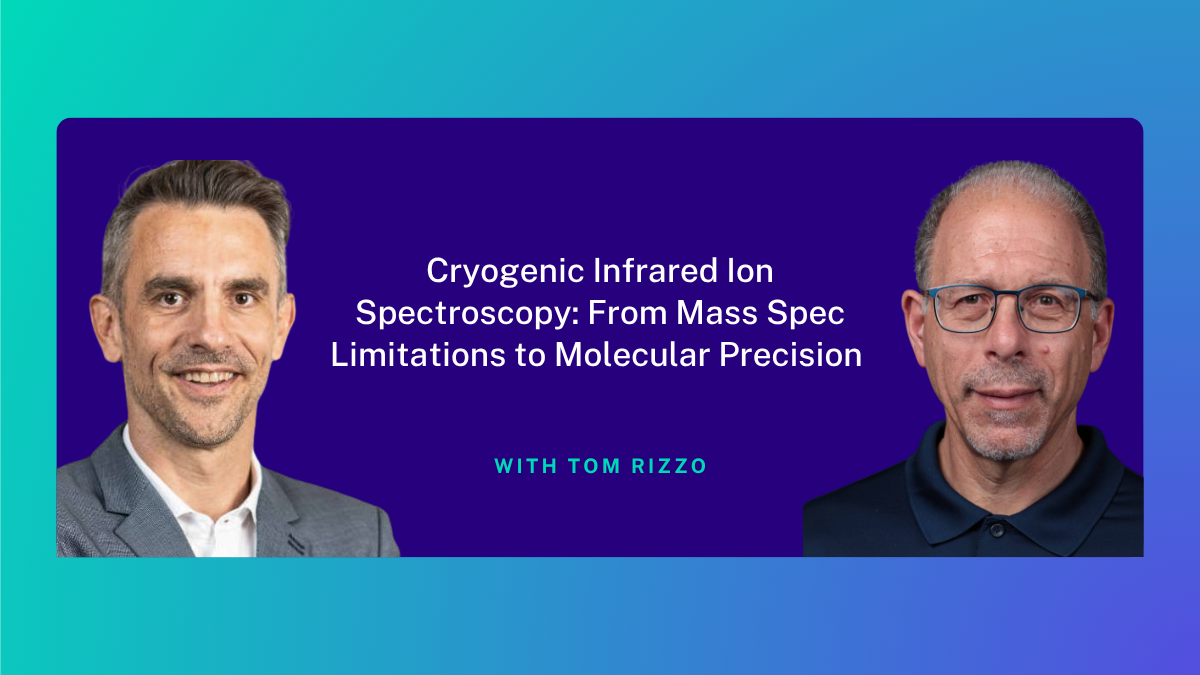
In this episode from the Smart Biotech Scientist Podcast, David Brühlmann meets Tom Rizzo, Professor Emeritus at EPFL and Co-Founder and CSO at ISOSPEC Analytics, a life science company that aims at simplifying molecular identification.
Key Topics Discussed
- Recap of cryogenic infrared ion spectroscopy and its potential for biomarker discovery and process optimization.
- The streetlight effect in science – Analogy illustrating limitations of targeted analysis and the need for broader metabolomic exploration.
- Advances in isomer-specific glycan analysis and implications for monoclonal antibody efficacy and safety.
- Unlocking deeper metabolomic insights for improved disease diagnostics.
- Building spectral libraries, using fragmentation, and applying AI and quantum chemistry for molecular identification.
- Managing data complexity and leveraging AI for better interpretation and bioprocess decision-making.
- Development of analytical services, AI-assisted platforms, and Agilent partnerships for instrument rollout.
- Tom Rizzo’s motivation to advance early disease detection and enable comprehensive biomolecular analysis.
Episode Highlights
- Practical benefits of isomer-specific glycan analysis for monoclonal antibody development [03:17]
- Expanded capabilities for disease detection and biomarker discovery—what new tech allows us to see [05:21]
- How AI, quantum chemistry, and automated library building enhance molecule identification [06:05]
- The shift from generating data to making meaningful decisions in process development, thanks to advanced analytics and AI [09:23]
- Future vision: service platform for comprehensive sample analysis and the timeline for commercial instrument availability [10:09]
- Tom Rizzo’s personal perspective on entrepreneurship after leaving academia, with advice for scientists considering a startup path [12:05]
- The importance of early diagnostics, drawing on personal experiences with cancer and leukemia [14:11]
- Technical insight into messenger tagging and high-sensitivity infrared detection [15:41)
- The main takeaway: a new data dimension that broadens molecule analysis beyond current limitations [17:55]
In Their Words
The streetlight effect goes as follows: you lose your keys in the dark, and the only place you look for them is under the streetlamp, because that’s the only place you can see. Now, you don’t know where you lost your keys, but you only look under the streetlamp because it’s dark everywhere else.
Well, you know, in the field of metabolomics, for example, one can identify only a small fraction of the total available metabolites. So what do you do? You do a targeted analysis — you look for certain metabolites, the ones that you can see. But there’s this whole 90% of them, perhaps, that you can’t see.
And so, by using this technology — where we can identify the large majority of metabolites, for example, and we believe that we can — it opens up a whole new world of investigation. Because you can look anywhere for your solution, and not only under the streetlamp.
Episode Transcript: Cryogenic Infrared Ion Spectroscopy: From Mass Spec Limitations to Molecular Precision - Part 2
David Brühlmann [00:00:53]:
Welcome to The Smart Biotech Scientist. I’m David Brühlmann, and this is part two of our conversation with Tom Rizzo, who is a Professor Emeritus at EPFL and now Chief Scientific Officer at ISOSPEC Analytics.
Last time, we covered the science behind cryogenic infrared ion spectroscopy, and today we’re getting practical — how this technology helps you discover biomarkers, identify mysterious degradation products, and accelerate process development.
We’ll also explore Tom’s transition from academia to entrepreneurship and what it takes to commercialize breakthrough technology. If you’re dealing with complex mixtures and unknown impurities — stay tuned. This is for you.
This new dimension — what will it enable scientists, companies, pharmaceutical organizations, or even biomarker researchers to do? Can we detect new molecules we weren’t able to detect before? Or will the workflow be faster?
I’ve done a lot of omics work in my career, which can be very complex. I imagine your technology could simplify that too.
Tom Rizzo [00:03:17]:
Okay, well, there are several parts to my answer on this one.
In the area of glycans, for example, there’s a real difficulty in analyzing different isomers. And we know — and there’s evidence in the scientific literature — that, for example, the glycosylation of a monoclonal antibody affects its efficacy, safety, and lifetime.
But if you can’t resolve the different isomers, you don’t know what’s responsible for that difference in efficacy. So being able to do isomer-specific glycan analysis sheds new light on the mechanisms or effects of glycosylation on efficacy.
That’s one side of things — being able to determine, down to the isomeric level, what species are adorning your protein is an important part of understanding its function and why it functions so well.
But there’s also a broader issue, particularly when you talk about different omics. Metabolomics, for example. And I like to use the analogy of the streetlight effect. Do you know what the streetlight effect is? Have you heard of this before?
David Brühlmann [00:04:18]:
No, I don’t know.
Tom Rizzo [00:04:19]:
Okay, so the streetlight effect goes as follows: you lose your keys in the dark, right? And the only place you look for them is under the streetlamp, because that’s the only place you can see. Now, you don’t know where you lost your keys, but you only look under the streetlamp because it’s dark everywhere else.
Well, you know, in the field of metabolomics, for example, one can identify only a small fraction of the total available metabolites. So what do you do? You do a targeted analysis — you look for certain metabolites, the ones that you can see. But there’s this whole 90% of them, perhaps, that you can’t see.
And so, by using this technology — where we can identify the large majority of metabolites, for example, and we believe that we can — it opens up a whole new world of investigation. Because you can look anywhere for your solution, and not only under the streetlamp.
So I think that’s an apt analogy to the situation, because current techniques can only identify such a small fraction of biological molecules — metabolites in particular.
David Brühlmann [00:05:21]:
Yeah, and I think it will open a lot of avenues in disease detection, because you’re making such a good point. If you go to the doctor, they have their program, and we’ve been measuring the same biomarkers for many years.
But now, I think with this expanded capability, we’ll be able to pick up a lot more metabolites. And on top of that, with AI, I imagine the possibilities will be endless.
So I just have a follow-up question about where you think AI will take this. And also, I think another very practical aspect is that with omics or with mass spectrometry, you usually need huge libraries to correctly identify your molecule. How does that work with your technology?
Tom Rizzo [00:06:05]:
You’re right. If you want to identify a molecule from its infrared spectrum, you need to have a library of infrared spectra — and, in fact, we have mechanisms for that.
Normally, you would think that you need a standard, and getting standards for different isomeric molecules can be extremely difficult, if not impossible. So this could potentially be a problem.
But we’ve developed techniques to interpret infrared spectra of molecules without having a standard. Here’s how it works: let me take the example of glycans, because that’s one we’ve done a lot of work on. You measure the infrared spectrum of an apparent molecule, and you find that it’s not in your database of spectra. Well, what do you do?
What we do then is fragment the molecule. We can measure the infrared spectra of the different fragments. Usually, you can find fragments that are characteristic of one isomer or another. So if you’re looking for a substitution on one branch or another branch, you break it off and then you see just that branch — not the rest of the molecule — and you can determine which species is on there.
Then, for that smaller molecule, you ask: is its infrared spectrum in our database? If it is, then you’ve identified it. And from that, you can say, “Okay, now we’ve identified the parent molecule, because we know that substitution was on this branch.”
If, after the first fragmentation, you still can’t identify the molecule, you can fragment again and measure the infrared spectrum of that smaller piece. You can continue doing that until you reach small enough species that are in our database.
Once you’ve identified the infrared spectrum of the parent molecule, you don’t have to repeat this fragmentation process — you just do it once. It’s now in your database. If, later, you have a larger molecule that fragments back to that known one, you only need to go as far as finding that fragment in the database.
So, we have a mechanism by which we grow the database from smaller species to larger species — by taking large molecules, breaking them down until we reach fragments for which we already have data. That’s the general procedure for analyzing large, more complex molecules.
Now, in the case of smaller molecules, like metabolites, we rely to some degree on computed spectra — quantum chemistry calculations. For smaller species, these calculations are actually quite accurate. That’s what helps us on the smaller end of the spectrum. And there are now AI-based techniques that enhance quantum calculations by matching them with measured infrared spectra.
So that’s one way we’ll be using AI — in combination with quantum chemistry calculations to improve the matching of computed and experimental infrared spectra.
But we also use AI in other ways. As you asked — once we get all this information about metabolites, what do we do with it? How do we use those measurements to increase our understanding of disease mechanisms?
There, we can use AI together with all this analytical information — alongside more traditional omics data — to integrate everything and help medical researchers better understand mechanisms of disease. We really think AI will help bridge the gap between analytical measurements and the understanding of disease mechanisms.
David Brühlmann [00:09:23]:
Yeah, that’s where I see both the opportunity and the challenge. I’ve had several conversations with my former boss about omics, and the question was always the same: It’s great — we’re able to generate tons of data — but it’s very difficult to draw meaningful conclusions from it.
What does it actually mean? For instance, at that time we were optimizing bioprocesses — we could see that there were changes, but what did those changes really mean? What should we change to actually make the process better?
So I think AI will definitely help us make much better decisions. My question now is: what is your vision for the technology? And as you’re combining this with AI and other technologies, where do you see this going in the next few years?
Tom Rizzo [00:10:09]:
We see it going in a couple of different directions.
One is that we’re establishing a platform that we can provide as a service — a platform to help medical researchers and pharmaceutical companies analyze biological samples with the goal of learning more about disease and understanding disease mechanisms.
So on one hand, we provide a service: people can send us samples, and we can not only give them data — not just an Excel sheet with “what’s in their sample” — but, using AI, we can also help them interpret those results. We can give them the tools to start analyzing and uncovering disease mechanisms. In other words, we would provide not just data, but a data and analytics platform equipped with AI tools to help interpret and visualize the findings.
On the other hand, we also want to put these tools directly into the hands of researchers. As I mentioned before, we’re working together with Agilent to produce a commercial instrument, allowing people to access this technology themselves and apply it in ways we might not even imagine. So we see it going in that direction.
Additionally, we have the ability to produce databases of infrared spectra using our current instruments. That means we can also offer a specialized service — developing custom spectral databases in different domains, because we have the expertise and infrastructure to do so.
David Brühlmann [00:11:28]:
When do you think this device will be available? Are we talking months, years — what’s your current timeline?
Tom Rizzo [00:11:38]:
So, we currently have a service that—
David Brühlmann [00:11:40]:
—you already offer as a service, yes.
Tom Rizzo [00:11:42]:
Exactly. We’re already working with hospitals, and we have collaborations here in Switzerland, Germany, and Belgium. But for people to actually get their hands on the instruments, it usually takes a couple of years to go from a prototype to a commercial product. An add-on module to existing instruments might become available relatively soon, but for a fully integrated instrument, I’d say we’re still a couple of years away.
David Brühlmann [00:12:05]:
Now I’d like to bridge your academic career with your current entrepreneurial career. A lot of our listeners are either in academia or they’re startup founders, so I’d love to get your take on this. You’ve seen both worlds — and the transition between them — and you’ve worked with many scientists throughout your career at EPFL.
What advice would you give to a scientist, a PhD student, or a postdoc who would now like to start his or her own company?
Tom Rizzo [00:12:37]:
As I said before, it’s a completely different world, right? And there’s a lot to learn — I’m still learning quite a bit. You really have to be passionate about what you’re doing. It’s not for the faint-hearted. Many startups just don’t make it, and one has to go in realizing that.
But from a very practical standpoint — something we’ve experienced personally — we only had about one year of overlap between my academic laboratory and the company, because of my retirement. Once you’re out on your own and no longer have that academic lab, you lose the ability to do R&D in the same way you did before.
That’s a real drawback. R&D in a startup is tough, because investors want to see how you can make money. Just doing R&D to improve your technique doesn’t generate income. If a professor spins off a startup while continuing to run an academic lab, and can do more fundamental R&D there while the company focuses on commercialization — that’s a huge advantage. Because the weight of doing R&D within a startup can be heavy.
There are also competing interests — someone might want to use the machine to understand the technology better, but at the same time, you have to deliver results for your customers. So that’s one very practical piece of advice I can offer.
David Brühlmann [00:13:52]:
Excellent. Tom, at the beginning of our conversation, you talked about legacy — about the purpose behind this new season as an entrepreneur. I’m really curious about that. You decided to start this new adventure with the company — what is giving you your sense of purpose now? And what legacy do you hope to build through this entrepreneurial chapter?
Tom Rizzo [00:14:11]:
As I look at things now, what drives me to some degree is life experience. You know, my father died of colon cancer. I’ve had friends with prostate cancer. My wife had leukemia. As you go through your career and get older, you see people — friends, colleagues — who suffer from these diseases, many of which, if diagnosed early enough, could have been treated effectively.
Fortunately, my wife’s leukemia was treated with a stem cell transplant, which was completely successful. She’s 100% in remission, and we’re deeply grateful for that. So the whole idea of early diagnostics is something that drives me. Can we find biomarkers that allow us to detect disease years before it develops?
If our technology helps in the early diagnosis of even one of these diseases, I would consider that a tremendous success. That would be a legacy worth leaving.
David Brühlmann [00:15:09]:
Wow. I love that. Very powerful. This has been great, Tom. Before we wrap up, what burning question haven’t I asked — something you’re eager to share with our biotech community?
Tom Rizzo [00:15:21]:
I think you’ve covered it pretty well, David. Offhand, I can’t think of any burning question you haven’t asked.
Actually, maybe not a burning question — but a technical one that you didn’t ask: how do we actually measure the infrared spectrum?
David Brühlmann [00:15:38]:
Oh yes, good point — tell me!
Tom Rizzo [00:15:41]:
Now, if you think about it — how can you make a technique that sensitive? Let’s consider the physics for a moment. You have a light source — maybe it emits 10¹⁷ photons per second. Let’s say you have a thousand molecules in your sample. If you try to detect absorption directly, you’re comparing 10¹⁷ photons to a change of only a thousand. That difference — 10¹⁷ minus 10³ — is effectively still 10¹⁷. So, you can’t detect the absorption of just a few molecules that way.
So how do we measure the infrared spectrum of samples inside a mass spectrometer when there are so few ions — sometimes as few as a thousand? The answer is: we use a special technique called messenger tagging. We attach a weakly bound tag — typically nitrogen (N₂) — to the molecule, because nitrogen binds weakly to ions. We then look at the mass of the molecule plus this tag.
When the molecule absorbs infrared light (at a specific vibrational frequency), that energy redistributes and causes the messenger tag to detach — or “pop off” — the molecule. We can detect that change in mass: the molecule without the nitrogen tag is lighter by 28 daltons. By measuring the ratio of tagged to untagged ions as a function of laser frequency, we can build an infrared spectrum. That’s how we achieve such high sensitivity — we’re not directly measuring photon absorption, but rather a consequence of it, which we can detect with exquisite precision. So, maybe not a burning question — but definitely one worth asking!
David Brühlmann [00:17:42]:
Wow, that’s actually really important — and fascinating! I’m glad you explained that. So, as we wrap up, Tom — what’s the most important takeaway you want our listeners to walk away with?
Tom Rizzo [00:17:55]:
I think the most important takeaway is that soon, you will no longer be restricted to analyzing only a small fraction of molecules in a biological sample.
By adding this new data dimension, we’ll be able to gain a much more comprehensive view of all the chemical changes occurring — for example, when a drug is metabolized, we’ll be able to observe all the metabolites, not just a selected few. This extra data dimension will fundamentally change how we do drug development and disease diagnostics.
David Brühlmann [00:18:33]:
Fantastic. Tom, where can people connect with you, learn more about your company, or explore your services — and maybe even get their hands on your instrument once it’s available?
Tom Rizzo [00:18:46]:
We have a website: www.isospecanalytics.com, or you can send me an email at tom@isospec.ch — that’s the simplest way to reach me.
We’re also on LinkedIn — just search for ISOSPEC Analytics. Through our website or LinkedIn, you’ll find updates and announcements — for example, when new instruments become available. We already announced our collaboration with Agilent, and we hope to share more about our next steps soon.
David Brühlmann [00:19:14]:
Well, thank you so much, Tom, for sharing your passion and purpose — and for explaining how you’re transforming the analytical space. It’s been a huge pleasure talking to you today and having you on the show.
Tom Rizzo [00:19:29]:
Well, it’s been my pleasure, David. I look forward to listening to more of your podcasts as well.
David Brühlmann [00:19:34]:
Thank you for joining me for this two-part conversation with Tom Rizzo. I hope you’re walking away with fresh insights on how advanced analytical techniques can solve real problems in bioprocess development and therapeutic characterization.
If this episode sparked ideas or answered questions you’ve been wrestling with, I’d love to hear about it. Please leave us a review on Apple Podcasts or your favorite platform.
Until next time — keep doing biotech the smart way.
Alright, smart scientists — that’s all for today on The Smart Biotech Scientist Podcast. Thank you for tuning in and joining us on your journey to bioprocess mastery. If you enjoyed this episode, please leave a review on your favorite podcast platform — it helps us reach and empower more scientists like you. For additional bioprocessing insights, visit www.bruehlmann-consulting.com. Stay tuned for more inspiring biotech discussions in our next episode. Until then — let’s continue to smarten up biotech.
Disclaimer: This transcript was generated with the assistance of artificial intelligence. While efforts have been made to ensure accuracy, it may contain errors, omissions, or misinterpretations. The text has been lightly edited and optimized for readability and flow. Please do not rely on it as a verbatim record.
Next Step
Book a free consultation to help you get started on any questions you may have about bioprocess development: https://bruehlmann-consulting.com/call
About Tom Rizzo

Tom Rizzo received his PhD in Physical Chemistry from the University of Wisconsin–Madison in 1983, following his undergraduate studies at Rensselaer Polytechnic Institute. After postdoctoral research at the University of Chicago, he joined the University of Rochester before moving to the École Polytechnique Fédérale de Lausanne (EPFL), where he became Professor of Chemistry and later served as Dean of the School of Basic Sciences.

His work focuses on integrating laser spectroscopy, ion mobility, and mass spectrometry to advance biomolecular analysis. Upon retiring from EPFL in 2023, he assumed the role of Chief Scientific Officer at ISOSPEC Analytics, a company applying his research to biomarker discovery and molecular diagnostics. His achievements have been recognized with the Bourke Award, the Ron Hites Award, and an ERC Advanced Grant, and he is a Fellow of both the American Physical Society (APS) and the American Association for the Advancement of Science (AAAS).

Connect with Tom Rizzo on LinkedIn.
David Brühlmann is a strategic advisor who helps C-level biotech leaders reduce development and manufacturing costs to make life-saving therapies accessible to more patients worldwide.
He is also a biotech technology innovation coach, technology transfer leader, and host of the Smart Biotech Scientist podcast—the go-to podcast for biotech scientists who want to master biopharma CMC development and biomanufacturing.
Hear It From The Horse’s Mouth
Want to listen to the full interview? Go to Smart Biotech Scientist Podcast.
Want to hear more? Do visit the podcast page and check out other episodes.
Do you wish to simplify your biologics drug development project? Contact Us

