
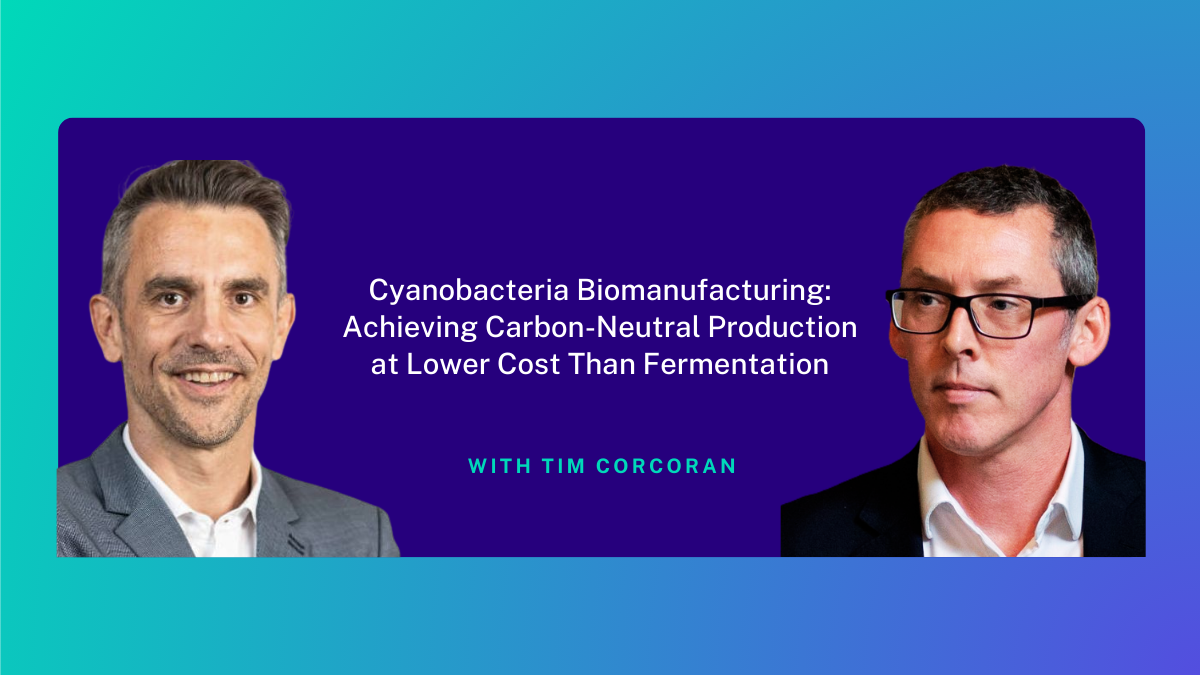
What if the ocean’s tiniest inhabitants held the secret to decarbonizing the entire chemicals industry? With mounting pressures for sustainability, biotechnology is urgently seeking efficient, eco-friendly alternatives to traditional manufacturing—and marine microbes just might be the missing link.
In this episode of Smart Biotech Scientist Podcast, David Brühlmann speaks with Tim Corcoran, CEO and Co-Founder of Deep Blue Biotech, whose unconventional path led him from a commercial background to pioneering synthetic biology with ocean-derived cyanobacteria.
Key Topics Discussed
- Tim Corcoran’s career journey and transition from commercial roles to synthetic biology
- Founding Deep Blue Biotech: motivations, co-founder collaboration, and focus on cyanobacteria
- Unique features of cyanobacteria: growth efficiency, robustness, and genetic engineering potential
- Ocean-derived products: commercial value, sustainability, and marketing advantages
- Technical comparisons of cyanobacteria vs. other microbial hosts for production
- Recent advances in cyanobacteria research and commercialization strategies
- Scale-up approaches and photobioreactor technologies for commercial production
- Business strategy and go-to-market decisions, from premium products to long-term commodity potential
Episode Highlights
- Tim Corcoran’s background in commercial roles, his pivot to biotech, and the founding story of Deep Blue Biotech [03:41]
- Overview of cyanobacteria biology: photosynthetic efficiency and its legacy in Earth's atmosphere [07:22]
- What makes the discovered ocean-based strain unique—and its advantages in robustness, growth rate, and use in personal care [08:27]
- Commercial challenges and scientific limitations that have made cyanobacteria difficult to industrialize—plus recent breakthroughs [9:38]
- Comparison with legacy hosts such as E. coli, yeast, microalgae: efficiency, feedstocks, genetic tractability, and downstream processing [11:02]
- The significance of direct secretion for lowering production costs and reducing CO₂ footprint [14:38]
- Scale-up strategies with photobioreactors: modularity, light and CO₂ management, and future tech improvements [15:17]
- Commercial strategy: starting with high-value personal care hyaluronic acid, regulatory considerations, and the rationale for this approach [17:17]
- The importance of aligning scientific innovation with market needs and early customer discovery [20:31]
- Long-term vision: potential for cyanobacteria in sustainable production of commodity chemicals like biofuels and the impact on global emissions [22:04]
In Their Words
Generally, when people think about cyanobacteria, it's often in the news for negative reasons. It's clogging up a lake somewhere. There's a loch in Northern Ireland where it seems to do that quite a lot. But actually, the things people don't realize about cyanobacteria are that they are among the most efficient photosynthetic organisms on the planet. They are the reason our planet developed a breathable atmosphere in the first place. So that was our starting point. We thought, well, that's got great potential.
And then you look at the similarities with other microbes — Escherichia coli, Streptococcus, yeast, and so on — that have been engineered to make useful products. And we think, well, can cyanobacteria do that? And the more we looked at it, the more we realized cyanobacteria could do that for a whole swathe of chemicals.
Cyanobacteria Biomanufacturing: Achieving Carbon-Neutral Production at Lower Cost Than Fermentation - Part 1
David Brühlmann [00:00:43]:
What if the ocean held the key to decarbonizing the entire chemicals industry? Today's guest spent three decades in commercial and leadership roles before discovering a remarkable microbe floating off Singapore's coast — cyanobacteria that could revolutionize how we manufacture everything from cosmetics to fuels. Tim Corcoran, CEO of Deep Blue Biotech, joins us to reveal how this marine organism secretes high-value molecules directly into seawater, why photosynthesis changes manufacturing economics, and what finally makes cyanobacteria commercially viable after years of failed attempts.
Welcome, Tim. It's good to have you on today.
Tim Corcoran [00:02:42]:
Thank you for having me.
David Brühlmann [00:02:44]:
It's a pleasure, Tim. Share something that you believe about bioprocess development that most people disagree with.
Tim Corcoran [00:02:53]:
Oh goodness. I think a lot of people view scaling bioprocesses as inherently difficult and quite off-putting. I don't think it necessarily needs to be the case. I think the technology is improving. People are learning at a tremendous pace. We personally have designed our technology specifically with scale-up in mind to make it as easy and as straightforward as possible. But certainly, when you speak to people, that is often one of the primary concerns on their minds.
David Brühlmann [00:03:22]:
Take us back into your story before we talk about the exciting science and technology you're developing. Tell us what sparked your interest in commercial and leadership. You're coming from a different background. And tell us also what led you to science and finally to the role you're currently in.
Tim Corcoran [00:03:41]:
I started off, I think when I was about 16, with my first sales job, just a summer job selling double glazing, which does not have a great reputation here in the UK, and it may well be the case elsewhere. But I realised that I quite enjoyed it and that I was competent. So when I left university, I didn't know what to do with my economic history degree. So I thought, I've been doing this through university to pay some bills, I'll carry on doing it. And then over the years that developed from sales into broader commercial and operations roles. I enjoyed looking at how businesses could commercialise, how they could grow revenues, how they could improve profits.
For a good number of years, I worked for a market research company that was dealing with innovation, specifically within the FMCG market. They were looking at what successful innovations did as case studies and why some innovations failed. And I always found that very thought-provoking. There were certain traits you saw time and time again in successful innovations. And so that informed a lot of my thinking about product development and about how you could create new things that people actually wanted and that would succeed.
I then became a business development consultant, and I was working with a lot of early-stage companies, helping them take what was often just an idea on a piece of paper and turn it into reality — helping them with investment, planning, strategy, and commercialisation. In particular, I was running a company called Master Investor at the time, working with a chap called Jim Mellon, who’s a fairly visionary investor. He's very keen on science in particular — how it can fix a lot of our problems and how you can use that to make money at the same time.
In particular, he was very interested in alternative proteins. He has a company called Agronomics — and still does — which has invested heavily in the alternative proteins market. Through him, I was exposed to a lot of really interesting companies. And it was that gradual process of thinking about innovation, thinking about how you commercialise things, talking to people who were frankly brilliant at what they did, and learning from them about how they could transform that into a living, breathing, hopefully profitable company.
David Brühlmann [00:05:42]:
What was that pivotal moment then that made you take the leap and found Deep Blue Biotech? And what was the vision behind it?
Tim Corcoran [00:05:49]:
It had been percolating away at the back of my mind for a while. I'd been working with these companies and I knew I'd been able to help them. And I thought, well, why don't I try and do it for myself?
At the same time, I have a longstanding and deep concern about climate change. I'd wanted to do something about it. I wasn't sure exactly how I could contribute, but I wanted to do something meaningful. I thought, well, if I help to commercialise climate-friendly technologies, then potentially that means I can sleep at night — I feel as though I've made a positive difference.
So I joined an accelerator — or more precisely, a venture builder programme — run by an organisation called Carbon13. They are focused on creating climate-focused companies, and they bring together technical people — scientists and engineers — and commercial people like me, essentially putting them in a room together for a three-month period to see what emerges.
That’s where I met my co-founder. He's a chemical engineer by training. He had been working as VP of Sustainable Innovation at Unilever, and he'd grown increasingly frustrated because all the sustainable ingredients and chemicals brought to him were either too expensive or not as performant as the ingredients they were already using. And Unilever weren’t going to accept that — and consumers weren’t going to accept it either. They didn’t want to pay more, and they certainly didn’t want something less effective.
So he had left, looking for a way to create a technology that could overcome that trade-off. Over the course of those three months at Carbon13, we looked at different technological options. We explored several approaches and eventually settled on cyanobacteria. And the more we looked at them, the more we thought this has huge potential.
David Brühlmann [00:07:15]:
That sounds exciting. And tell us more about these cyanobacteria and why this is an interesting host organism to work with.
Tim Corcoran [00:07:22]:
I have a tendency to get overexcited at this point, so I'll try to keep myself calm. Generally, when people think about cyanobacteria, it's often in the news for negative reasons. It’s clogging up a lake somewhere. There’s a loch in Northern Ireland where it seems to do that quite a lot.
But actually, what people don’t realise about cyanobacteria is that they are among the most efficient photosynthetic organisms on the planet. They are the reason our planet developed a breathable atmosphere in the first place. So that was our starting point. We thought, well, that’s got great potential.
And then you look at the similarities with other microbes — Escherichia coli, Streptococcus, yeast, and so on — that have been engineered to make useful products. And we think, well, can cyanobacteria do that? And the more we looked at it, the more we realised cyanobacteria could do that for a whole swathe of chemicals.
Now, traditionally, people have been held back with cyanobacteria because they grow more slowly than some of these other microbes, and the yields were often quite disappointing. So it was hard to commercialise. There was also a relative lack of scientific knowledge about cyanobacteria — the tools for genetically modifying them and the understanding of how to cultivate them efficiently were less developed.
That has changed significantly over the last few years. The strain that we're working with was discovered about five years ago, so it's a relatively recently discovered and not widely characterised strain. That does create challenges when you're trying to engineer it, because you're learning things for the first time that no one else has encountered. But equally, it has huge potential because it grows much faster than many other cyanobacterial strains. It achieves relatively high biomass productivity and has been shown to yield commercially relevant amounts of chemicals and ingredients.
So when you take that as your base chassis organism and then think, okay, how can I improve it? It holds enormous potential to finally realise what cyanobacteria can truly do.
David Brühlmann [00:09:06]:
How is that vision linked to the discovery of this cyanobacterial strain? Tell us more about that.
Tim Corcoran [00:09:11]:
Our strain of cyanobacteria is an ocean-based strain. Now, that's important because it means it tends to be more robust. It’s used to dealing with a range of different light intensities, temperatures, CO₂ concentrations, and varying nutrient levels in the ocean. Because it’s robust, it can tolerate environmental fluctuations much better. And potentially — and we're working on this at the moment — you can fine-tune its cultivation conditions to reach a point where growth and product formation are optimised.
The fact that it's an ocean-based strain also means the chemicals it produces can legitimately be described as ocean-derived. In certain industries that may not matter as much, but in personal care — which is the industry we're focused on at the moment — that matters a great deal. Consumers respond positively to ocean-derived ingredients. They may pay more for them and choose them over other alternatives. There is a clear brand and marketing advantage.
Now, our first product is hyaluronic acid. Our hyaluronic acid would be the only ocean-derived hyaluronic acid on the market. And when you speak to personal care companies about that — and we've spoken to many — that’s the point where they start to see strong commercial potential. They can envision unique products with distinctive marketing claims that justify premium pricing, grow sales, and improve profits.
At the same time, we can say: the primary carbon feedstock here is CO₂. So the process is carbon-neutral and it is potentially carbon negative if we choose our electricity sources quite carefully. And because it's such a simple mechanism, it's a very clean, efficient process. We can make these ingredients for less than you are currently paying. So that green premium I mentioned earlier, that's no longer a factor. Worries about whether or not it's effective or not are no longer a factor because it's a drop-in solution. And you've got these unique marketing claims around the ocean-derived side, and it creates quite a compelling proposition.
David Brühlmann [00:10:54]:
You definitely have a lot of unique selling points — net zero, ocean-derived — it’s compelling. Help people better understand the differences between cyanobacteria and some more established production hosts. It can get confusing quickly. We have Escherichia coli, we have moss, we have microalgae. What are the main differences?
Tim Corcoran [00:11:15]:
I guess the starting point is prokaryotes, which include Escherichia coli and cyanobacteria — organisms without a membrane-bound nucleus — versus eukaryotes, which include microalgae, moss, yeast, and essentially most multicellular organisms. Eukaryotes are fundamentally more complex. Prokaryotes are simpler, and from a genetic engineering perspective, that simplicity can be advantageous. It can also make them metabolically efficient.
So from a cyanobacteria point of view versus microalgae, for example, which are essentially very small single-cellular plants. Cyanobacteria are simpler, and that means the photosynthetic process tends to be more efficient. Because the photosynthetic process is more efficient, that conversion of CO₂ into chemicals is more efficient. So that's sort of where it lies.
Other prokaryotes like E. coli and things like that, they're not photosynthetic. Cyanobacteria are somewhat unique in being essentially photosynthetic bacteria. So they sit almost in between the two, and arguably you could create a whole separate sort of classification for them.
David Brühlmann [00:12:09]:
Besides photosynthesis and the CO₂ aspect, are there other advantages to working with cyanobacteria?
Tim Corcoran [00:12:15]:
Because the inputs are so limited, you're not feeding sugar. Take Escherichia coli as an example — it generally requires sugar-based feedstocks. Cyanobacteria use CO₂ as their carbon source and light as their energy source, which means you can potentially leverage natural sunlight. That reduces both your carbon footprint and your input costs.
Another key aspect is the cultivation medium and the resulting broth composition. Compared with organisms like Streptococcus species or E. coli, the medium is much simpler. For marine cyanobacteria, it’s essentially water with defined mineral salts. That simplicity can make downstream processing more straightforward.
It’s worth noting that Gram-negative bacteria, including cyanobacteria and E. coli, do contain lipopolysaccharides (endotoxins). However, depending on the product and application — particularly for non-parenteral uses like cosmetics — the regulatory and purification requirements are different.
Because the cultivation inputs are defined and relatively simple, and because we design the system for secretion of the target molecule into the medium, downstream processing can be highly efficient. That efficiency is a key driver in reducing our overall cost of production and improving competitiveness versus incumbent manufacturing methods.
David Brühlmann [00:13:02]:
So this leads me to this question then. What I'm hearing, Tim, is that the current strain has many advantages and significant potential. But why haven’t more people worked with cyanobacteria historically? And why does it seem that now several companies are starting to see the opportunity? Why now?
Tim Corcoran [00:13:24]:
People have been trying to make this into an industrially viable organism — or platform technology, depending on how you want to describe it — for well over a decade. Most cyanobacterial strains grow several-fold more slowly than conventional production hosts. That’s a challenge from the outset.
Then there’s titre. Even after genetic engineering, product titres were often only a small fraction of what you might achieve with Escherichia coli, Streptococcus, or yeast. That combination — slow growth and low titres — is what historically put people off.
As I mentioned, the discovery of this relatively recent strain was one of the triggers for renewed interest. It’s still not as fast as those heterotrophic microbes, but the gap is significantly reduced. That enables greater volumetric productivity. At the same time, the molecular biology toolkit for cyanobacteria has improved considerably. Genome annotation, transformation methods, promoter systems, CRISPR-based editing — these tools have matured.
We’re working with researchers such as Alastair McCormick at the University of Edinburgh, who has developed tools for more efficient genetic modification of cyanobacteria, including our strain. That makes the R&D process far more tractable. I wouldn’t say it’s easy — it isn’t — but it makes development feasible within reasonable budgets and timelines.
David Brühlmann [00:14:38]:
One advantage I see is that your product is directly secreted. When you work with E. coli, for example, you often have to lyse the cells first. That could offset slower growth rates or even lower titres.
Tim Corcoran [00:14:53]:
Definitely. Secretion into the culture medium simplifies downstream processing substantially. We estimate that it reduces cost of goods by roughly 25–35%, which is significant. It reduces the number of unit operations and simplifies purification.
It also lowers energy demand because you’re avoiding mechanical cell disruption and some of the associated clarification steps. Fewer and simpler downstream steps mean lower overall energy consumption and a reduced carbon footprint.
David Brühlmann [00:15:17]:
And how about scale-up? You need light, CO₂, temperature control. You mentioned that scale-up was built into your thinking from the beginning.
Tim Corcoran [00:15:27]:
One of the things that we liked about cyanobacteria is that they typically grow in photobioreactors, which are essentially a series of glass tubes. They're modular by nature, and that means you don't see a significant difference in performance between, say, 100 or 1,000 litres or 10,000 litres because you're just adding more glass tubes. It's more a case of scaling out than it is scaling up. Now, I don't want to minimise the challenges involved. There will always be some challenges. So as you scale up, you have to think about access to light. You've got to make sure all of the microbes are getting access to the light coming in. You've got to make sure that the temperature remains roughly consistent because again, the more light generally, the more heat you get with it. So you've got to try and keep that controlled.
And you've also got to think about the CO₂ mixing, making sure all of the cyanobacteria are getting equal access. But actually there is enormous headroom on photobioreactor development. There's some really interesting companies coming up with some unique models to tackle these things and make it more repeatable and scalable. Companies like Algenie, for example, in Australia, who are developing a helical photobioreactor for continuous production. It makes the entire process substantially more efficient. Now, we've actually not factored in these yet. We're hoping to do some testing with these new photobioreactors in the future where potentially our cost of production comes down even further because of them. In contrast to bioreactors, I think people have been investing in and developing bioreactor technology and infrastructure for a long time now, and that reached a fairly sophisticated level. I think photobioreactors will take a similar path, but they're probably 10, 20 years behind. So the headroom for improvement is really quite exciting.
David Brühlmann [00:17:02]:
Now let's talk about the business side of things. And since you have a commercial background, I'm very curious about your thinking behind what kinds of products you have chosen. And tell us, what were the reasons behind the choices and also the business choices you made?
Tim Corcoran [00:17:17]:
It's a good question. So at the time that we formed in 2023, it was around the time that money was getting quite expensive. Interest rates were going up. People weren't investing in lending money quite like they had done for the previous 10 or 20 years. So we consciously thought about how can we be profitable quickly so that we don't have to keep going back to the well? I think the days when synthetic biology companies take 10 years to develop a product that was commercially viable are gone. You won't get the time for that. The very first piece of research we did was what is our cyanobacteria predisposed to make? What chemical precursors does it contain? And there's a really long list. So that was a good starting point. It did then make a lot of work for us though, because what we had to do is take that list and combine it with market sizes and market prices, because we wanted something with a large market and ideally a high price. If it's got a high price, then we could be competitive quickly. So when you take that Venn diagram and you sort of transpose all of those different factors, there were a number of candidates in there, but the single best candidate to start with was hyaluronic acid because it's expensive. You're generally looking $2,000 per kilogram, often sometimes quite a bit more than that. The market is big and it's growing quickly.
But also the other factor was hyaluronic acid is very popular in the personal care sector where storytelling matters. Now you can use it in pharmaceuticals, for example, and sort of therapeutics, but the storytelling matters a lot less there. If you're in that sector, people just want it to work. Whereas in personal care, when you talk about the origins of the ingredient, you talk about ocean-derived, you talk about carbon neutral, that matters and that adds value to the product. People will pay to a greater or lesser extent for that.
The other factor that we like about personal care sector is from a regulatory point of view, it's much more accessible. If you want to go into pharma or food, the regulatory barriers are somewhat intimidating. They are time-consuming and they're expensive to deal with. Personal care, obviously there are regulatory barriers, particularly safety and efficacy testing and things like that. But relatively speaking, it's a shorter, less expensive process, and there is a well-trodden path for biotech-type solutions in personal care products. So all of that together, it meant that we ended up with a nigh on, as far as we were concerned, a more or less perfect business case for hyaluronic acid. We do have a list of second, third, and fourth generation products that we're going to tap into once we've got the hyaluronic acid up and running and profitable. But also as the technology improves and becomes more efficient, you can move down the value chain and tackle slightly less expensive products until hopefully you get towards the sort of the commodity end of the market. Because from an environmental perspective, that's where you'll have the biggest impact.
David Brühlmann [00:19:51]:
Your approach sounds a lot like the Tesla model where you start with the premium products to earn some money quickly and then you walk down, should I say, the value chain, or at least the cost. This is an important message. I just want to stress that again because a lot of people listening are scientists and we think about the science. Tim, you have a commercial background, so tell the scientists listening why your approach is such a game changer. What changes when you start with the premium product first?
Tim Corcoran [00:20:20]:
When you start with a premium product, it means the technology doesn't have to be perfect to go to market. You've got a far better chance of taking something which is good enough and turning it into a profitable business. Now, in the years I worked as a business development consultant, I worked with a lot of brilliant people who were fantastic at what they did, but they didn't have that commercial expertise. They didn't know how to translate that. There are people all over the place, business development consultants like me. If you're at a university, they will have entire departments dedicated to taking technical ideas and translating those. And what I would say I'd say to any scientist with an idea out there is go and speak to these people. Ask them, do you think this could work? How could it work? Because they can help you with the planning. They can help you with identifying the customers.
One of the things when I was working in innovation market research a few years ago, one of the key characteristics of successful innovation, successful new products, was understanding the market, understanding what people want. Now, that's not necessarily a job for scientists. They'll need people to help them with that. But speak to your potential customers. Understand what it is they want. I think if you go back 20 years, maybe more, companies used to come up with a new product and then try and find a way of chucking it at the market and hoping it stuck. I think in the last 10 years in particular, companies have become a lot more efficient, a lot more intelligent about it. They look at the market, they look at what the market wants, where the gaps are, and then they start on the innovation process. And they end up with products which hopefully are perfectly suited to an unmet need in the market. So that market research, customer discovery is a vital part of the process. Before you start sinking significant amounts of money into sort of the development and commercialisation, you need to understand that because that help guide your subsequent research.
David Brühlmann [00:21:55]:
And what are some commodity products you think could still be interesting, but where you have a huge ecological benefit? What are you thinking about?
Tim Corcoran [00:22:04]:
From our point of view, biofuels is an area of strong interest. Now, cyanobacteria are able to make things like butanol, for example. Now, butanol currently isn't used as a biofuel because there isn't really a clean, efficient way of making it. But actually, as a biofuel, it holds great potential because it has a far closer profile to petrol and diesel than ethanol does. So if you can make butanol in a carbon-neutral fashion, it has great potential as a biofuel. Now, the challenge is butanol is currently, it's about $2 a litre, so it's cheap. And generally speaking, people don't want to pay a huge amount more for their fuel. So the goal is to be able to make butanol efficiently. Now, the thing that the triggers for us to be able to do that, and it's somewhere in the future, but we are going to be working on it further, is we need to get the yields from the cyanobacteria up. Now, the good news is for our cyanobacteria străin, the yields that we've already got are actually looking far more promising than we ever expected. So we actually think there are multiples of what we thought were achievable are now achievable. The cost of productions are much lower than we initially expected, and the technology continues to improve.
Scaling up to deal with a biofuel to make a significant impact on the petrol market or the diesel market or something like that, that's a somewhat intimidating prospect because you think about the scale of the petrochemical industry. But if you want to replace them, you do need to be able to scale it up. So if you want to have a photobioreactor producing butanol that isn't the size of a small country, the critical points will be that yield, getting a few grams per liter, perhaps 5 to 10 grams per liter into that photobioreactor, at which point it starts to look potentially like quite an efficient way of doing it. The environmental impact is sort of absolutely mind-blowing.
David Brühlmann [00:23:46]:
We have explored why cyanobacteria's unique biology, photosynthesis, CO₂ utilization and direct secretion finally makes commercial sense. In part 2, we'll dive into the strategic decisions that separate successful synthetic biology from brilliant failures. We'll talk about choosing hyaluronic acid over commodity fuels, navigating photobioreactor scale-up, and building toward a licensing model instead of capital-intensive facilities.
All right, smart scientists, that's all for today on the Smart Biotech Scientist Podcast. Thank you for tuning in and joining us on your journey to bioprocess mastery. If you enjoyed this episode, please leave a review on Apple Podcasts or your favorite podcast platform. By doing so, we can empower more scientists like you. For additional bioprocessing tips, visit us at smartbiotechscientist.com. Stay tuned for more inspiring biotech insights in our next episode. Until then, let's continue to smarten up biotech.
Disclaimer: This transcript was generated with the assistance of artificial intelligence. While efforts have been made to ensure accuracy, it may contain errors, omissions, or misinterpretations. The text has been lightly edited and optimized for readability and flow. Please do not rely on it as a verbatim record.
Next Step
Book a free consultation to help you get started on any questions you may have about bioprocess development: https://bruehlmann-consulting.com/call
About Tim Corcoran

Tim Corcoran is the Co-Founder and CEO of Deep Blue Biotech and an experienced business development consultant with over 25 years of experience guiding start-ups and scale-ups.

He specializes in growth strategies, investor relations, and building strong partnerships that create long-term business value.

Connect with Tim Corcoran on LinkedIn.
David Brühlmann is a strategic advisor who helps C-level biotech leaders reduce development and manufacturing costs to make life-saving therapies accessible to more patients worldwide.
He is also a biotech technology innovation coach, technology transfer leader, and host of the Smart Biotech Scientist podcast—the go-to podcast for biotech scientists who want to master biopharma CMC development and biomanufacturing.
Hear It From The Horse’s Mouth
Want to listen to the full interview? Go to Smart Biotech Scientist Podcast.
Want to hear more? Do visit the podcast page and check out other episodes.
Do you wish to simplify your biologics drug development project? Contact Us

