
Across biotech labs, researchers swim in oceans of process data: sensor streams, run records, engineering logs, and still, crucial decisions get stuck in spreadsheets or scribbled into fading notebooks. The challenge isn’t having enough information—it's knowing which actions actually move the needle in cell culture productivity, process stability, and faster timelines.
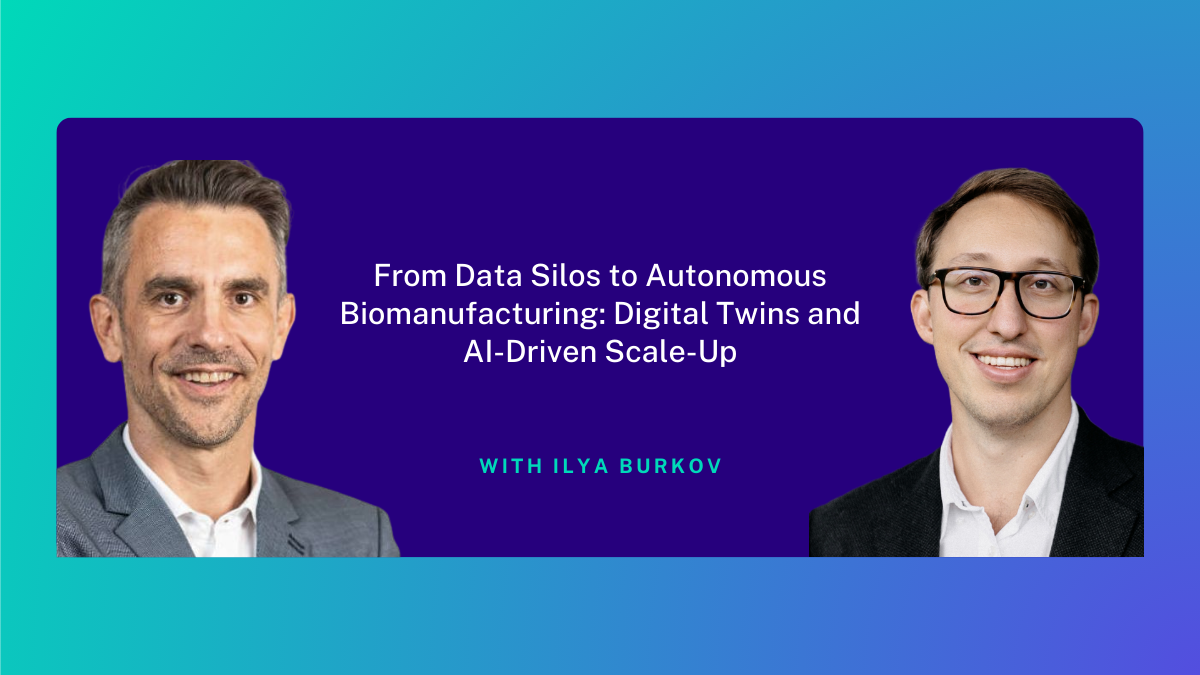
This episode, David Brühlmann brings on Ilya Burkov, Global Head of Healthcare and Life Sciences Growth at Nebius AI. With a career spanning NHS medicine, regenerative research, and cloud infrastructure, Ilya Burkov has lived the leap from microscope to server room.

He’s seen firsthand how digital twins, autonomous experimentation, and cloud-first strategies are shifting the way biologics are developed and scaled.
Key Topics Discussed
- Central debate on whether AI is a truly practical, demystifying tool for bioprocess development or simply an overhyped concept.
- The immense complexity of CMC (Chemistry, Manufacturing, and Controls) and the difficulty in deriving actionable insights from the overwhelming volume of biotech data.
- How AI unifies, structures, and leverages bioprocess data, leading to the creation of Digital Twins for real-time monitoring and process optimization.
- The tangible benefits of AI in accelerating workflow, reducing timelines in Drug Discovery (lab automation/robotics), and optimizing Cell Line and Protein Production.
- Using AI to transition from exhaustive “test everything” to efficient “test the right things,” thereby reducing failed experiments and making therapies more affordable.
- AI's critical role in predicting and preventing costly failures during Scale-Up by integrating multiscale data and enabling data-driven decisions.
- Strategies for smaller companies to manage and secure complex data using Cloud Solutions while ensuring compliance (e.g., ISO, HIPAA).
Episode Highlights
- Shifting from experimental-based to computational bioprocess development, and the evolving role of human expertise vs. AI [02:48]
- Ilya Burkov's journey from medicine and orthopedics to AI and cloud infrastructure [04:15]
- Solving data silos and making real-time decisions with digital twins and automated analytics [06:36]
- The impact of AI-driven lab automation and robotics on drug discovery timelines [08:51]
- Using AI to accelerate cell line selection, cloning, and protein sequence optimization [10:12]
- Why wet lab experimentation is still essential, and how predictive modelling can reduce failure rates [11:15]
- Reducing costs and accelerating development by leveraging AI in process screening and optimization [12:32]
- Strategies for smaller companies to effectively store and manage bioprocess data, including practical advice on cloud adoption and security [14:30]
- Application of AI and digital twins in scale-up processes, and connecting diverse data types like CFD simulations and process data [17:18]
- The ongoing need for human expertise in interpreting and qualifying data, even as machine learning advances [19:09]
In Their Words
Bioprocessing teams generate massive amounts of data, but much of it is sitting in silos or spreadsheets. Sometimes I've seen it even sitting in notebooks—paper notebooks. So I think AI changes that by creating a living model of the process. It learns from the normal behavior of a cell culture, looking at the runs that are being processed, and it starts flagging deviations before they become a problem.
A human needs a lot of training to be able to do that. So instead of reacting to data, a lot of the teams can now anticipate what's going to happen. They can start adjusting feed rates or temperatures or harvest timings in real time.
Episode Transcript: From Data Silos to Autonomous Biomanufacturing: Digital Twins and AI-Driven Scale-Up - Part 1
David Brühlmann [00:00:43]:
Welcome to the Smart Biotech Scientist. Today's episode might transform how you think about bioprocess development. I'm sitting down with Ilya Burkov, who is a Global Head of Healthcare and Life Sciences Growth at Nebius AI, who is bridging medicine, data science, and manufacturing reality. We are tackling the question every process-development scientist is asking: Can AI actually help us scale faster and smarter, or is it just a hype? From drowning in analytics data to autonomous labs running your DOEs, let's cut through the noise and find what works.
Ilya, welcome. It's good to have you on today.
Ilya Burkov [00:02:37]:
Thanks, David. It's really great to be here. Thanks for having me.
David Brühlmann [00:02:41]:
Ilya, share something that you believe about bioprocess development that most people disagree with.
Ilya Burkov [00:02:48]:
So that's a great start to the session. I think most people still think that bioprocess development is mainly an experimental science run more on batches, collecting more data, tweaking parameters, and so on. But I actually believe that it's becoming a computational science, and the best insights won’t come from just the wet lab experiments. Relying on those is no longer viable, but from smarter use of AI and simulations. That's the key to the progress and the development that's been going on.
The bioreactor of the future will be as much digital as it is physical. So a lot of people still believe that intuition and experience are what drive really great bioprocess designs. But I think that time is changing, and the new generation of models are trained on enormous biological and process datasets, and that's when they're starting to see a lot of patterns that we cannot. I believe that human expertise will continue to guide the strategy going forward, but AI will drive a lot of the execution.
David Brühlmann [00:03:53]:
Yeah, it's definitely exciting to see where the industry is going. And before we dive a bit further into this topic, let's talk about yourself, Ilya, because you have a unique background. Tell us how you started in medicine and now actually ended up in AI. That's quite a stretch, isn't it? And tell us a bit how this all came about. I'm really curious about your story.
Ilya Burkov [00:04:15]:
It's been a wild journey, David. I'm the Global Head of Healthcare and Life Sciences Growth here at Nebius, based in the UK. I've been leading the vertical for about 14 months or so. We've already seen quite incredible innovation happening over that period. It's almost like you can say there's normal time and then there's AI time—it's like dog years, if you like.
I joined Nebius with over 15 years of experience within this sector, within the healthcare and life sciences sector. Before my time in Nebius, I spent about three years at AWS Cloud Services, which was a great experience into the cloud, as they were initially the pioneers of a lot of the cloud technologies that we use today. And early on in my career, as you rightly said, I worked in the NHS in orthopaedics at Addenbrooke’s Hospital in Cambridge. I worked on biomarker identification for early disease onset, and particularly looking at things like osteoarthritis, osteoporosis, and before that I worked in regenerative medicine. I also dabbled in some biomedical engineering as well.
And kind of combining all of those things, I've always been fascinated with how biology works as a system. Messy, it's complex, but at the same time, I think it's very incredibly elegant. During my PhD, I spent hours and hours watching how small processes are changing everything. And later on, when I started working with a lot of the large-scale AI and compute infrastructure, that's when I realized that this is exactly the kind of complexity AI was built for. That, for me, was the aha moment. AI could finally let us see, predict, and really optimize biology in a way that human intuition could never do on its own.
So medicine taught me how fragile and complex life is, but technology has really been able to show me how powerful data can be. And that's what really fascinates me. And I know that AI will fundamentally reshape how we design and manufacture a lot of the biologics going forward.
David Brühlmann [00:06:10]:
We are in AI times, as you said. It's amazing. On the other hand, there is a huge challenge because now, as a bioprocess scientist, you're drowning in data. You can measure pretty much everything, you can generate a lot of data. But how do you actually make sense of this data? And how can you leverage the data you're generating to make better decisions in real time?
Ilya Burkov [00:06:36]:
Yeah, you're absolutely right. Bioprocessing teams generate massive amounts of data, but much of it is sitting in silos or spreadsheets. Sometimes I've even seen it sitting in notebooks—paper notebooks. So I think AI changes that by creating a living model of the process. It learns from the normal behavior of a cell culture, looking at the runs that are being processed, and it starts flagging deviations before they become a problem. A human needs a lot of training to be able to do that. So instead of reacting to data, a lot of the teams can now anticipate what's going to happen. They can start adjusting feed rates or temperatures or harvest timings in real time to really protect the quality and the yield.
So what's happening now is a rise of digital twins. That's something that's coming up very frequently. To put it simply, they're just AI models that mirror what's happening inside a bioreactor or a purification process in real time. They continuously learn from the sensor data and analytics. They help the operator test those what-if scenarios before even touching the actual system. That's something that no human can do at that scale, especially if there are multiple sites in question. And it's like having a virtual bioprocess engineer essentially working alongside you. They can spot the patterns, they can predict outcomes, and really suggest optimizations that a human would most likely miss.
David Brühlmann [00:08:05]:
Where do you see the most immediate value of AI in these applications?
Ilya Burkov [00:08:11]:
I think in general for optimization of these processes, but also for understanding where we can save time and effort and accelerate a lot of the workflows. So as always with most businesses: how can you save time and money with a lot of this? And if you can automate the processes and you can use the data to accurately automate them, I think that's the biggest value.
David Brühlmann [00:08:35]:
Let's look at several applications—let me say it differently, several stages of the development. If we start early on in the drug discovery, what do you see happening there and what are the key drivers of change there?
Ilya Burkov [00:08:51]:
So we're seeing the development timelines compress dramatically. Going from idea to clinical trial has been compressed. I see that AI-driven lab automation is now allowing a lot of the initial processes that have taken months to now be done in weeks, or processes that have taken years to be done in months. So reduction in those timelines. There's a lot of robotics that's being involved and included in drug discovery. It can run hundreds of small-scale experiments in parallel, while at the same time AI models learn from every run and those parameters are refined and adjusted in real time. So for me, it creates this kind of continuous feedback loop between the design, the experiment, the insights, and then essentially what you're trying to do is get that early development and get that drug to market quicker. So for me, what's happening is a convergence of robotics, AI, and very high-performance computing.
David Brühlmann [00:09:53]:
And what do you see at the next stage? Once you have a protein, you have a sequence, you need to produce that in the cell line. Do you see AI technologies come in, for instance in the vector construction, or even in the cell-line selection? What is going on in that space?
Ilya Burkov [00:10:12]:
Absolutely. So the magic lies in how fast the loop now closes. AI models are designed to improve protein sequences or cell lines, various automated systems then test them, and the results are given pretty instantly. They're fed back into that model, and every cycle—when you're looking at that—makes the algorithms a lot smarter. So instead of waiting months for manual cloning and screening and understanding, you can now iterate dozens of times in a few weeks.
And again, that saves time, that saves money, that saves the capacity of the people working on it. It's the same principle that made software development faster, just applied to biology. You don't need to do these things manually anymore. There's a lot of advancements that can be done and accelerations that can be made to amplify this.
David Brühlmann [00:10:59]:
What is your vision? I'd say—do you think we will always have a combination of in silico methods and wet lab, or do you think eventually in certain areas we will not run experiments anymore?
Ilya Burkov [00:11:15]:
I think there will always be experiments. I don't think that it's going to reduce the wet lab work. I think what it can do is reduce the number of failed wet lab experiments, so it will be able to predict which ones need to be done and run in a wet lab and which experiments don't, because it can virtually iterate a lot of the processes and say, yes, this makes sense or this does not make sense. So I would say there's always going to be a combination of analytical and computational workflows as well as wet lab work. It's just that we will have less failure rate for the wet lab because you can predict it in advance.
David Brühlmann [00:11:52]:
You mentioned that AI enables us to go much faster and this results in lower costs. And I think this is a big driver and a big need in our industry because unfortunately a lot of therapies are not accessible yet to a widespread population because of the cost. And one area where you can save also a lot of costs is in the whole process development. So if you can speed that up, if you can reduce the number of experiments, you can save a lot of money. If we focus now on the process development—the screening—a lot of companies run screening experiments, whether it's in 96 deep-well plates or it's in Ambr 15, Ambr 250. What do you think is the most powerful strategy to go about to accelerate process development?
Ilya Burkov [00:12:39]:
Yeah, that's a great question. And machine learning is changing the mindset from “test everything” to “test the right things.” It learns by looking at historical process data across multiple parameters. So in bioprocessing, looking at temperature, pH, feed strategy, yield and so on, machine learning models can predict which combinations are most likely to succeed. Instead of running hundreds of experiments, the teams might only need to focus on a few dozen to reach the same level of process confidence. And that's how you compress months of trial and error into a few targeted iterations.
So even when you're looking at every bioreactor run that produces a huge amount of data—and historically most of it has just sat in notebooks and spreadsheets—machine learning models can now capture this data across these runs, learn from the patterns, link the process parameters, and understand how that affects the outcomes and the quality. So the more data that you feed into them, the smarter they get. Meaning that the new experiments add exponentially more insights, and that results in itself into a faster, more robust process with fewer total runs.
David Brühlmann [00:13:53]:
And what would your advice be? Because I think what you're saying—that you have a lot of data sitting somewhere, even sometimes on a spreadsheet or in a notebook or somewhere—I think bigger pharma has done a lot of work in that to streamline it. But I think where it can be challenging is in the smaller company or a mid-sized company where you either don't have the expertise in-house or you just don't have the resources because you have to focus on your assets. What would be some simple strategies to store your data in the same place or in the same format, or whatever that might be, to leverage your data?
Ilya Burkov [00:14:30]:
I mean, it really depends on the workflow and what you're used to—how you handle the data, actually getting access to it. But cloud seems to be a very good answer to that because there are a number of locations that some of this information is coming from. You need to make sure that it's happening in real time. You need to have continuous understanding of what data you have access to. When you're looking at GPUs and using them as a powerful tool for a lot of this acceleration, again, doing that on-prem and in one site is a limiting factor. I'd say accelerating the typical workflows, adding the data into the cloud infrastructure that's safe and secure, would be the biggest starting point for that.
David Brühlmann [00:15:13]:
Speaking of cloud, I hear now some people probably saying, well, wait a minute, there is a security concern or we have highly sensitive data. How do you handle these kinds of objections?
Ilya Burkov [00:15:26]:
Absolutely. I mean, the same way that the data is stored securely on-site. If you work with a company like Nebius, who takes security as the starting block for everything we do—we have all of the ISO certifications necessary to adhere to the worldwide standards. We have SOC 2 Type II, we have HIPAA, we have all of the essentials for storing the data. But also we have the specific locations which are very, very secure in the sense that even the locations themselves—when they build a data center—there are standards that need to be adhered to so that if there are any fires in the nearby area or if there are any conflicts in the geography, the data center is fully secure and fully protected.
Both from environmental factors, but also risk of hacking or physically actually getting in. Those are very high-level, highly secure facilities. You can visit some of our data centers that we have around, and you'll have to get your passport out just to enter.
David Brühlmann [00:16:26]:
Now, a lot of people are talking about using AI, machine learning models, digital twins in the development space. I think a lot of people have found powerful ways to significantly reduce experimental runs and leverage data to predict outcomes. I would like to have your perspective on what comes after process development when you scale up into large scale, whether it's pilot scale or even commercial scale, because that's usually where a lot of things can go wrong if you have not done the homework. If you have well-characterized your bioreactors, usually it's almost a routine operation, but you need to put a lot of effort into that to fully understand what's going on. How do you see, at the moment, what are some powerful technologies we can use to simplify and streamline scale-up?
Ilya Burkov [00:17:18]:
Yeah, absolutely. I mean, scale-up is where biology meets economics, and it's also where a lot of the good ideas fail. I'd say that AI helps by identifying a lot of the scale-ups that are at risk before they become expensive. Model training on multiscale data from lab, pilot, or production runs can predict how parameters like mixing, oxygen transfer, or shear stress will change at larger volumes. That lets teams adjust the process early rather than discovering issues after investing millions into a new bioreactor suite or whatever workload they have.
Every process run leaves digital fingerprints — how the cells respond, what conditions caused drift, or what correlated with yield. AI can be used to connect those dots across scales and really understand what makes a process stable or fragile. And when you scale up, you're not guessing; you're building on a data-driven, very good understanding of what actually drives consistency. That is the difference between hoping a process scales and factually, with data, knowing that it will. I think that's key.
David Brühlmann [00:18:35]:
Have you seen case studies where, for instance, companies combine different kinds of data? Let's say people are doing CFD simulations, and then you have process data, you have more engineering data. How does AI facilitate that? Because I think AI is pretty good at connecting the dots between various data sets and very diverse things. What are you seeing there?
Ilya Burkov [00:18:59]:
Yeah, absolutely. AI is very good at doing very targeted workloads, and it's up to the human to connect those outputs from individual workloads. It's not going to do something for you unless it's trained to do that. So, as you said, if you're looking at one process, you find the results; you look at the next process, you find the results. The human is then in the loop to understand which direction we need to take, which information we feed back from one process to another, and how we can combine that. AI is not going to do it for you — there's no AI button. It's just going to help you do that workload faster.
You can have all of those records, you can have all those process deviations, everything in place. Generative AI is transforming how a lot of these companies make sense of the data. They can look through PDFs in real time, they can look at spreadsheets or handwritten logs. But it's the person, the scientist, who can qualify and quantify that just to make sure they're heading in the right direction. I think that's the best way to explain it in terms of efficiency and workflow. There's a lot of historical data that needs to be analyzed, and without having the person in the loop, there's no efficiency in that.
David Brühlmann [00:20:08]:
That's where we'll pause our conversation with Ilya Burkov. We've explored how AI is moving from buzzword to bioprocessing tool, helping you make sense of mountains of data, optimize upstream and downstream operations, and slash development timelines through autonomous experimentation. In Part Two, we'll tackle where you should store your data and what the factory of the future actually looks like. If this resonated with you, leave a review on Apple Podcasts or your favorite platform. It helps fellow scientists like you discover these conversations. See you next time.
For additional bioprocessing tips, visit us at www.bruehlmann-consulting.com. Stay tuned for more inspiring biotech insights in our next episode. Until then, let's continue to smarten up biotech.
Disclaimer: This transcript was generated with the assistance of artificial intelligence. While efforts have been made to ensure accuracy, it may contain errors, omissions, or misinterpretations. The text has been lightly edited and optimized for readability and flow. Please do not rely on it as a verbatim record.
Next Step
Book a free consultation to help you get started on any questions you may have about bioprocess development: https://bruehlmann-consulting.com/call
About Ilya Burkov

Ilya Burkov, Global Head of Healthcare and Life Sciences Growth at Nebius AI, is a pivotal leader driving cloud adoption across EMEA. With a PhD in Medicine and 8+ years of industry experience, he specializes in executing complex projects that deliver measurable value.

Ilya has a successful track record of maximizing profit, managing large-scale contracts, and building strong relationships with C-level stakeholders, fueled by a passion for innovation and transformation in healthcare and life science.

Connect with Ilya Burkov on LinkedIn.
David Brühlmann is a strategic advisor who helps C-level biotech leaders reduce development and manufacturing costs to make life-saving therapies accessible to more patients worldwide.
He is also a biotech technology innovation coach, technology transfer leader, and host of the Smart Biotech Scientist podcast—the go-to podcast for biotech scientists who want to master biopharma CMC development and biomanufacturing.
Hear It From The Horse’s Mouth
Want to listen to the full interview? Go to Smart Biotech Scientist Podcast.
Want to hear more? Do visit the podcast page and check out other episodes.
Do you wish to simplify your biologics drug development project? Contact Us

