
For many biotech innovators, high throughput screening platforms promise faster discoveries and streamlined workflows. Yet beneath the glossy veneer, the reality often feels more complicated—requiring hands-on expertise, careful assay design, and a sharp understanding of microbial physiology just to avoid costly missteps.
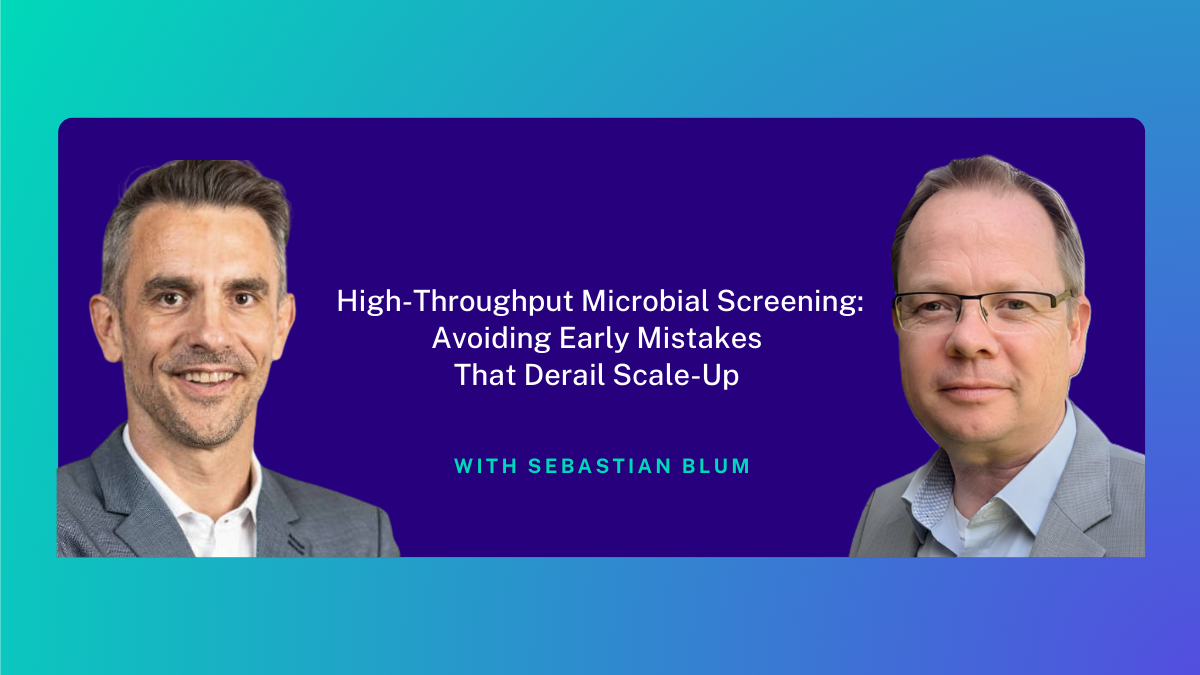
Smart Biotech Scientist Podcast host David Brühlmann is joined by Sebastian Blum, a microbiologist with more than two decades in the life sciences and now Market Development Manager at Beckman Coulter Life Sciences.
Key Topics Discussed
- Comparison of shake flasks, benchtop reactors, and high-throughput platforms, with guidance on choosing the right tool.
- High-throughput screening and automation require deep biological understanding, assay development, and specialized personnel.
- Misconceptions about automation: it simplifies tasks but does not replace expertise or experimental design.
- Practical use of the BioLector XT Microbioreactor includes tailored consultations, technical preparation, and handling unique process conditions.
- BioLector XT Microbioreactor excels in flexible process development, parameter screening, and scalable modular upgrades.
- Placement in workflow: primarily used in upstream development for strain selection, media optimization, and culture setup.
- Common challenges include overestimating simplicity, underinvesting in bioinformatics, and risks from poor experimental design.
- Future trends: automation, miniaturization, AI-driven modeling, digital twins, and continued emphasis on core bioprocess engineering principles.
Episode Highlights
- Practical advice for startups considering systems like the BioLector XT Microbioreactor, including the need for technical expertise and tailored applications [02:34]
- Scenarios where the BioLector XT Microbioreactor is the best fit (flexibility, multiple microorganisms, modular upgrades) [04:22]
- The most common mistakes scientists make with screening technologies, and why specialized personnel are still essential [06:45]
- How automation, robotics, and AI are shaping the future of early-stage bioprocess development, and why core engineering principles remain vital [08:14]
- Tips for evaluating screening tool placement in your process and aligning technology with your application needs [11:13]
- Resources for further learning about BioLector XT Microbioreactor [12:43]
In Their Words
Some believe that high-throughput screening is a kind of black box, where you throw a sample in and it spits out the perfect hits. And automation is often misunderstood as synonymous with simplicity. The reality is, high-throughput screening is highly complex. It requires very careful assay development and validation, a deep understanding of the biology, precise robot programming, and sophisticated data analysis. The system must be calibrated, maintained, and constantly monitored. Misunderstanding this can lead to suboptimal decisions, especially when the team believes it’s “just pushing a button” and underestimates the need for highly specialized personnel.
Episode Transcript: High-Throughput Microbial Screening: Avoiding Early Mistakes That Derail Scale-Up - Part 2
David Brühlmann [00:00:38]:
Welcome back to Part Two with Sebastian Blum from Beckman Coulter Life Sciences. We’re continuing our conversation on mastering early-stage bioprocess development. Here is Part One of our conversation. We’re talking about practical guidance on choosing between shake flasks, benchtop bioreactors, and high-throughput platforms, and understanding when each approach makes sense for your specific application. We’re also covering the common pitfalls that trip up even experienced teams and how to avoid them. Thanks to Beckman Coulter Life Sciences for making this episode possible. If you want to make smarter screening decisions and save months of troubleshooting, this episode is for you. Let’s dive back in.
What would you tell a startup founder who says, “Well, I’m interested in the BioLector XT Microbioreactor because the system looks great. We can test a lot of things and move quickly,” as many startups want to do. But from your answer, Sebastian, it seems you also need some technical background to use the system correctly. Would you advise for, against, or under what conditions would you say no? This makes sense. You will get the most out of using a BioLector XT Microbioreactor.
Sebastian Blum [00:03:04]:
Normally, when a customer comes to us, or we approach a customer, we talk intensively about their applications. Just as an example, we had one academic customer who wanted to do strictly anaerobic cultivations with a very low OD—starting at 0.x and wanting to induce at 0.x. When we recognized this, we saw that it didn’t match the BioLector XT Microbioreactor specifications, which work from OD 1 up to, let’s say, the sky is the limit because of the scattered light measurement.
We try to understand how important this is for the customer. When he told us it was essential for his process, we said, “Okay, then the BioLector XT Microbioreactor is the choice for him.” So this can happen, but it’s application-dependent.
LUA scripting is not often used in academia. Interestingly, it’s more common in industry, where you might want to combine different feeding modes in one run to mimic larger fermenters, which may switch from exponential to linear or constant feeds. This is possible with LUA scripting, but it does not happen too often. Of course, if customers ask for it, the solution is there. If they cannot handle LUA scripting themselves, we can do it for them. This is normally not a showstopper.
David Brühlmann [00:04:22]:
So what are the scenarios in which it makes the most sense to use the BioLector XT Microbioreactor?
Sebastian Blum [00:04:28]:
I would say anything related to process development, like finding the right parameter combinations—media, pH, induction, induction profiling—and where there’s a need for flexibility across different microorganisms. For example, CDMOs need to be very flexible because they serve multiple clients with different microorganisms and applications.
The BioLector XT Microbioreactor is a very good fit, especially because we can upgrade modules depending on the application. For instance, a customer can start with a simple batch system, then upgrade to a microfluidic system to allow feeding and pH control for up to 32 wells. If the customer requires an anaerobic application, the system can be upgraded with an anaerobic module to perform feeding and pH control under strictly anaerobic conditions.
If offline analytics are needed, the whole system can be integrated with a Beckman Coulter Life Sciences Biomek i5 or i7 workstation to leverage full automation advantages.
So, if a customer needs flexibility, is screening a lot of parameters, and is trying to find the best conditions, that’s where the BioLector XT Microbioreactor excels.
David Brühlmann [00:05:54]:
So that means it’s particularly suited for early-stage screening, correct?
Sebastian Blum [00:05:58]:
Yes, exactly. That accounts for 99% of our systems, placed in upstream development for early R&D screening.
David Brühlmann [00:06:06]:
Speaking of automation and Biomek, where do you see companies typically place the BioLector XT Microbioreactor in their workflow?
Sebastian Blum [00:06:13]:
As I mentioned before, there’s upstream development, downstream development, and finished production. Typically, we see the system used only in upstream development. That’s where you do strain development, identify the best media, and set up initial culture conditions for optimal growth and productivity.
David Brühlmann [00:06:35]:
What are the most common misconceptions you see in scientists who want to acquire a BioLector XT Microbioreactor or already have one? From what we’ve discussed, it’s a powerful tool. You can do a lot of things, but sometimes it's also about managing expectations and helping people use the technology best. What misconceptions do scientists generally have about high-throughput screening systems?
Sebastian Blum [00:07:02]:
Some believe that high-throughput screening is a black box—you put a sample in, and it spits out perfect hits. Automation is often misunderstood as synonymous with simplicity. The reality is, high-throughput screening is highly complex. It requires careful assay development and validation, a deep understanding of the biology, precise robot programming, and sophisticated data analysis.
The system must be calibrated, maintained, and constantly monitored. Misunderstanding this can lead to suboptimal decisions. When teams think it’s “just pushing a button,” they underestimate the need for highly specialized personnel.
As a result, they might underinvest in assay development or bioinformatics expertise, leading to poorly designed assays, unreliable data, high error rates (false positives or negatives), and ultimately a loss of valuable time and resources because results cannot be interpreted or reproduced.
So the “black box” idea is a misconception. It’s not that simple—you can’t just put something in and automatically get the perfect hit.
David Brühlmann [00:08:02]:
This is very well said. I’ve done a lot of deep-well plate experiments in my career, and understanding the process side and analytics is just as important. Thank you for highlighting this, Sebastian.
Looking ahead, with more technology on our end—robotics, automation, and now AI—I’m curious about your perspective. How do you see early-stage bioprocess development evolving in the future?
Sebastian Blum [00:08:34]:
What I see is more automation and miniaturization. There's a clear tendency in this direction. So we are going to see even higher throughput, more sophisticated microbioreactor systems, and a lot more integration of robots for end-to-end automation workflows—from media preparation all the way to sample analyzers. AI is the buzzword, and you see it at every conference at the moment as well.
The huge amounts of data that high-throughput screening generates will increasingly be used with artificial intelligence (AI) and machine learning (ML) for predictive modeling—really fast identification of optimal conditions and a much deeper understanding of the mechanisms at play. It’s going to move beyond just finding what works to understanding why it works. So I see a lot of potential for AI, and that trend is clearly moving in this direction.
What I see as well, especially in larger industries, is more use of digital twins and process simulations. We can expect the development of more robust in silico models, basically digital twins of bioprocesses. That will let scientists simulate thousands of scenarios virtually before they even perform a physical experiment, which will speed up optimization even more. I think that’s still somewhat the future, but I see that customers are already discussing this idea and goal.
I still think some skills will always remain critical—the core bioprocess engineering principles. You still need a fundamental understanding of microbial physiology, cell biology, fluid dynamics, mass transfer, and reaction kinetics. The tools might change, but those underlying biological and engineering principles are constant, in my opinion.
Of course, you also need critical thinking and problem-solving skills—the ability to evaluate data critically, identify the root causes of problems, and design robust experiments. These will always be at the heart of successful development.
David Brühlmann [00:10:24]:
Before we wrap up, Sebastian, what burning question haven’t I asked that you’re eager to share with our biotech community?
Sebastian Blum [00:10:33]:
Honestly, David, your questions have been very good. I’ve also watched your podcast in the past and was impressed by the spectrum you cover. In my opinion, everything relevant was discussed here. I really appreciate your questions and the podcast—thank you for having me.
David Brühlmann [00:10:52]:
Great. Thank you very much for the feedback—it’s always wonderful to hear directly from our guests.
David Brühlmann [00:10:58]:
By the way, if you have feedback about the Smart Biotech Scientist Podcast, please leave a review. This means the world to me. Sebastian, what is the most important takeaway from our conversation?
Sebastian Blum [00:11:13]:
In my opinion, it’s to carefully consider where to implement high-throughput screening tools in your process and evaluate the need and advantages for your specific application. I hope I’ve highlighted the possibilities that customers have by using the BioLector XT Microbioreactor. Above all, I encourage people to stay curious, stay critical, and choose the right tool for the right job.
David Brühlmann [00:11:45]:
Fantastic, Sebastian. Thank you for helping us understand the key success principles for early-stage screening and sharing your insights. Where can people learn more about the BioLector XT Microbioreactor and get in touch with you?
Sebastian Blum [00:12:00]:
The Beckman Coulter Life Sciences website has a lot of information about the BioLector XT Microbioreactor, including publication lists, application notes, and a gallery showing how the system works. There’s also a small training section. If someone is interested in Europe, I’m available as the Market Development Manager to guide them as needed.
David Brühlmann [00:12:29]:
Excellent. I’ll include that info in the show notes. Once again, thank you very much, Sebastian, for being on the show today.
Sebastian Blum [00:12:37]:
David, it was a pleasure. Thank you.
David Brühlmann [00:12:40]:
Thanks for joining us today for this deep dive into bioprocess screening strategy. Remember the right early stage decisions, save months of troubleshooting downstream. If today's conversation gave you actionable insights for your own development work, please leave us a review on Apple Podcasts or whatever platform you're listening on. It truly makes a difference. Thank you so much for your feedback. I love hearing from you. And until next time, keep doing biotech the smart way.
All right, smart scientists, that’s all for today on the Smart Biotech Scientist Podcast. Thank you for tuning in and joining us on your journey to bioprocess mastery. For additional tips, visit www.bruehlmann-consulting.com. Stay tuned for more inspiring biotech insights in the next episode. Until then, let’s continue to smarten up biotech.
Disclaimer: This transcript was generated with the assistance of artificial intelligence. While efforts have been made to ensure accuracy, it may contain errors, omissions, or misinterpretations. The text has been lightly edited and optimized for readability and flow. Please do not rely on it as a verbatim record.
Next Step
Book a free consultation to help you get started on any questions you may have about bioprocess development: https://bruehlmann-consulting.com/call
About Sebastian Blum

Sebastian Blum has spent over two decades in the life sciences industry, with a background in biology and microbiology. He is currently Market Development Manager at Beckman Coulter Life Sciences, focusing on high-throughput screening technologies for bioprocess development.

In 2010, he discovered an innovative micro-fermentation system that sparked his interest in transforming early bioprocess workflows. Motivated by strong researcher feedback, he joined m2p-labs in 2011 to help advance the technology.  Following the acquisition of m2p-labs by Beckman Coulter Life Sciences, Sebastian embraced the opportunity to continue the journey within a global organization.

Connect with Sebastian Blum on LinkedIn.
David Brühlmann is a strategic advisor who helps C-level biotech leaders reduce development and manufacturing costs to make life-saving therapies accessible to more patients worldwide.
He is also a biotech technology innovation coach, technology transfer leader, and host of the Smart Biotech Scientist podcast—the go-to podcast for biotech scientists who want to master biopharma CMC development and biomanufacturing.
Hear It From The Horse’s Mouth
Want to listen to the full interview? Go to Smart Biotech Scientist Podcast.
Want to hear more? Do visit the podcast page and check out other episodes.
Do you wish to simplify your biologics drug development project? Contact Us

