
Bioprocess development has always been slowed down by legacy assumptions: big stainless-steel bioreactors, endless timelines, and the belief that complex therapeutics can only be produced in closed systems.
But what if you could grow life-saving antibodies in a greenhouse instead?
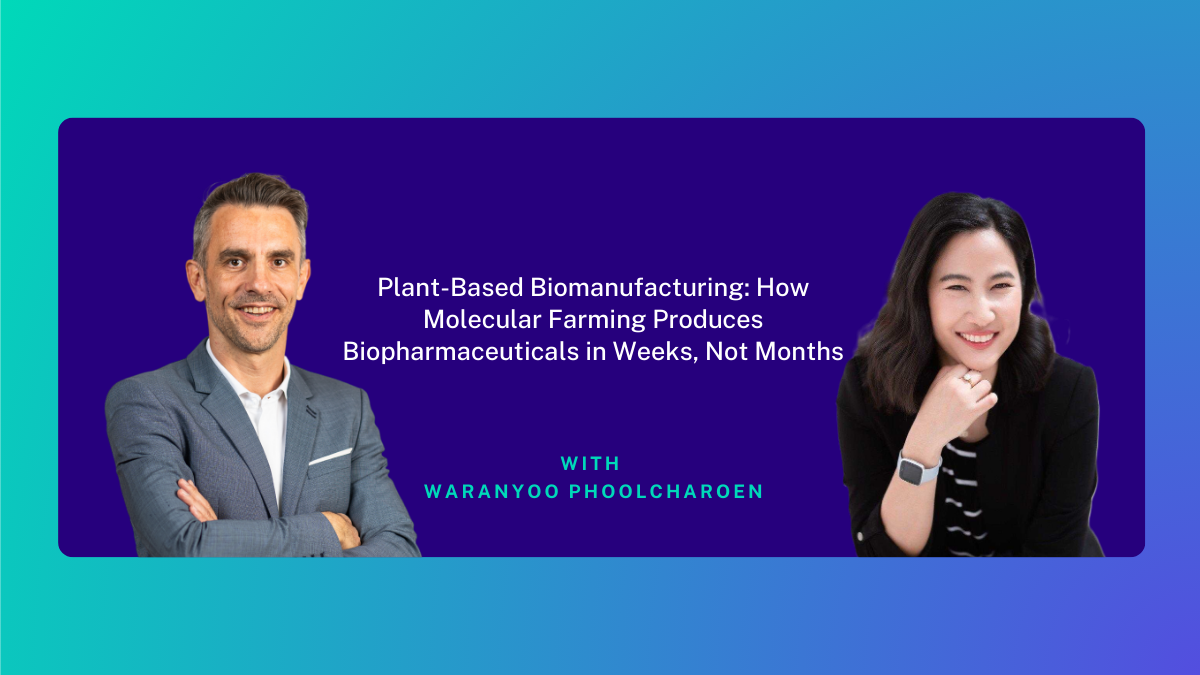
Today's guest on Smart Biotech Scientist Podcast with David Brühlmann is Waranyoo Phoolcharoen, co-founder of Baiya Phytopharm in Thailand, a pioneer in molecular farming—turning plants into agile biofactories for recombinant proteins, vaccines, and antibody therapeutics.
Key Topics Discussed
- Waranyoo Phoolcharoen’s unexpected path into plant biotechnology and his pioneering work in plant-based biopharmaceuticals.
- How early bioprocess planning can significantly accelerate development and improve scalability.
- The advantages of molecular farming compared with traditional biopharmaceutical manufacturing.
- How scholarships and ethical motivations shaped Waranyoo’s academic journey toward plant biotechnology.
- The transition from academia to entrepreneurship to create real-world impact beyond publications.
- Using whole plants like Nicotiana benthamiana as scalable biofactories for biologic production.
- Mindset shifts scientists must make when building commercially viable biotech companies.
- Opportunities and challenges shaping the biotechnology landscape in Southeast Asia.
Episode Highlights
- Waranyoo Phoolcharoen's personal journey: from an accidental start in plant biotechnology to making a global impact with molecular farming [03:57]
- The pivotal moment that shifted her focus from publishing papers to translating research into real-world solutions [06:12]
- The initial steps and uncertainties of co-founding Baiya Phytopharm in Thailand [07:12]
- How 'the plant of life' philosophy drives their biopharma platform, and why whole plants (not just cell cultures) are used as biofactories [9:56]
- Key mindset shifts when transitioning from academia to entrepreneurship, including the importance of teamwork and commercial thinking [12:55]
- Strategies for making impact-driven biotech startups in resource-constrained environments, and why courage and speed matter [15:50]
- Insights into the biotech and pharmaceutical landscape in Southeast Asia, including opportunities and challenges for innovators [19:27]
In Their Words
I came across a scientific paper on molecular farming, which is the idea of using plant to produce pharmaceutical proteins. Then I think at that time, I just realized from the paper that, oh, plants is not just sources of food or raw material, but we can use it as efficient biological system to produce so many things. They grow using sunlight, water, and time. They naturally produce complex molecules. So I began to question why are we relying on expensive control industrial system, big fermenter to make medicine if this plant can produce those kind of things as well?
Plant-Based Biomanufacturing: How Molecular Farming Produces Biopharmaceuticals in Weeks, Not Months - Part 1
David Brühlmann [00:00:35]:
What if you could grow life-saving antibodies in a greenhouse instead of stainless steel bioreactors? Professor Waranyoo Phoolcharoen spent years pioneering molecular farming, which means turning plants into biofactories for rabies treatment and COVID vaccines, before co-founding Baiya Phytopharm in Thailand. Today she reveals how her platform produces biopharmaceuticals in weeks instead of months and why Southeast Asia's biotech landscape offers unique advantages, and what pivotal moment pushed her from publishing research to building a clinical-stage company that's redefining pandemic preparedness. Welcome, Waranyoo Phoolcharoen, to the podcast. It's great to have you on today.
Waranyoo Phoolcharoen [00:02:36]:
Hello. Thank you very much.
David Brühlmann [00:02:38]:
Waranyoo, share something that you believe about bioprocess development that most people disagree with?
Waranyoo Phoolcharoen [00:02:46]:
If we think about bioprocess development, one thing that people disagree on is that bioprocess development does not have to take a long time. I think timing is quite important, which is something people often consider, especially for pharmaceutical bioprocess development. This idea likely stems from traditional technology. From my experience with molecular farming and bioprocess development, if you start thinking about the process early—considering manufacturer scalability and downstream constraints from day one—then that should shorten the timeline. I believe the real challenge is not that bioprocess development is inherently slow, but rather that we often treat it as though it must be slow.
David Brühlmann [00:03:37]:
I'm looking forward to this discussion today because you're making a very good point, and we need to find ways to accelerate process development. So take us back to the beginning; what sparked your passion for plant biotechnology, and what were some pivotal moments along your journey?
Waranyoo Phoolcharoen [00:03:57]:
That's a very interesting question. I did not plan to work in plant biotechnology at all. I completed my undergraduate and master's degrees in Thailand. I was interested in science in general; like other students, I just enjoyed learning, but I did not have a clear passion or long-term vision for my career. The real turning point came later during my PhD when I received a scholarship from the Thai government to pursue my PhD in plant biotechnology at Arizona State University. It was not necessarily because this was my dream; rather, it was a requirement of the scholarship.
At the same time, I knew that upon returning to Thailand, I would have to teach at the Faculty of Pharmaceutical Sciences due to this scholarship. I began asking myself the ethical question: what should I focus on to connect plant biotechnology with pharmaceutical science and medicine? With this question in mind, I began to read and search for more research publications. And I came across a scientific paper on molecular farming, which is the idea of using plant to produce pharmaceutical proteins. Then I think at that time, I just realized from the paper that, oh, plants is not just sources of food or raw material, but we can use it as efficient biological system to produce so many things. They grow using sunlight, water, and time. They naturally produce complex molecules.
So I began to question why are we relying on expensive control industrial system, big fermenter to make medicine if this plant can produce those kind of things as well? And at first it's just the field that I had to study, but over time I became more interested in when I saw the result. I saw that we can really make medicine more affordable and easy to bring it to people who don't have access. I mean, this part did not start with big dream, but during my PhD, then I used plant to produce antibody and vaccines for Ebola. And I saw that it really worked in animal model. And later I can see that people use this work to test in human. And I think that experience changed what I believe. It changed how I think because I feel like this is not just publication. It's not just in theory, but we can use it, the plant, to produce something to save people's lives. And I think that is the moment that I saw that this technology have potential in the real world.
David Brühlmann [00:06:31]:
Very exciting. And what I love about your story is that it’s driven by both curiosity and a sense of purpose—making therapies more accessible to more people. I think that's a very important topic, especially in your region. I'm eager to dive into that a bit further later in our conversation. At this point, I'm curious about your journey as you finished your PhD and postdoc. At one point, you had the idea or opportunity to co-found a company. Can you share what sparked this idea and what ultimately made you decide to take that step? Founding a company is quite a leap.
Waranyoo Phoolcharoen [00:07:12]:
Actually, I observed how biotech companies operate while I was in Arizona. I had the chance to work at a biotech company in San Diego, and it was my first exposure to that environment since we don’t have such companies in Thailand. However, I knew I had a scholarship that required me to return to be a professor at a university. After coming back to work at the university in Thailand, I followed what I believed was the right academic path. I worked as a professor, taught students, conducted research, and published papers. On paper, everything looked successful. I secured research funding, and many students contributed to scientific knowledge.
However, over time, I began to feel uncomfortable with this situation. It seemed like all my research ended the same way—with publications. We utilized a lot of research funding, which is public money, and given that Thailand is a low and middle-income country, we don't have abundant resources. This led me to question what tangible benefits our country derives from just publications. I couldn't find a satisfactory answer. Yes, I trained students, and I take pride in that—they went on to secure good jobs, but most of them, let's say none of them, continued in research. It was a simple reality: researchers in our country do not get paid well, and many students end up selling products online, earning more than they would in a laboratory. Accepting this was a hard reality.
At some point, I realized that I needed to do something differently. Publishing papers alone wasn’t sufficient. If this technology truly works, I thought, then I need to take action. Starting the company was an idea we had—it stemmed from wanting to do something different, not out of sheer confidence. When we co-founded Baiya Phytopharm in 2018, our initial idea was simply to commercialize something from our research. We didn't have a clear business plan or roadmap; we were looking to try something new. That decision led us to where we are today.
David Brühlmann [00:09:40]:
When I looked at your website, what stood out was the phrase, "We grow the plant of life." What does this actually mean? Also, can you share with our listeners what kind of plants you're using and how you utilize them to produce medicine?
Waranyoo Phoolcharoen [00:09:56]:
Because the plant of life is not just a metaphor for us, but it's the real way to describe what we do. At Baiya Phytopharm, we use plants as a living system to make medicines. Instead of producing drugs in stainless steel tanks, we can grow them, produce the medicine in the plant cells. And you can think of a plant as a natural factory. Plants already know how to grow quickly. They know how to make complex molecules. And what we do is just give the plant clear instructions, telling the plant how to make specific medical proteins, such as vaccines, monoclonal antibodies. And then for a short period of time, the plant can follow this instruction and produce medicine inside the leaf. And the plant can stay healthy and continue to grow. But during that time, it becomes a biofactory.
And the real advantages of this approach are speed and flexibility. We can go from a gene sequence to producing useful protein in a week, not years. And we don't have to build new factories or redesign the whole system for each new product. The same platform can quickly adapt to medicines for new diseases or new variants. Then we can design the whole process as one system, from how plants grow to how we harvest them, how we purify these medicines. This allows us to meet pharmaceutical quality standards while keeping the benefits of plants, like lower cost and easy scalability.
So when we say that we grow the plant of life, we mean exactly that. We are growing plants to make real medicines—medicines that can be produced faster, more affordably, and closer to the people who need them. The plant is not just a tool, but the foundation of a new way of making medicines.
David Brühlmann [00:11:58]:
When you say plants, this means that you are literally growing the whole plant, not as many people do plant cell cultures, just individual cells in a bioreactor?
Waranyoo Phoolcharoen [00:12:08]:
No, we grow the whole plant.
David Brühlmann [00:12:11]:
And what kind of plants do you usually use?
Waranyoo Phoolcharoen [00:12:14]:
The plant we use is one type of tobacco plant. The scientific name is Nicotiana benthamiana, and it is a species of tobacco that contains a lower amount of nicotine. It is a plant that most plant biologists use in the lab. They use it to study phenotypes and genotypes because it is quite susceptible to Agrobacterium transformation.
David Brühlmann [00:12:38]:
Now, before we dive a bit more into the technology and the science itself, as you were transitioning from a more academic role into an entrepreneurial role, what were some key mindset shifts you had to take in order to succeed in that role?
Waranyoo Phoolcharoen [00:12:55]:
I did not plan to change from scientist to entrepreneur at the beginning. I think I changed over time. And I think the biggest mindset shift is that we moved from just asking simple research questions—we didn’t want our work to end with publication. As professors, we know the pathway: getting grants, doing research, publishing, training students, and so on.
But as an entrepreneur, we have to ask different questions. It’s not just, “Oh, this is interesting and we want to do it.” The mindset comes from asking different questions: Who is going to pay for this? Does it make commercial sense? These are questions I never thought about when I was only a scientist.
I think the biggest shift comes from the questions we ask, because when you have the right question, it leads to the right answer.
David Brühlmann [00:13:56]:
Thinking about whether it makes commercial sense, the question I want to ask is: as you were thinking about this, what were the products that came into your mind?
Waranyoo Phoolcharoen [00:14:09]:
When we started the company, yes, we wanted to make medicines—we wanted to make drugs and vaccines. That’s the goal, because we believe it’s very important. And as a professor in the Faculty of Pharmaceutical Sciences, that’s what we want to do.
But when we started the company, we began with products that could reach the market quickly with lower regulatory barriers. For example, we started producing different types of growth factors that could be sold as raw materials for cosmetic products. The regulation is different compared to vaccines or drugs.
Actually, I learned this from our CEO, who has more experience from a business perspective than I do. What we do together is that I support the technology—what we can do scientifically—while she works on the market size, which products we can realistically bring to market and generate revenue from. The technology and the business side have to work together, and from that, we determine which products we are going to make.
David Brühlmann [00:15:19]:
Translating an innovation or technology can be quite a struggle. I’ve talked to a lot of scientists, and I’ve also been part of technology innovation initiatives. I’d say it’s not only in academia—even in larger corporations, scientists sometimes struggle with this. I would love to hear your perspective.
Based on your journey, what advice would you give to researchers who want to create impact-driven biotech companies, especially in a context like yours, where resources may be limited?
Waranyoo Phoolcharoen [00:15:50]:
I think the first thing I would say is that there are many ways to create impact from research. Building your own company is just one of them. Not every scientist needs to become an entrepreneur.
There are many pathways. You can file patents and license them to other companies, or you can transfer or sell your intellectual property. There are different ways to create impact.
But if you want to build your own company, I think the most important step is to be very honest with yourself. You need to understand what role you can perform well.
In my case, when I started the company, I didn’t have many choices because there was no one else who could take this research to commercialization. That’s why I felt I needed to do it myself. But I also needed to understand what I could do and what I could not do.
For example, I knew I could not be both CTO and CEO. Some scientists can manage both roles, but for me, management, finance, and marketing involve many skills that would take time to learn. That’s why I found a partner—someone who is strong in the areas where I am not. I think that is very important.
Another important lesson is timing. If you wait until you feel completely ready, you will probably never start. You have to begin when you feel unready. In a resource-constrained environment, perfect conditions never exist.
You will make mistakes. You will fail. But speed matters. Move fast, fail fast, and fail forward. Each failure gives you information and lessons learned. You cannot get that from planning alone.
Before I started the company, someone gave me very simple advice. He said, “Be brave.” At that time, it sounded simple, and I didn’t fully understand it. But along the journey, I realized how true it is. You will face many things you are afraid of—regulatory uncertainty, funding gaps, technical challenges, and many other issues.
Courage doesn’t mean you are not afraid. It means you move forward anyway. For me, one of the most important things was simply to start and learn from doing. Learning itself is already a form of impact.
Different countries and regions are different. You need to start, act, and learn from your own environment.
David Brühlmann [00:18:39]:
Yes, I love that. What I’m hearing are three things:
- Be brave.
- Fail often and try often.
- There is no perfect moment—just start.
I would love to hear your perspective and also for you to tell our listeners more specifically about the landscape where you are building your company—in Thailand. You studied in the United States, and many of our listeners are from Europe and the U.S. They may not be very familiar with the scientific and technological landscape in Southeast Asia.
Could you paint a picture for us of what research looks like in Thailand, and how the pharmaceutical industry operates there and more broadly across Southeast Asia?
Waranyoo Phoolcharoen [00:19:27]:
I think Southeast Asia has an interesting and often misunderstood biotech landscape. It is not yet a global biotech hub like Boston or California, but it is certainly not an empty space.
What we see today is a region with strong scientific talent and growing infrastructure, but still relatively immature in terms of the translation ecosystem. In countries like Thailand, Singapore, Malaysia, and Indonesia, there are many excellent academic researchers, strong clinical talent, and increasing government investment in the life sciences.
However, the systems that connect discovery to commercialization—such as venture capital, experienced biotech operators, contract development and manufacturing organizations (CDMOs) at scale, and advanced laboratory know-how—are still developing. This gap creates both challenges and opportunities.
From the opportunity perspective, Southeast Asia has real unmet medical needs, especially for infectious diseases and biologics that are either too expensive or not prioritized by Western markets. This creates a strong case for locally developed, cost-effective biologics. We are also close to diverse patient populations and regional clinical sites, which is valuable for translational and clinical research.
Another advantage is the cost structure. Biotech is never cheap, but building R&D and manufacturing capacity here in Southeast Asia can be significantly more cost-efficient than in the U.S. or Europe. If you design the process carefully, this is especially important for technologies like molecular farming, where scalability and cost of goods sold matter from the beginning.
At the same time, the challenges are real. Capital is more limited here. Investors tend to be more risk-averse when it comes to deep-tech biotech. We also have fewer people with experience in taking biologics from the lab through clinical development and into regulatory approval.
As a founder, you are not just building a company—you are also helping to build the ecosystem around it. You need to develop talent, partnerships, regulatory pathways, and even public trust. Education is part of the work as well.
These are both challenges and opportunities.
David Brühlmann [00:22:20]:
Yes. And if I may add to that—something you said, Waranyoo, about cost-effectiveness being very interesting in Southeast Asia—I can confirm that. Recently, I’ve done a lot of research in the region regarding CDMO capabilities, and there are increasingly more excellent CDMOs in Singapore, Thailand, Malaysia, and even Vietnam.
There is a lot happening in Southeast Asia. I agree with what you’re saying—it is often misunderstood. It’s important to raise awareness that the region has a strong competitive advantage and is evolving very quickly.
Waranyoo Phoolcharoen [00:23:02]:
Yes, and I think now more people are starting to realize that. I see more companies from other regions looking toward Southeast Asia.
David Brühlmann [00:23:14]:
This wraps up Part 1 of our conversation about molecular farming. We’ve explored how Waranyoo transformed academic breakthroughs into Baiya Phytopharm’s commercial endeavor, how molecular farming addresses structural limitations of closed production systems, and what building biotech in Thailand reveals about emerging markets.
In Part 2, we’ll examine the platform’s plug-and-play capabilities, how they achieved Asia’s first plant-derived COVID-19 vaccine to enter clinical trials, and the development of a GMP manufacturing facility for pandemic response.
If this resonated with you, please leave a review on Apple Podcasts or your favorite platform and share it with a colleague. Thank you so much for tuning in today, and I’ll see you next time.
All right, smart scientists—that’s all for today on the Smart Biotech Scientist Podcast. Thank you for joining us on your journey to bioprocess mastery. If you enjoyed this episode, please leave a review on Apple Podcasts or your preferred podcast platform. By doing so, we can empower more scientists like you.
For additional bioprocessing tips, visit smartbiotechscientist.com. Stay tuned for more inspiring biotech insights in our next episode. Until then, let’s continue to smarten up biotech.
Disclaimer: This transcript was generated with the assistance of artificial intelligence. While efforts have been made to ensure accuracy, it may contain errors, omissions, or misinterpretations. The text has been lightly edited and optimized for readability and flow. Please do not rely on it as a verbatim record.
Next Step
Book a free consultation to help you get started on any questions you may have about bioprocess development: https://bruehlmann-consulting.com/call
About Waranyoo Phoolcharoen

Waranyoo Phoolcharoen is a plant biotechnology scientist, entrepreneur, and professor at Chulalongkorn University. She co-founded Baiya Phytopharm in 2018 to translate molecular pharming research into scalable biopharmaceutical solutions, using plants as biofactories to produce medicines for infectious diseases such as rabies and COVID-19.

Dr. Phoolcharoen holds a B.Sc. in Biochemistry from Chulalongkorn University, an M.Sc. in Molecular Genetics and Genetic Engineering from Mahidol University, and a Ph.D. in Plant Biology from Arizona State University. Alongside her academic work, she leads innovation at Baiya, advancing plant-based pharmaceutical manufacturing while mentoring the next generation of scientists in Thailand.

Connect with Waranyoo Phoolcharoen on LinkedIn.
Further Listening
You may also enjoy exploring these additional conversations from the podcast, featuring ideas, insights, and perspectives across biotechnology and innovation.
Episodes 141 - 142: How Microalgae Cuts Antibody Costs by 70% and Redefines Biomanufacturing with Muriel Bardor
Episodes 163 - 164: How Moss Enables Production of Unproducible Protein Therapeutics with Andreas Schaaf
Episodes 229 - 230: Cyanobacteria Biomanufacturing: Achieving Carbon-Neutral Production at Lower Cost Than Fermentation with Tim Corcoran
David Brühlmann is a strategic advisor who helps C-level biotech leaders reduce development and manufacturing costs to make life-saving therapies accessible to more patients worldwide.
He is also a biotech technology innovation coach, technology transfer leader, and host of the Smart Biotech Scientist podcast—the go-to podcast for biotech scientists who want to master biopharma CMC development and biomanufacturing.
Hear It From The Horse’s Mouth
Want to listen to the full interview? Go to Smart Biotech Scientist Podcast.
Want to hear more? Do visit the podcast page and check out other episodes.
Do you wish to simplify your biologics drug development project? Contact Us

