
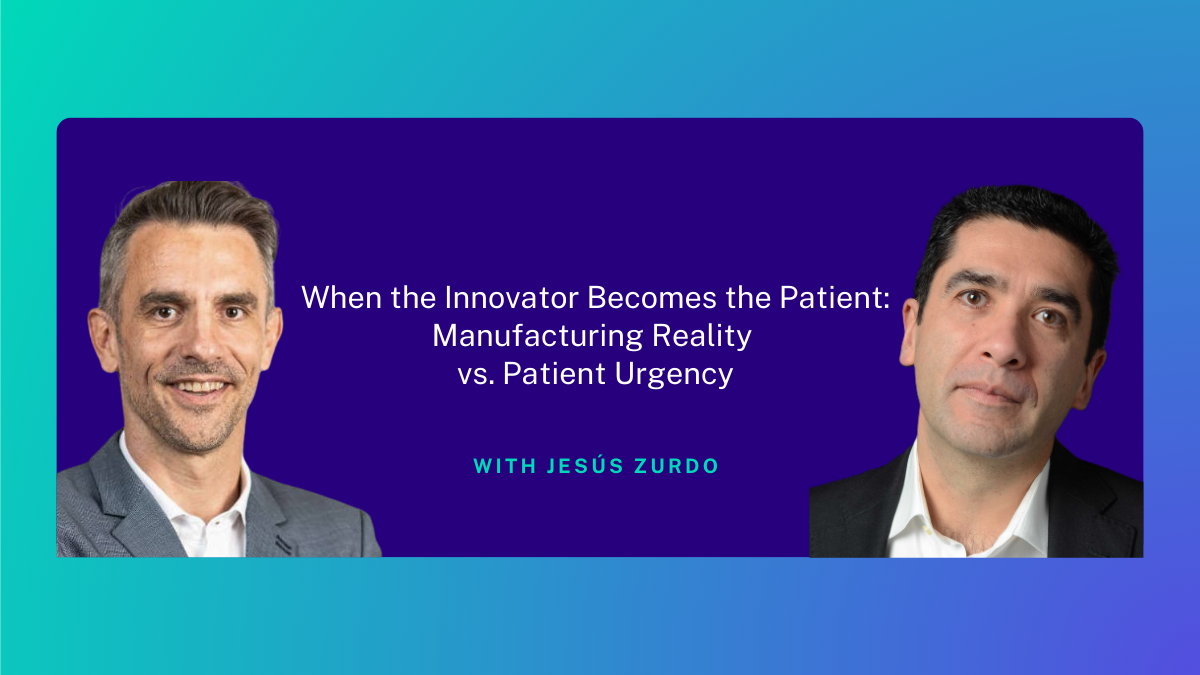
What happens when therapeutic innovation meets real patient urgency? In this conversation, the barriers between scientist and patient all but vanish, bringing clarity—and a new sense of mission—to some of the biggest problems facing advanced therapy manufacturing and delivery.
Meet Jesús Zurdo, a biotech leader whose three decades of experience in innovation took on a whole new perspective when he became a leukemia patient himself. Seamlessly straddling the worlds of industry and patient care, Jesús Zurdo brings a refreshingly honest, systems-level view to cellular therapies, manufacturing bottlenecks, and the realities of getting therapies from the lab to bedside.
Key Topics Discussed
- Point-of-care production, especially for stem cell and CAR-T therapies, can reduce wait times and improve access by decentralizing final manufacturing steps while centralizing key components.
- Allogeneic “off-the-shelf” therapies hold major promise but face hurdles in genetic editing, immune compatibility, and pricing models, though emerging cell types and edits offer hope.
- In vivo approaches may overcome limitations of autologous and allogeneic therapies but bring challenges in delivery, targeting, and toxicity, requiring pragmatic hybrid solutions.
- Automation, standardization, and flexible delivery platforms are advancing, but overengineering remains a risk; practical, clinically validated solutions are needed.
- The biggest bottleneck for cell therapy adoption is often hospital readiness—infrastructure, staffing, and training—not just price, limiting timely patient access.
- Moving advanced therapies earlier in treatment protocols could improve outcomes, supported by real-world evidence, regulatory evolution, and payer alignment.
- Integrating patient experience—from clinic logistics to at-home realities—enhances therapeutic relevance and ensures scientific progress translates into meaningful patient benefit.
Episode Highlights
- Experiences and lessons from stem cell registries and point-of-care manufacturing models [03:15]
- Challenges and potential of autologous and allogeneic cell therapies, including scalability and accessibility [06:08]
- The promise and limitations of in vivo cell therapy, including delivery risks and patient safety [07:06]
- Reflections on current trends in manufacturing automation, delivery platforms, and the risk of overengineering [09:49]
- Barriers to wider adoption of advanced cell therapies, including hospital infrastructure and economic constraints [13:31]
- The case for earlier lines of treatment with new modalities and value in learning from actual patient experiences [14:30]
- The importance of integrating voices of patients, clinicians, and developers when solving complex problems [17:31]
- Why urgency and remembering our future roles as patients should guide therapy development [18:51]
In Their Words
For me, the key thing is we are dealing with complex realities and this requires complex solutions. And probably we need to be humble, all of us, I mean all stakeholders. I am a scientist or a professional as a patient about what we can contribute and what we can't. I think we need more people challenging the system, practices and views.
We need to be critical, but we need to be humble about what solutions we bring. I can try to identify holes, but it would be a bit naive for me saying, „oh, I have this solution”, but I can bring it perspective. And I think by getting different stakeholders, manufacturing developers, clinicians, patients into the same room and just looking at what is failing, what is working, what would be the ideal solution, we will be able to develop much better therapeutics.
Episode Transcript: When the Innovator Becomes the Patient: Manufacturing Reality vs. Patient Urgency - Part 2
David Brühlmann [00:00:50]:
In part one, Jesús Zurdo shared how becoming a leukemia patient rebranded—rewrote—his professional mission after three decades in biotech innovation. Now, as both treatment receiver and industry insider, he is tackling the manufacturing and delivery challenges head on. Can point-of-care production work? Will allogeneic therapy solve scalability? What business models could actually democratize access? His patient urgency pushes these conversations beyond theory into practical solutions that could transform advanced therapy delivery.
I would like to talk about a slightly different aspect, but you said, well in this frame, how can we do it without bringing the patient to the clinic to measure all these metrics? This leads me to this point because we hear often about point-of-care manufacturing, especially with stem cells, CAR-T, and so on. What is your perspective? How should this evolve and how can this solve the affordability and more importantly, the accessibility crisis.
Jesús Zurdo [00:03:15]:
I have some points of view and I can share some experience that I come across. I'll tell you one big realization and we were talking about. For me, realizing how stem cell registers have been operating for decades now, very effectively, and how they provide cells to patients. I mean, you look at the quality assessment and the batch release. I mean, my dose of CE was a batch and they had to do some testing before they released. But you cannot just do the classical sterility testing. You cannot do everything you would do traditionally in pharma and talking to people, friends that are working in CAR-Ts that they had all this quality release.
And that adds a lot of time. And that means that you need to freeze the cells and you do all this testing and then you release the batch, but you use lots of sample in testing and then you go and take it to the patient. That adds a tremendous amount of time, that adds a tremendous amount of work and cost. And now if you look at how some people are doing this point-of-care and I mean, there's several examples here, current cross promoting this, the Hospital Clinic in Barcelona, they've been, I think they treated 600 patients or something like that by now, which is pretty impressive, out of a single hospital.
There was this, Galapagos was promoting something similar. Unfortunately, they stopped that. Then this is a different paradigm because you have the apheresis at hospital and then you use the fresh cells, you modify them, purify them, and immediately you put them back into the patient. Because using aseptic technologies, I mean, it's a question of risk assessment, which is what you always do in medicine. You need to test if you've done your validation up front. And then what they see the risk of infection because of bacteria or whatever virus this way into sample is negligible.
Of course you need to validate this, but once you've done that, that means that you cut time tremendously and you can do everything in the hospital. And the only thing you need is to have the viral vector. But this means that you can centralize the viral vector as the key ingredient, make sure the quality is right, and then decentralize the final manufacturing step. It brings down costs, it brings down time, and importantly, the patient doesn't have to wait so long. I mean, there are horrible examples of hospitals where patients die because they don't have the treatments fast enough. So to me, it's not necessarily the solution for everything.
But clearly for autologous cell therapy, it could be a game changer. Not for everything, not for everybody. But in some cases, some experience showing that this has promise and is leveraging what is being in use for many years. I mean, don't reinvent the wheel. Just look at what people have been using. It works. Now let's look at the difficult stuff that is getting in the way.
David Brühlmann [00:05:52]:
And to what extent could we develop more allogeneic therapies? Obviously it's not possible for everything, but maybe in certain cases, instead of an autologous therapy, we could move over to allogeneic and then produce that centrally and ship it, for instance.
Jesús Zurdo [00:06:08]:
Well, we can, and there are examples. Unfortunately, it doesn't seem that the allogeneic cell therapies are getting traction. And I don't know, there are different problems. I mean, on one hand, not every allogeneic cell therapy is built the same way. And there's some cases where probably too much editing or I remember HLA knockouts are not a great idea because then your body thinks you're bringing another cancer. But there's some promises there. It can help in some regards. But I think, you know, it's not going to be a magic bullet.
What I like about allogeneic is that it is off-the-shelf. You have it ready. That means that immediately you can give it to the patient, you shorten the intervention time. And I do believe that, I hope there would be some—I don't know whether it's gamma delta T cells, or it's going to be NK cells, or it's going to be an edited cell, or a combination of all this—that would make it… there is promise there.
However, I think probably in vivo cell therapy has more chances of succeeding. And my take on this is that I think it could revolutionize how cell therapy takes place.
Maybe not how people say it, because I had this conversation—how it's going to bring cost down. I disagree. I mean cost, yes, not price, because we price… I mean, we talked about this before. Pricing of medicines is different. And you look at what is the price of some viral therapies right now which require doses, clearly they do not represent the cost of manufacturing.
However, one thing to me as a patient is transformational is you might not need to use conditioning or lymphodepletion in cancer, but also in autoimmune diseases. And this is huge. It's huge because it reduces risk to patients, it reduces mortality linked to infections, and this is really important. But also it reduces the impact of some of this chemo in your brain, in your body—generally you are stronger, you're able to deal with things in a better way.
And also I like the flexibility that brings. You can be very creative, you can bring multiple—I mean, I know multiple CARs, you can do multiple dosings. Now the issue I think that probably we are not considering enough is the delivery. The delivery remains a problem and no matter how much engineering we would do into the vectors, doesn't matter which LNPs, some viral vectors, there's going to be always some off-target delivery. And this is something we've seen in ADCs in the past. And there were issues with the heart toxicity and liver toxicity, etc.
Now when we're having genetic medicines, this is a different story. If your cargo is integrated or has a genetic impact in the wrong cell type, maybe that is not desirable. I mean maybe I'm worrying unnecessarily, but the problem is translating observations from a lab or animal model into a patient is not trivial.
However, there are options like ex vivo at bedside that people are exploring. And I'm a firm believer that in vivo and the right delivery and the right vehicles could transform completely how autoimmune and how some oncology conditions are treated. I mean I'm really hopeful. I am impressed about the results people are observing.
David Brühlmann [00:09:24]:
Yeah, it's amazing. And it's also amazing to see how fast it moves, how fast it evolves. When you look across the industry, Jesús, what are the trends you see with respect to new manufacturing technologies, with respect to new delivery methods, with respect to new ways to bring the drug to the patients? What is hot right now or where do you think the industry is moving to?
Jesús Zurdo [00:09:49]:
I think this is where I'm a bit disconnected and I don't know if it's… I'm old fashioned but we were talking about overengineering or is just what is the purpose of the innovation you're introducing? And I need to be careful. I think automation, there are beautiful solutions out there, more companies getting solutions. It's very impressive what these platforms can do. And I think automation has a place even at point-of-care manufacturing because that means that you reduce risks, you reduce the human elements. So what I was saying before, people are putting too much emphasis in this. Automation is not a solution to price of goods but it's an important element to introduce in manufacturing consistency. But the problem is that it has to be agnostic.
You should be able to use whatever automation for a given product so you're not having to go through the barrier or buy new equipment in order to manage different cell therapies you are administering out of a single hospital. And this is a problem the industry has to reckon with. We need to have standards. We need to have like in computers, I suppose everybody can use a USB port. So we have an understanding what are the products starting—the apheresis, if you will—that people can start and then you have whatever automation solution but the standards are maintained.
The other I think is, I mean we were talking about in vivo. There is lots and lots of work done and it's fascinating what people are doing these days with these nanoparticles and how they're engineered. Again, I think they have a place. I think they are super cleverly designed. Some of them—it’s fascinating how much science is put in there. My question is again, are we overengineering these things? What problems are we solving? I was talking before about delivery. These solutions, sometimes they retain significant delivery challenges but also other aspects of durability of response, et cetera. We are maybe trying to get the perfect solution before finding what is the real problem. And I was saying maybe a hybrid between in vivo and ex vivo is something that would have a bigger impact and produce much better outcomes to patients.
Going back to patient urgency, rather than going for a super sophisticated technology that would require lots of testing and validation. I mean if I have a new—and I don't want to demonize nanoparticles, the same goes with viral vectors—doesn't matter which platform you have. If I have a super innovative delivery platform, I would need to show that it's safe, that it doesn't go to the wrong place, et cetera. And then the question is which patient will accept to be treated? I mean I'm talking about a patient that is not suffering or a healthy volunteer. It becomes challenging. I would not volunteer for that, but it has to be tested. What are the limitations of these platforms?
At the same time we have solutions that are already working. So why don't we combine some of these super cleverly designed vectors with simpler platforms that can ensure fast adoption in the clinic and then see what we can do with in vivo cell therapy or ex vivo or bedside or whatever. To me the challenge is being pragmatic and recognize the urgency and go step by step. Yeah, let's make sure we can validate physiological effect and then we refine the delivery in due time.
David Brühlmann [00:13:14]:
What do you think will have the biggest impact right away? Because my feeling is there's a lot to be done. It will take time. Is there something that stands out that you think will have an immediate effect and will move the needle significantly?
Jesús Zurdo [00:13:31]:
Two things: 1. Healthcare provider capacity. You cannot make a significant improvement in the adoption of cell therapies if hospitals cannot administer to patients. And this is something that is hidden. People assume it's not just pricing. You could price it whichever way you want, but if the hospital cannot give it to patients because they don't have the right infrastructure, the training or the capabilities, forget it. It will never happen. And now we see it in Europe—clearly problematic in the UK—when our healthcare systems are limited in the amount of money they receive, you tell them you need to invest now in building capabilities, for example for autologous, which is what is right now also maybe in the future for other types of cell therapies, then who's going to pay for that? So that is a big, big bottleneck.
The other—maybe making it… I'm so hopeful—looking at some bold clinical trials. Unfortunately not many in Europe or in the US. I see brilliant things being done in China. Innovation that is coming out of China is unbelievable. Using some of these treatments as first line and it's mind blowing what they observe in some conditions. I mean, you need to take things with a pinch of salt, but it's how they combine—I’m more familiar with the CAR-T arena—how they combine multiple CARs, how they combine, how they administer the treatment, how they combine with other drugs. And there are cases where they're using this as first line for multiple myeloma, for ALL in some cases, without the need of chemo. And they see some impressive remission and good survival without symptoms. And this is really important for me. Now, early days, but I think this, to me, it shows the promise. This could be really revolutionary.
But I know we need to be prudent. We cannot just go completely crazy. But there are, I think there's a case for some conditions to really move these treatments earlier. This is another thing I found out as being a patient. Yes, it's good to have another weapon, if you will, in reserve if the first line of treatment fails. The problem is that these treatments are really, really hurting patients. By the time they are eligible because they have maybe a couple of relapses already, they have issues with their kidneys, they have liver problems and that means that they are too weak in some cases to settle to receive these therapies.
And even if you said, you know, we're going to try anyway, it's less likely they will survive. So if we were using these treatments early on, maybe we would give them a better chance to survive the disease. And I think this is maybe changing and I know many clinicians already promoting this, but they are a bit alone. I mean, there's lots of things need to happen from a regulatory perspective, from a health economics perspective, from a payer’s perspective, that makes it acceptable to provide these treatments early on. And I think this could be transformational.
I also believe that we need to do better—or we need to do more—to improve the cell therapies that are already in the clinic. They are brilliant, but they are not as fantastic as many people think. But we have new knowledge and this is why I think it's important that patients are treated because we learn. We learn when they work, when they don't, we learn about the limitations and that will help innovation, that would help in our second or third generation of therapies.
David Brühlmann [00:16:59]:
Yeah, I believe that if we figure out the economic side and then obviously some other safety side to use these powerful new modalities early on, earlier treatment, and also, as you said, first in line and not end in line, I think this will be a total game changer. I do hope that we are getting there sooner than later. So this has been great. Jesús, before we wrap up, what burning question haven't I asked that you're eager to share with our biotech community?
Jesús Zurdo [00:17:31]:
For me, I think you touched really the important stuff. I think there were very pertinent questions to the point. For me, the key thing is we are dealing with complex realities and this requires complex solutions. And probably we need to be humble, all of us, I mean all stakeholders—I as a scientist or a professional, as a patient—about what we can contribute and what we can't. I think we need more people challenging the system, practices and views. We need to be critical, but we need to be humble about what solutions we bring.
I can try to identify holes, but it would be a bit naive for me saying, „oh, I have this solution”, but I can bring perspective. And I think by getting different stakeholders, manufacturing developers, clinicians, patients into the same room and just looking at what is failing, what is working, what would be the ideal solution, we will be able to develop much better therapeutics.
And particularly, I want to emphasize patient side—for me it has been enlightening how you use these therapies and why people are not receiving it or when they are, even when they're eligible, what happens, why the efficacy can be down? Well, because the reality, the experience in the clinic and at home. And I think this will increase the value of our efforts hundredfold. No doubt about it.
David Brühlmann [00:18:45]:
Jesús, what is the most important takeaway from our conversation today?
Jesús Zurdo [00:18:51]:
I would say, remember, we all are or will be patients. This is important. It's not I'm a scientist or I'm a professional or I'm a clinician and then I'm working for somebody else's benefit. No, no, no. At some point in my life… I will be a patient. And this I think brings an element of humanity and urgency as well. It's not okay to hope or wait for a number of years—going back to urgency—because patients matter and the need happens now. Cutting corners is not the solution, but it's finding what is the big issue we are facing. So if we see that when we work with patients, we're working with ourselves when that will be us in a few years or is now or it was us in the past, I think that would change the conversation.
David Brühlmann [00:19:38]:
What a great way to conclude our fantastic conversation. Jesús, patients do matter. Thank you for reminding us that patients matter. And finally, what we're doing as scientists is for the patient at the end of the day. And thank you also for giving us this perspective that goes beyond just the science. Finally, we are serving the patients that desperately need these life-saving therapies. And thank you also for sharing your own personal experience. Very powerful.
Jesús Zurdo [00:20:06]:
Thank you, David.
David Brühlmann [00:20:07]:
Where can people get a hold of you, Jesús?
Jesús Zurdo [00:20:09]:
Well, I think I've shared with you my email address. The easiest is to find me on LinkedIn and message me. Easy to reach through LinkedIn and I would encourage anybody that has ideas, interests, initiatives or willing to collaborate, please reach out. I think we are all in this together. I'm really happy to work with other people in finding better solutions.
David Brühlmann [00:20:31]:
Smart biotech scientists, please reach out to Jesús. You find the infos in the show notes and thank you once again Jesús for being on the show today.
Jesús Zurdo [00:20:40]:
Thank you David, it's been my pleasure and thanks a lot for hosting me.
David Brühlmann [00:20:45]:
Jesús Zurdo just gave us a masterclass in reimagining how we manufacture and deliver advanced therapies. His unique vantage point as both innovator and patient reminds us why solving these challenges matters beyond the lab. If this conversation sparked ideas for your own work, we'd love a review on Apple Podcasts or wherever you listen. Your feedback helps us reach more scientists and if you need support in development or the manufacturing of advanced therapies or biologics, please check out the links in the show notes. We are here to help you and thank you so much for tuning in today and I'll see you next time.
All right smart scientists, that's all for today on the Smart Biotech Scientist Podcast. Thank you for tuning in and joining us on your journey to bioprocess mastery. If you enjoyed this episode, please leave a review on Apple Podcasts or your favorite podcast platform. By doing so, we can empower more scientists like you. For additional bioprocessing tips, visit us at www.bruehlmann-consulting.com. Stay tuned for more inspiring biotech insights in our next episode. Until then, let's continue to smarten up biotech.
Disclaimer: This transcript was generated with the assistance of artificial intelligence. While efforts have been made to ensure accuracy, it may contain errors, omissions, or misinterpretations. The text has been lightly edited and optimized for readability and flow. Please do not rely on it as a verbatim record.
Next Step
Book a free consultation to help you get started on any questions you may have about bioprocess development: https://bruehlmann-consulting.com/call
About Jesús Zurdo

With more than two decades of experience in the biopharmaceutical industry, Jesús Zurdo plays an active role in advancing therapeutic development and improving patient access. His background spans cell and gene therapy, cancer immunotherapy, and executive coaching, complemented by the unique perspective he brings as a leukemia survivor.

He contributes to the field as a Non-Executive Director at Telomere Therapeutics and as an Expert Jury Member for the EIC Accelerator Program, collaborating with organizations to progress in next-generation therapies. Committed to genuinely patient-centered healthcare, he combines scientific expertise with lived experience to help drive innovations that deliver real value to patients.

Connect with Jesús Zurdo on LinkedIn.
David Brühlmann is a strategic advisor who helps C-level biotech leaders reduce development and manufacturing costs to make life-saving therapies accessible to more patients worldwide.
He is also a biotech technology innovation coach, technology transfer leader, and host of the Smart Biotech Scientist podcast—the go-to podcast for biotech scientists who want to master biopharma CMC development and biomanufacturing.
Hear It From The Horse’s Mouth
Want to listen to the full interview? Go to Smart Biotech Scientist Podcast.
Want to hear more? Do visit the podcast page and check out other episodes.
Do you wish to simplify your biologics drug development project? Contact Us

