
Bioprocess development has always been slowed down by legacy assumptions: big stainless-steel bioreactors, endless timelines, and the belief that complex therapeutics can only be produced in closed systems. But what if you could grow life-saving antibodies in a greenhouse instead?
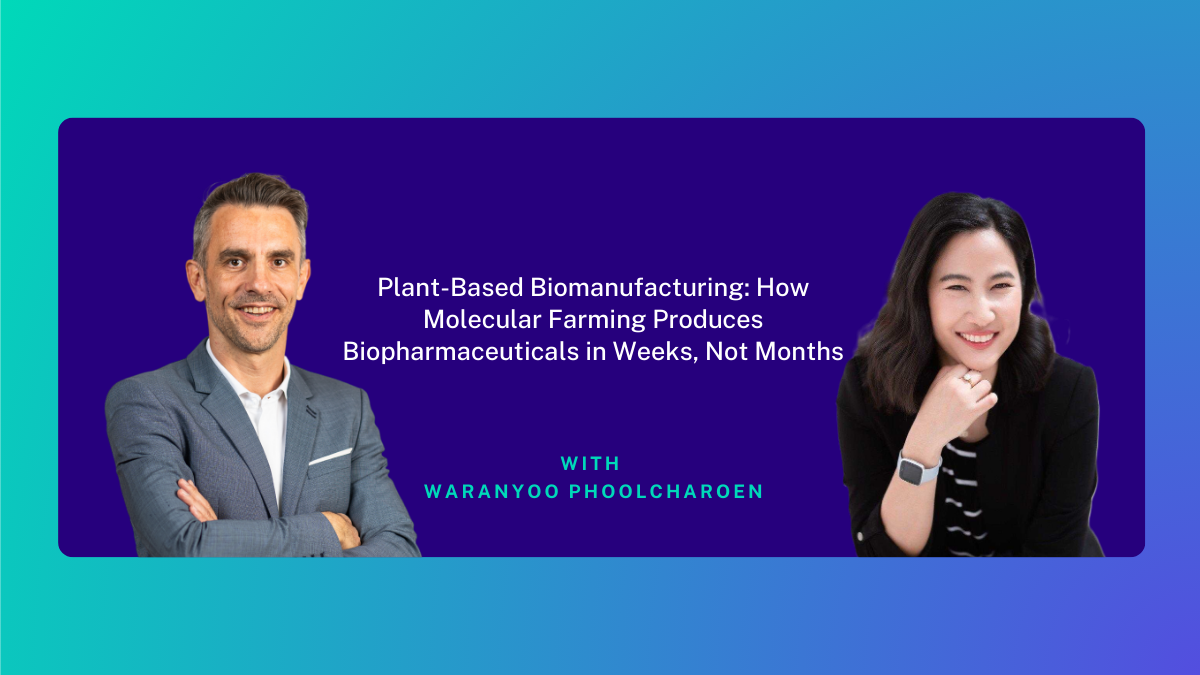
In this episode of Smart Biotech Scientist Podcast, host David Brühlmann sits down with Professor Waranyoo Phoolcharoen, co-founder of Baiya Phytopharm, to explore how she’s transforming cutting-edge academic research into life-saving biopharmaceuticals made from plants.
Key Topics Discussed
- Different pathways scientists can use to create impact from research, including entrepreneurship, licensing, and intellectual property transfer.
- Waranyoo Phoolcharoen’s unexpected journey into plant biotechnology and her pioneering work in molecular farming.
- How early bioprocess planning can accelerate development and challenge the idea that biotech manufacturing must be slow.
- The academic experiences and ethical motivations that shaped her passion for plant-based pharmaceutical research.
- The transition from academia to entrepreneurship to translate scientific discoveries into real-world applications.
- How molecular farming uses plants like Nicotiana benthamiana as scalable biofactories for producing medicines.
- The mindset shift scientists must make when moving from research curiosity to commercial viability and market needs.
- Strategic early product decisions and insights into the opportunities and challenges of building biotech in Southeast Asia.
Episode Highlights
- How plant-based molecular farming compares to traditional microbial and mammalian cell systems [02:44]
- The flexibility and rapid scalability of using plants for biomanufacturing [05:06]
- Speeding up process development with transient expression versus transgenic plants [05:45]
- Regulatory perspectives and the approval process for plant-produced biologics [06:52]
- An overview of the ongoing oncology and infectious disease antibody pipeline [08:08]
- Strategic challenges: balancing product development, revenue, and market-ready innovations through subsidiary companies [09:51]
- Lessons learned from building a GMP facility capable of 5 million doses per month during the pandemic, with supply chain as the biggest bottleneck [12:50]
- Future innovations in molecular farming and the role of plant platforms in medicine production [14:47]
In Their Words
During the COVID-19 pandemic, we conducted Phase 1 and Phase 2 clinical trials for COVID-19 vaccines produced using our technology. We received many questions from regulators. With scientific questions, we used scientific knowledge to explain and answer them. That is why we were approved for both Phase 1 and Phase 2 clinical trials.
Plant-Based Biomanufacturing: How Molecular Farming Produces Biopharmaceuticals in Weeks, Not Months - Part 2
David Brühlmann [00:00:26]:
Welcome back to our conversation about molecular farming. In Part 1, Waranyoo Phoolcharoen explained how plants become biofactories and why Southeast Asia’s biotech landscape shaped Baiya Phytopharm’s strategy.
Now we tackle deployment. How does their platform address everything from oncology to infectious diseases? What enabled Asia’s first plant-derived COVID-19 vaccine to reach clinical trials and achieve a production capacity of 5 million doses per month in Bangkok? And where is this technology heading next? Let’s find out.
Let’s look at the technology itself. Your platform is very interesting—a unique and different way to produce life-saving drugs and medicines in a more affordable way.
However, scientifically speaking, you are competing with legacy systems—microbial systems, yeast expression systems, and mammalian cell systems like CHO cells.
How does your platform compare to these, and what makes it a strong choice for certain molecules?
Waranyoo Phoolcharoen [00:02:44]:
In the pharmaceutical industry today, we all know that CHO cells (Chinese Hamster Ovary cells) are the standard platform. CHO cells and microbial systems are incredibly powerful and have enabled modern biologics manufacturing. However, they were built for environments with significant capital investment and stable infrastructure.
That is not always the reality in low- and middle-income countries.
The biggest limitations are cost and complexity. CHO cell manufacturing requires expensive facilities, complex equipment, and tightly controlled conditions. This makes it difficult to build and operate in settings where capital, supply chains, and utilities may be limited.
Another issue is scalability. CHO cell systems scale by building larger bioreactors, which increases cost very quickly. That model works well for high-margin products, but it is harder to apply for affordable vaccines or monoclonal antibodies.
If you consider microbial systems, they are fast and relatively inexpensive. However, they cannot produce complex biologics like monoclonal antibodies due to the lack of proper post-translational modifications.
Molecular farming takes a different approach. Plants are naturally scalable—you grow more biomass instead of building larger reactors. The infrastructure is simpler, the system is more robust, and the cost structure is better aligned with the needs of low- and middle-income countries.
Molecular farming is not replacing CHO or microbial systems. But for products where speed, cost, and access truly matter, it is often a better structural fit.
David Brühlmann [00:04:41]:
One additional advantage I see is that you have much more flexibility with your system in terms of demand. When scaling up a biologics process, you typically need to build a larger facility or install larger bioreactors. But if I understand correctly, Waranyoo, in your case—if demand changes quickly—you could simply plant more plants in a short time. Is that correct?
Waranyoo Phoolcharoen [00:05:06]:
Yes. Because we use plants, we can grow them continuously. The plants we grow do not need to be committed to a specific product immediately—we can decide later which product to produce.
To scale up, we simply grow more plants. This is very different from scaling up CHO cell manufacturing, where obtaining additional bioreactor capacity is a major investment. For us, increasing production for each product is relatively straightforward—grow more plants. That makes scaling easier.
At the beginning of our conversation, you mentioned the importance of accelerating process development. How does your platform speed up process development?
Waranyoo Phoolcharoen [00:05:45]:
When we talk about molecular farming—using plants to produce proteins—at our company, we do not create transgenic plants. Instead, we use what is called transient expression.
This means we do not need to generate stable cell lines. Once we have the gene sequence, we introduce it into the plant and begin producing the protein almost immediately. The plant acts as a living bioreactor, translating the genetic information very quickly.
Within three to four days, we can express the target protein. From gene sequence to harvest typically takes about one week—not months.
This is why our platform enables rapid product changes and accelerated development. The key advantages are speed and flexibility.
David Brühlmann [00:06:41]:
What is the regulatory perspective on this technology? Since it is quite a different production approach, have you received buy-in from regulators?
Waranyoo Phoolcharoen [00:06:52]:
The technology itself is not new. Most regulators, including the U.S. Food and Drug Administration (FDA), have been familiar with plant-based expression systems for more than 20 years. There may be additional questions because there are still relatively few products on the market using this platform. However, regulators understand the scientific principles.
Regardless of whether a product is produced in CHO cells, bacterial systems, or plant cells, regulators ultimately evaluate the product itself. You must demonstrate purity, safety, and efficacy. The standards are similar, even if the production platform differs.
We have evidence of regulatory acceptance through our COVID-19 vaccine program. During the COVID-19 pandemic, we conducted Phase 1 and Phase 2 clinical trials for vaccines produced using our technology.
We received many questions from regulators. But scientific questions can be addressed with scientific data. By providing strong evidence and explanations, we were approved to proceed with both Phase 1 and Phase 2 clinical trials.
David Brühlmann [00:07:59]:
Beyond the COVID-19 vaccine and other vaccines, what additional molecules are in your pipeline, and how advanced are these programs?
Waranyoo Phoolcharoen [00:08:08]:
Right now, we have several products in our R&D pipeline. We are focusing more on monoclonal antibodies. We use our platform to engineer molecules and try to develop “biobetters.”
For example, we are working on cancer antibodies. We have animal data showing that our plant-produced monoclonal antibodies can be used for cancer immunotherapy.
We are also engineering different glycan structures to study whether glycosylation patterns affect antibody half-life. That is one of our key research areas.
Beyond oncology, we are also working on infectious diseases. We are developing antibodies against RSV (Respiratory Syncytial Virus), using RSV antibodies as a model to improve half-life extension strategies.
Another important focus is rabies monoclonal antibodies. Rabies remains a significant problem in Thailand and Southeast Asia. In our region, equine-derived polyclonal antibodies are still commonly used.
What we are trying to demonstrate is that plant-produced monoclonal antibodies can perform effectively as an alternative. That program is currently in progress.
David Brühlmann [00:09:31]:
As you work on these programs—especially monoclonal antibodies and your oncology pipeline—what manufacturing, development, or regulatory challenges do you anticipate before reaching market approval?
Waranyoo Phoolcharoen [00:09:51]:
After we stopped the clinical trials for our COVID-19 vaccine, we restructured the company. We have subsidiary company. We still want to focus on developing drug and new product. But I would say we need to think about revenue. We need to think about how to sell the product. Then we structured the company that I would say now maybe our goal is not develop one drug from the beginning and we aim for marketing that product. Then with Baiya Phytopharm, we still focus on developing new drugs, but we focus on what we are good at. Let's say we're thinking about developing things like if we can have molecules, antibody that have longer half-life, then we might spin off this and try to do Phase 1 clinical trial if we can. And license that product to our partner or someone else. But we have two more subsidiary companies.
One subsidiary focuses on molecular farming services. Because we have a GMP facility, we realized that many groups are interested in producing proteins using plant-based systems but lack the infrastructure or technology. By offering our platform as a service, we can support external partners, test our system across different proteins, and generate revenue while strengthening our expertise.
Another subsidiary is BGF Pantry. BGF Pantry focuses on growth factors and other proteins that can be sold as raw materials for cosmetic applications. These products face lower regulatory barriers and can reach the market more quickly. They use the same plant-based platform but provide faster commercialization pathways.
This part of the business generates cash flow and helps maintain our team and manufacturing capabilities while our therapeutic programs continue to advance.
The key point is that we must develop multiple parts of the company simultaneously to push the platform forward. We still aim to develop high-value therapeutic antibodies, but the journey to market approval is long. That is why we need multiple business engines to move the company forward. Balancing these efforts allows us to continue advancing plant-based medicines.
David Brühlmann [00:12:30]:
I’d like to go back to the GMP facility. You built it with the goal of producing a COVID-19 vaccine there—if I’m correct, with a capacity of up to 5 million doses per month. Can you tell us what the biggest technological and regulatory challenges were, especially as you were preparing during a pandemic?
Waranyoo Phoolcharoen [00:12:50]:
When I think back to that time, during the COVID-19 vaccine development, many people asked how difficult the regulatory process was. Surprisingly, it was not as difficult as many expected.
We worked closely with the Thai Food and Drug Administration. They were knowledgeable and maintained strict quality standards and protocols. Most of their questions were scientific, and scientific questions can be answered with scientific data.
Looking back, I did not see major bottlenecks from a laboratory or regulatory perspective.
The more serious challenge was actually the supply chain. Many critical pieces of equipment, reagents, and consumables required for biomanufacturing—such as filters, chromatography resins, and single-use components—were not produced locally in Thailand. We had to import everything.
During the pandemic, when every country was trying to produce vaccines at the same time, these supply chains became a major constraint. Lead times increased significantly, shipments were delayed, and that became a major bottleneck for GMP production.
That experience taught us an important lesson: pandemic preparedness is not just about having the technology or a GMP facility. It requires building the entire ecosystem.
David Brühlmann [00:14:26]:
Yes, it’s often much more global and holistic than we think, right?
Waranyoo Phoolcharoen [00:14:31]:
Exactly. In normal situations, you never think about those aspects.
David Brühlmann [00:14:35]:
As we wrap up, what are some interesting technological innovations in molecular farming that you see emerging in the future?
Waranyoo Phoolcharoen [00:14:47]:
At this point, when people ask me about our next plan, I’m not always sure which specific product we will sell. In biotech, product direction can change quickly.
But for me, the most important goal is to prove that plants can be recognized as a mainstream production platform. I don’t want plant-based systems to be viewed merely as an alternative option.
When we think about producing a protein, we typically consider mammalian cells, insect cells, E. coli, and other microbial systems. I want plants to be part of that standard list of platform choices.
Our goal is to demonstrate that plants are a reliable and scalable platform for producing medicines.
David Brühlmann [00:15:35]:
This has been great, Waranyoo. With everything we covered today, what is the one key takeaway you want listeners to remember?
Waranyoo Phoolcharoen [00:15:44]:
My key takeaway is that manufacturing platform choice truly matters.
If you are in biotech and struggling with long development timelines or scale-up challenges, it may not always be the molecule—it may be the system you are using.
Molecular farming offers a different set of trade-offs: faster development and flexible scaling. It will not replace traditional microbial or mammalian systems, but it provides scientists with another practical option.
So don’t default to only one platform. Step back and consider alternatives. And if you would like to explore this approach, feel free to reach out to me.
David Brühlmann [00:16:31]:
That’s a very good point.
Waranyoo Phoolcharoen [00:16:32]:
We are very happy to collaborate and test your molecules on our platform.
David Brühlmann [00:16:39]:
Where can people reach you?
Waranyoo Phoolcharoen [00:16:42]:
You can visit our website at www.baiyaphytopharm.com. We are also active on LinkedIn.
David Brühlmann [00:16:51]:
There you have it, smart biotech scientists. I will put the link in the show notes. Please reach out to Waranyoo.
Waranyoo Phoolcharoen [00:16:56]:
Yes, we are very open to new collaborations and excited to explore new molecules using our platform.
David Brühlmann [00:17:06]:
Well, there's your offer. Please take advantage of it and reach out to Waranyoo and her team. And Waranyoo, thank you so much for sharing your new technology, what you're doing in Thailand. It has been a wonderful conversation. Thank you so much.
Waranyoo Phoolcharoen [00:17:21]:
Thank you.
David Brühlmann [00:17:23]:
Waranyoo’s journey—from molecular farming researcher to building pandemic-ready biomanufacturing capacity in Bangkok—reveals a powerful truth: plants can help democratize medicine production.
Weeks instead of months. Regional resilience instead of dependency. Accessible biologics instead of supply chain bottlenecks.
As her oncology pipeline advances, the next chapter of molecular farming is unfolding.
If this conversation changed how you think about biomanufacturing’s future, please leave us a review on Apple Podcasts or your preferred platform.
Thank you for tuning in today, and I’ll see you next time.
All right, smart scientists—that’s all for today on the Smart Biotech Scientist Podcast. Thank you for joining us on your journey to bioprocess mastery. Stay tuned for more inspiring biotech insights in our next episode. Until then, let’s continue to smarten up biotech.
Disclaimer: This transcript was generated with the assistance of artificial intelligence. While efforts have been made to ensure accuracy, it may contain errors, omissions, or misinterpretations. The text has been lightly edited and optimized for readability and flow. Please do not rely on it as a verbatim record.
Next Step
Book a free consultation to help you get started on any questions you may have about bioprocess development: https://bruehlmann-consulting.com/call
About Waranyoo Phoolcharoen

Waranyoo Phoolcharoen is a pioneer in molecular pharming and co-founder of Baiya Phytopharm, a biotechnology company developing plant-based platforms for rapid and scalable biopharmaceutical production.

As Chief Technology Officer and a professor at Chulalongkorn University’s Faculty of Pharmaceutical Sciences, she bridges academic research and real-world impact—using plant biotechnology to develop medicines for infectious diseases. Her work focuses on making biologics faster, more accessible, and more affordable while fostering a collaborative scientific culture and strengthening Thailand’s biotechnology ecosystem.

Connect with Waranyoo Phoolcharoen on LinkedIn.
Further Listening
You may also enjoy exploring these additional conversations from the podcast, featuring ideas, insights, and perspectives across biotechnology and innovation.
Episodes 141 - 142: How Microalgae Cuts Antibody Costs by 70% and Redefines Biomanufacturing with Muriel Bardor
Episodes 163 - 164: How Moss Enables Production of Unproducible Protein Therapeutics with Andreas Schaaf
Episodes 229 - 230: Cyanobacteria Biomanufacturing: Achieving Carbon-Neutral Production at Lower Cost Than Fermentation with Tim Corcoran
David Brühlmann is a strategic advisor who helps C-level biotech leaders reduce development and manufacturing costs to make life-saving therapies accessible to more patients worldwide.
He is also a biotech technology innovation coach, technology transfer leader, and host of the Smart Biotech Scientist podcast—the go-to podcast for biotech scientists who want to master biopharma CMC development and biomanufacturing.
Hear It From The Horse’s Mouth
Want to listen to the full interview? Go to Smart Biotech Scientist Podcast.
Want to hear more? Do visit the podcast page and check out other episodes.
Do you wish to simplify your biologics drug development project? Contact Us

