
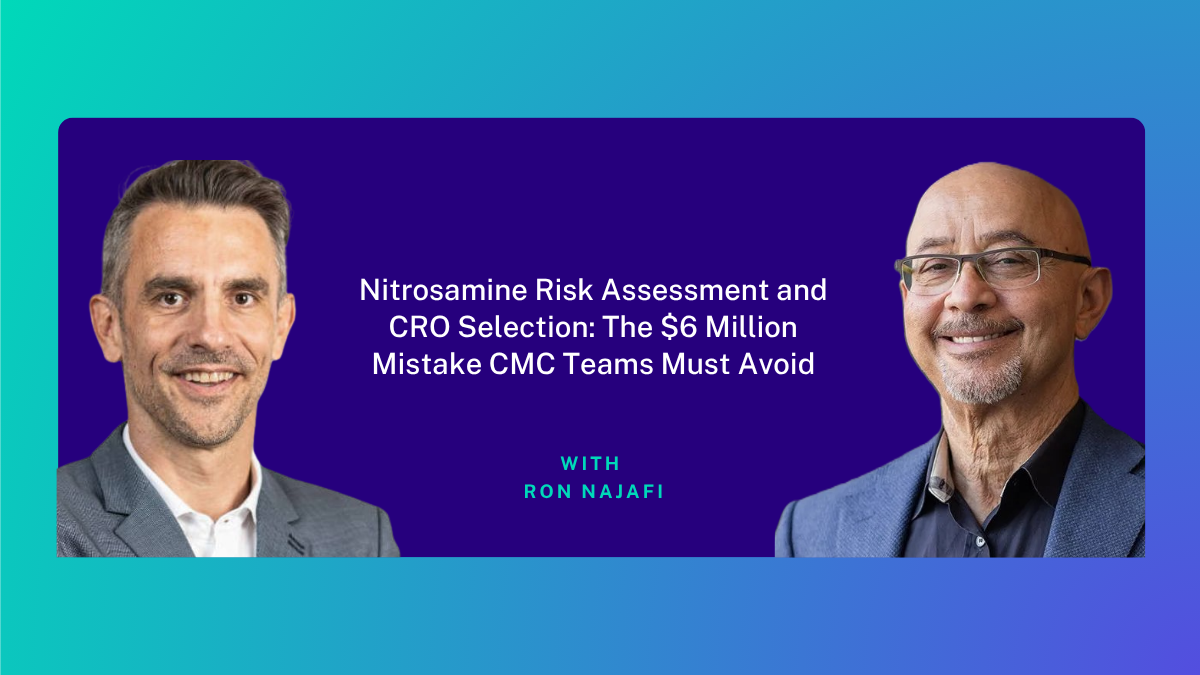
When drug safety fails, patients—and entire markets—pay the price. Understanding your CMC isn’t just compliance; it’s the line between therapeutic promise and product recall.
That’s the lived experience of Ron Najafi, a serial biotech entrepreneur whose forensic work on nitrosamine contamination (most notably in ranitidine/Zantac) made national headlines—and changed FDA policy. From bench chemist to founder of NovaBay Pharmaceuticals and Emery Pharma, Ron exemplifies the scientist’s role in both discovery and diligence.
Key Topics Discussed
- Introduction to Ron Najafi and overview of his career milestones in pharma and CROs
- Importance and philosophy of CMC (Chemistry, Manufacturing, and Controls) in drug development success
- Early inspirations and academic foundation shaping Najafi’s path in chemistry
- Entrepreneurial journey from academia to founding multiple companies (NovaBay, Emery Pharma)
- Deep dive into CMC “control” and the critical role of impurity detection in pharmaceuticals
- The nitrosamines crisis and Najafi’s role in uncovering NDMA in Zantac
- Chemical sources and formation pathways of nitrosamines in drug products
- Risk assessment practices and broader impurity control challenges in pharma and biotech
Episode Highlights
- Early academic experiences and inspirations that Ron Najafi to a science career [05:46]
- Challenges and milestones in building companies like CP Lab Safety and NovaBay Pharmaceuticals [07:59]
- The invention and impact of the ECO Funnel® on lab safety and environmental responsibility [12:01]
- The formation of Emery Pharma following industry setbacks and lessons in adaptation [17:03]
- The fundamentals of impurity risk analysis, especially nitrosamine contamination in pharmaceuticals [20:56]
- The ranitidine (Zantac) NDMA discovery, its investigation, and consequences for drug regulation [23:33]
- Common sources of nitrosamine and practical advice for bioprocess risk management [27:51]
- Differences in impurity risk between small molecule and biologic drug processes [28:03]
- The necessity and regulatory expectation of impurity and leachable/extractable analysis [30:07]
In Their Words
We were contacted by a pharmacy out of Connecticut, and they were testing Zantac, which is ranitidine, the active ingredient. And they were testing it by gas chromatography. In gas chromatography, you are heating the sample significantly in order to volatilize certain impurities. And they were observing lots and lots of nitrosamines, specifically N-nitrosodimethylamine, NDMA—millions of nanograms of nitrosamine, which is just completely unacceptable.
NDMA, according to the FDA, you can have only 96 nanograms per day. Our investigation effectively unraveled what was happening with ranitidine. Effectively, ranitidine was breaking down, and the breakdown product of ranitidine was NDMA.
Nitrosamine Risk Assessment and CRO Selection: The $6 Million Mistake CMC Teams Must Avoid - Part 1
David Brühlmann [00:01:01]:
What does it take to build a company around a scientific discovery that reshapes public health policy? Ron Najafi has done exactly that. From his early days as a bench chemist to founding NovaBay Pharmaceuticals and taking it public to leading Emery Pharma, a CRO deeply committed to science, CMC and bioanalytical testing. Ron's career is a masterclass in turning scientific curiosity into real world impact. Today, he shares where that journey began.
Welcome, Ron. It's good to have you on today.
Ron Najafi [00:02:54]:
Thank you, David. It's a pleasure to be talking to you again.
David Brühlmann [00:02:59]:
Ron, share something that you believe about bioprocess development that most people disagree with.
Ron Najafi [00:03:07]:
I think one of the things that people should not disagree with is the need to do proper homework on CMC development, because that's going to be one of the biggest holdups as a project moves from pre-preclinical to preclinical and so forth. Understanding CMC, understanding the challenges associated with manufacturing, and the analytical chemistry of your drug substance and drug product—whether small molecules or biologics—are essential to your success.
It is also essential to your pharmacology and your toxicology. So you need to know as much as possible about your Chemistry, Manufacturing, and Controls. And I say that with some intentionality. Chemistry is really how you make your product—how you make your compound, how you produce your biologics. You really need to understand it well.
It makes a big difference in how you're ultimately going to manufacture the product—chemistry, manufacturing, and manufacturability—whether this is going to cost you a million dollars to make or whether you'll never be able to make it at all. So those are all connected and related.
And then, of course, Controls really refers to quality control. It refers to how you're going to test the product, how you're going to maintain it, and how you establish its shelf life.
So these are areas where there may be agreement and disagreement, but I think there should be more attention given to all of that—the CMC—at the pre-preclinical and preclinical stages, because the FDA cares about it, the EMA cares about it, and we need to make sure that we also care about these aspects. Otherwise, they can become a major holdup for anyone developing either small molecules or biologics.
David Brühlmann [00:05:19]:
Very good reminder. Thank you, Ron. And this is a point I've been stressing multiple times here on the podcast. CMC is important and should not be an afterthought.
Ron, you have been on a fascinating journey for several decades. Draw us into your story—what first sparked your passion for science, and what were some of the interesting pit stops along the way?
Ron Najafi [00:05:46]:
I’ve actually thought about it. One of the things that sparked my passion was when I was in high school and had a chemistry teacher who was very engaged in the subject. When the time came to go into the laboratory and perform experiments, we were given a lab coat.
I remember vividly carrying that lab coat—it felt like a cape, like Superman’s cape. It gave me a sense of authority and identity that I had never experienced before. That was one spark.
The second spark was when I was at the University of San Francisco, where I met the professor who later became my primary mentor during my bachelor’s and master’s studies. He strongly encouraged me to pursue synthetic chemistry.
I remember staying in the lab until 4 a.m. at times, working on reactions such as 9-BBN and other synthetic chemistry projects. Organoboron chemistry was particularly exciting—especially following the Nobel Prize awarded to H. C. Brown in 1979.
Another pivotal moment was when I was given a key to the lab. That was a major milestone. I felt like I now had my own lab space, my own desk.
So those two points were two sparks in my life. It was like a quantum leap from one place from one location to the next location. And it was transformative to most people that maybe not that big of a deal, but to me, getting a lab coat in high school and going to the lab at the University of San Francisco, getting a key to the lab and having my own desk in the lab was very significant for me.
David Brühlmann [00:07:45]:
And what were some other interesting stops and experiences you had along your—I believe it's more than three decades already now—as an entrepreneur and scientist? Tell us your story.
Ron Najafi [00:07:59]:
I have to warn your listeners that time flies. Three decades flew by so fast. But I never watched the clock, David. I have never been a clock watcher. I work, work, work—and I enjoyed it.
So basically, one thing led to another. I got my bachelor's and master's degrees with this professor at USF and ended up going to UC Davis, continuing in organoboron chemistry, which was the Nobel Prize–recognized chemistry developed by H. C. Brown. So I worked with several professors connected to H. C. Brown’s work, and I got my Ph.D. from UC Davis shortly thereafter.
I was really hoping to get a job in the San Francisco Bay Area, where my family lived, but unfortunately there were no jobs. Genentech wasn’t really doing synthetic chemistry at the time. There was Dow Chemical, Clorox, and a few other very small biotech companies—but nothing like what exists in the Bay Area today. Absolutely nothing. This was more than 30 years ago.
I applied to Hewlett-Packard in Corvallis, Oregon, but I was rejected. My mentor, George Zweifel, said, “Ron, if you want to go work for Aldrich Chemical Company, I can get you an interview.” I said okay. It was in Wisconsin, and I initially thought, “No, I don’t want to go to Wisconsin.” But I ended up going.
I interviewed in July—it was beautiful, warm, and sunny—and they made me an offer on the spot. My job started in February, and it was a blizzard with heavy snow.
I spent about two and a half years at Aldrich Chemical Company, where I worked on organosilicon and organoboron chemistry. Then I was recruited to join Rhône-Poulenc Rorer (RPR) in Philadelphia. There, I continued practicing synthetic chemistry—making molecules day in and day out—as a research scientist. I stayed there for another two and a half years.
One of the things I’m very proud of is that I started a symposium called Visions in Chemistry, which continued all the way up to the pandemic. Each symposium focused on a specific area of chemistry. The first one I organized was dedicated entirely to organoboron chemistry. I invited H. C. Brown, along with leading professors and scientists in the field, including my former colleagues from Aldrich.
After that, I really wanted to come back to California. The same recruiter who placed me at RPR introduced me to two opportunities—one in San Diego and one in the San Francisco Bay Area. I chose the Bay Area and joined Applied Biosystems, an instrument company focused on DNA synthesis.
There, I became deeply involved in phosphoramidite chemistry and got heavily engaged in Chemistry, Manufacturing, and Controls (CMC). There was a major issue affecting DNA synthesis—specifically, the phosphoramidites used for A, G, T, and C were not producing high-quality primers.
I dove deeply into the analytical chemistry behind the problem, identified the root cause, and resolved it both at small scale and large scale. For that work, I was awarded the highest chemistry award at Applied Biosystems among approximately 1,200 Ph.D. scientists.
That same year, I also invented a product called the Eco Funnel. It is a funnel that screws onto the top of a bottle to prevent hazardous vapor release and environmental contamination in the lab. I invented it to reduce pollution from laboratory operations.
Throughout my career, I’ve been actively involved in safety committees at every company I’ve worked for. I’ve always cared deeply about the environment. I cared about people. I didn’t want individuals to be exposed to chemicals unnecessarily, and I also didn’t want solvents evaporating into the fume hood. You know, you put a gallon of solvent into a fume hood and leave it open—within a few days, there’s no liquid left. Everything has evaporated. So I essentially created a trap to prevent evaporation. At the same time, you could safely dispose of liquid waste into the same container.
So I invented that product. Applied Biosystems was very forward-looking and an early adopter of new technologies. They supported the idea and told me, “Ron, go ahead—develop it, manufacture it, and patent it yourself.”
I developed it largely during my breaks—lunch hours, evenings, and weekends. The company chose not to pursue the patent, so I did it independently. I patented the product and built a company around it—CP Lab Safety, a laboratory safety–focused company. This year, we’re celebrating 30 years of CP Lab Safety.
I ran that company for several years and made sure it became successful. It was a challenging product at first. People would say, “Why should I buy this? Right now, I’m evaporating hazardous solvents in the fume hood for free. If I buy your product, I have to pay for it and also pay for proper waste disposal.” And I would say, “Yes—that’s exactly the point. That’s the responsible thing to do.”
If you evaporate solvents into a fume hood, it’s essentially like dumping them onto the sidewalk. If you dump chemicals on the sidewalk, you go to jail—but doing it through a fume hood is effectively the same environmental outcome.
Over time, I was able to convince many people to do the right thing. Fire marshals supported this approach and began enforcing it. The EPA also recognized the importance of proper solvent handling and adopted similar practices. In fact, one of the first things the EPA did was purchase Eco Funnels for their laboratories.
Within a few years, we knew the company would be profitable.
But being who I am, I’m always thinking about the next innovation. I started exploring antimicrobial technologies—specifically hypochlorous acid and chloramine-based compounds for infection control. That led me to start building another company, NovaBay Pharmaceuticals.
Initially, I incubated NovaBay within CP Lab Safety for several months—close to a year—before formally launching it. Around the year 2000, I transitioned fully to NovaBay. My wife took over CP Lab Safety and successfully grew the company, while I focused entirely on NovaBay.
The initial funding for NovaBay actually came from CP Lab Safety.
At NovaBay, we developed treatments targeting infections such as diabetic ulcers, venous ulcers, and pressure ulcers. Ultimately, one of our key products reached the market—Avenova, also known as NeutroPhase—a leading treatment for blepharitis, an infection of the eyelid.
During that time, I built numerous strategic partnerships with companies such as Alcon, Novartis, Galderma, Virbac China, Pioneer Pharma, and Pung Pharmaceutical in Korea. I was on the plane with my business development guy all the time.
David Brühlmann [00:15:57]:
I imagine that must have been quite a stressful period—quite exciting at the same time.
Ron Najafi [00:16:04]:
Exactly. Attending lots of BIO conferences, attending many BIO-Europe conferences, and also attending Arab Health in Dubai. A lot of partnerships came from those conferences.
We had very extensive partnerships with Alcon, Novartis, and Galderma. When Novartis acquired Alcon, within about a year or so, they decided to cancel the contract.
We had a very extensive contract, and upon its cancellation, I had to let people go. At the time, we had roughly 60 employees at NovaBay. I had to let about a dozen people go, which was a very painful thing to do.
David Brühlmann [00:16:47]:
Oh, that’s a difficult thing to do.
Ron Najafi [00:16:50]:
But on the spot, I made a decision. I said, we have a lot of equipment—we have extensive analytical capabilities. We had NMR—nuclear magnetic resonance spectroscopy—we had mass spectrometry, and we also had strong microbiology capabilities.
I said to the people I was planning to lay off, “Would you like to stay on? I will build a CRO around you.” At the time, we were in Emeryville, and I said, “We can call it Emery Pharma or Emeryville Pharmaceutical Services.”
Out of the dozen people, some accepted the severance package and left, but several said, “No, we want to stay.” They chose to remain and be involved with both NovaBay and the new CRO.
So essentially, Emery Pharma was born in 2011.
David Brühlmann [00:17:39]:
That’s an exciting story. I mean, what a fascinating journey you’ve been on.
Ron Najafi [00:17:44]:
It was really a case of turning death into life at that moment. Upon receiving that notice, we essentially formed a new company. I remember going to Emeryville City Hall in California, filing for the name, and officially registering the company. That was a meaningful moment. In 2015, we experienced some clinical setbacks at NovaBay, although we also had success with Avenova. In fact, we were generating millions of dollars in revenue.
However, the composition of my board had changed. Some of my strongest supporters had retired, and new board members had joined. There were disagreements at the board level. One of the board members, who is an accountant, I won't mention his name. Since this is going to be made public, everybody probably will know who that is. Basically, he spearheaded essentially a change in strategy. He wanted to get rid of all the people with lab coat. He wanted to get rid of Emery Pharma as the subsidiary of Novo Bay. And I was in disagreement. Basically the battle of strategy. I lost in that battle. Part of that loss - I also had to throw in my resignation. And the thinking was, upon my resignation, an announcement of downsizing of the company. We were public, by the way, I took the company public, NovaBay. In 2007, we took the company public. In 2008, I opened the stock market, American Stock Exchange. It's on my personal YouTube channel. The video of opening of the stock market also another big memorable event.
David Brühlmann [00:19:27]:
Wow, that’s amazing. Very fascinating.
Ron Najafi [00:19:31]:
But let me just wrap up. So basically, on the day of the announcement, instead of expecting the stock to go up, it actually fell—because biotech is essentially rooted in hopes and expectations, and that shift was not well received.
So I left. In November 2015, I departed NovaBay and took over Emery Pharma. I then focused on growing Emery Pharma and moved the company to Alameda, California, where we are today—about 20 scientists strong. At Emery Pharma, we do what very few CROs can do. And I can get into that a little bit later if you’d like.
David Brühlmann [00:20:10]:
Absolutely—we will get into that a bit later. I would also like to ask a few follow-up questions about your entrepreneurial journey, because you clearly have a lot to share. But we’ll return to that later in the interview.
For now, I’d like to dive deeper into the science. You mentioned that CMC has three components: Chemistry, Manufacturing, and Controls. So let’s focus on the “Controls” aspect.
Impurity testing has been a major part of your career for many years. Before we get into the story that made you—shall I say—well known, tell us first: what are the main impurities scientists need to watch for in bioprocessing?
Ron Najafi [00:20:56]:
Excellent question. This is an area that is very near and dear to my heart. For example, in DNA synthesis—during my time at Applied Biosystems—we were synthesizing DNA primers. Any bifunctional impurities that enter the reaction can participate in chain extension and effectively propagate through the synthesis. These impurities amplify their impact, so they must be eliminated. Even levels below 0.1% may not be acceptable.
So for DNA synthesis—or any polymerization process—you have to be extremely careful about impurities, especially bifunctional ones that can actively participate in the reaction.
More recently, my work with nitrosamines became a major, newsworthy event—one that ultimately led to my appearance on national television on January 9, 2020, on CBS News, alongside the head of the FDA.
That situation began when we were contacted by a pharmacy in Connecticut called Valisure. They were testing Zantac, which contains ranitidine as the active ingredient.
They were using gas chromatography, where the sample is heated significantly to volatilize compounds for analysis. During testing, they observed extremely high levels of nitrosamines—specifically N-nitrosodimethylamine (NDMA)—in the range of millions of nanograms, which is completely unacceptable.
For context, according to FDA guidelines, the acceptable daily intake limit for NDMA is 96 nanograms per day, assuming lifetime exposure over decades with minimal cancer risk.
So finding millions of nanograms in a single dose was astonishing.
Valisure became very concerned and issued a press release announcing their findings. As a result, many manufacturers voluntarily pulled their ranitidine (Zantac) products from the market.
We chose not to be part of that announcement. In fact, Valisure asked us to join the press release—but we declined. And because we said we needed to do more investigation, we weren’t fully confident in the initial results. We believed the findings were influenced by excessive heating of the ranitidine during analysis.
So we initiated our own internal investigation to understand what was really happening.
Our investigation effectively unraveled the mechanism behind ranitidine degradation. Ranitidine was breaking down, and one of its degradation products was NDMA.
On December 10, the FDA issued a press release stating that if NDMA impurity levels were below 96 nanograms per day, the product could remain on the market. This guidance was directed at manufacturers at the time.
However, we determined that this interpretation was incorrect. We pointed out to the FDA that NDMA in this case was not simply an impurity—it was being formed as a degradation product from ranitidine itself.
This was, of course, a significant and difficult finding for manufacturers of ranitidine.
Eventually, I was invited to appear on national television, where the head of the FDA was also present. During that discussion, the FDA indicated that further investigation was needed and that they were not yet certain about Emery Pharma’s findings.
They proceeded with their own investigation, and approximately three months later, they confirmed that our conclusions were correct. In fact, they sent us a formal letter acknowledging and validating our findings.
As a result of this work, we became deeply involved not only in root cause analysis of nitrosamines in ranitidine but also in risk and root cause analysis for other drugs, such as valsartan, a blood pressure medication.
Through this work, I developed deep expertise in the synthetic pathways and mechanisms that can lead to nitrosamine formation in pharmaceuticals.
Today, we are considered among the leading experts in nitrosamine analysis and mitigation. We’ve been invited to present at major organizations and companies, including Genentech, Gilead, Exelixis, and others. We have built significant expertise in this area.
In terms of impurities, this goes beyond typical concerns like DNA-related issues in synthesis. Here, we are dealing with genotoxic impurities—compounds that can damage genetic material and potentially cause cancer.
NDMA is a well-known genotoxic compound. It has been shown to cause cancer in every animal model in which it has been tested. So it is absolutely critical to control and eliminate it from pharmaceutical products. Strong analytical controls and risk assessments are essential. We now advise many companies—currently working with over a dozen organizations that are developing drugs for market—on nitrosamine risk assessment and mitigation strategies.
And I don’t want to alarm your audience, but if you’re developing a drug and haven’t yet conducted a nitrosamine risk assessment—this is something you need to start thinking about now.
David Brühlmann [00:26:29]:
I have a question about that, Ron, because I’m sure some of the listeners are wondering: where do nitrosamines actually come from? If I’m developing a novel process, what do I need to watch out for? Are these coming from raw materials, reagents, or somewhere else?
Ron Najafi [00:26:47]:
That’s a very valid question. If your process involves secondary, tertiary, or even quaternary amines, and you also have oxidative conditions—particularly involving chloramine species or similar oxidants—you have the potential to form nitrosamines.
One key risk factor is the presence of nitrite sources—especially sodium nitrite, which is a major contributor. Sodium nitrite can be present at low levels even in common excipients, such as microcrystalline cellulose, which is widely used in tablet formulations. The reaction essentially involves the formation of a nitrosonium ion (NO⁺), which reacts with secondary or tertiary amines to form nitrosamines.
For those interested in learning more, I recommend visiting our website—we’ve published extensive material on this topic. I’ve also recorded a detailed YouTube presentation focused specifically on nitrosamine formation and control. And of course, we’re always open to engaging with others in the industry to help address these challenges.
David Brühlmann [00:27:52]:
So this suggests that nitrosamine risk is greater in traditional small-molecule pharmaceutical processes and less of a concern in biologics—is that correct?
Ron Najafi [00:28:03]:
It’s less of a risk in biologics. But if you have a small molecule with secondary, tertiary, or quaternary amines in your process, you absolutely need to be vigilant. FDA reviewers have seen it all—they are very sensitive to this issue.
As of August 2025, every manufacturer with a product on the market—or in development—must submit a very thorough nitrosamine risk assessment. This includes evaluating incoming raw materials, the chemistry, and the manufacturing process to ensure that no nitrosamines are formed or introduced.
We had a very instructive case with one of our clients. They performed only a superficial risk assessment. We advised against that approach and recommended conducting proper analytical testing to confirm the absence of nitrosamines.
Instead, they proceeded with manufacturing—spending approximately $6 million to produce three batches. At the final stage, the FDA required them to perform testing. When they did, they found NDMA at 11,000 nanograms in a single pill that was supposed to be 40 mg.
That’s why it’s far better to conduct a thorough risk assessment early.
At Emery Pharma, we often perform an initial, high-level risk assessment at no charge. If clients share their process under an NDA, we evaluate it and help them understand the level of risk associated with moving forward based on a superficial versus a comprehensive analysis.
Now, in biologics, nitrosation is much less of a concern. For a nitroso compound derived from a biologic to become genotoxic, it would need to be metabolically activated—typically by cytochrome P450 (CYP) enzymes. However, these enzymes generally cannot accommodate large biologic molecules. So overall, small molecules are significantly more prone to nitrosamine-related risks than biologics.
David Brühlmann [00:30:07]:
And I would add to that, Ron, it’s good practice in general to perform impurity risk assessments. This is what health authorities expect—not just for nitrosamines, but for all types of impurities. For example, leachables and extractables from single-use systems are also important considerations.
Ron Najafi [00:30:28]:
Absolutely. Those compounds can leach into the product and become part of the final formulation. Many single-use plastics contain plasticizers and stabilizers, which are not ideal for patient exposure. So it’s critical to have proper controls in place.
David Brühlmann [00:30:46]:
Ron Najafi’s journey from bench chemist to serial founder is a compelling reminder of what’s possible when scientific depth meets entrepreneurial drive. In Part Two, we’ll go deeper into the practical side—exploring CRO partnerships, the future of pharmaceutical analytics, and the lessons learned from more than three decades of building companies.
If this episode brought you value, please leave a review on Apple Podcasts or your preferred platform. Thank you for tuning in today, and I’ll see you next time.
All right, smart scientists—that’s all for today on the Smart Biotech Scientist Podcast. Thank you for joining us on your journey to bioprocess mastery. If you enjoyed this episode, please leave a review on Apple Podcasts or your favorite podcast platform. By doing so, we can empower more scientists like you. For additional bioprocessing tips, visit smartbiotechscientist.com. Stay tuned for more inspiring biotech insights in our next episode. Until then, let’s continue to smarten up biotech.
Disclaimer: This transcript was generated with the assistance of artificial intelligence. While efforts have been made to ensure accuracy, it may contain errors, omissions, or misinterpretations. The text has been lightly edited and optimized for readability and flow. Please do not rely on it as a verbatim record.
Next Step
Book a free consultation to help you get started on any questions you may have about bioprocess development: https://bruehlmann-consulting.com/call
About Ron Najafi

Dr. Ramin (Ron) Najafi is a scientist and entrepreneur with over 30 years of experience in the pharmaceutical and biotechnology industries. He is the Founder of CP Lab Safety, a laboratory safety–focused company dedicated to improving environmental health and safe lab practices. He is also the Founder, President, and CEO of Emery Pharma, where he leads a team deeply committed to advancing science, safety, and quality in drug development.

Under his leadership, Emery Pharma provides expert support in CMC and bioanalytical testing, including PK, PD, and TK studies, helping clients meet rigorous regulatory and scientific standards.

Connect with Ron Najafi on LinkedIn.
Further Listening
If you’re interested in this topic, check out these episodes on building a robust scale-up strategy. To get it right, you need to view the process from multiple angles—regulatory, digital, and operational.
Episodes 23 - 24: Strategies for Success: Master CMC Development with Gene Lee
Episodes 57 - 58: Crafting a Solid CMC Strategy: Key Factors and Common Pitfalls with Matthias Müllner
Episodes 139 - 140: Regulatory Secrets Revealed: Why Your CMC Strategy Could Make or Break Your Biotech Startup with Rivka Zaibel
Episodes 189 - 190: Why Smart Biotech Founders Plan CMC First (While Competitors Burn Cash Later)
Episodes 199 - 200: Mastering Quality by Design: From Product Failures to Commercial Success in Biologics CMC Development
Episodes 203 - 204: Mastering CRO Selection: Essential Questions for CMC Analytical Development with Daniel Galbraith
Episodes 231 - 232: From IND to BLA: The Biologics CMC Decisions That Determine Regulatory Success with Henri Kornmann
Smart Biotech Scientist Toolkit
Below, you’ll find a curated collection of resources, technical guides, and regulatory links shared by our guest.
- Ron's digital twin on Emery Pharma's website
- Emery Pharma's YouTube channel
David Brühlmann is a strategic advisor who helps C-level biotech leaders reduce development and manufacturing costs to make life-saving therapies accessible to more patients worldwide.
He is also a biotech technology innovation coach, technology transfer leader, and host of the Smart Biotech Scientist podcast—the go-to podcast for biotech scientists who want to master biopharma CMC development and biomanufacturing.
Hear It From The Horse’s Mouth
Want to listen to the full interview? Go to Smart Biotech Scientist Podcast.
Want to hear more? Do visit the podcast page and check out other episodes.
Do you wish to simplify your biologics drug development project? Contact Us

