
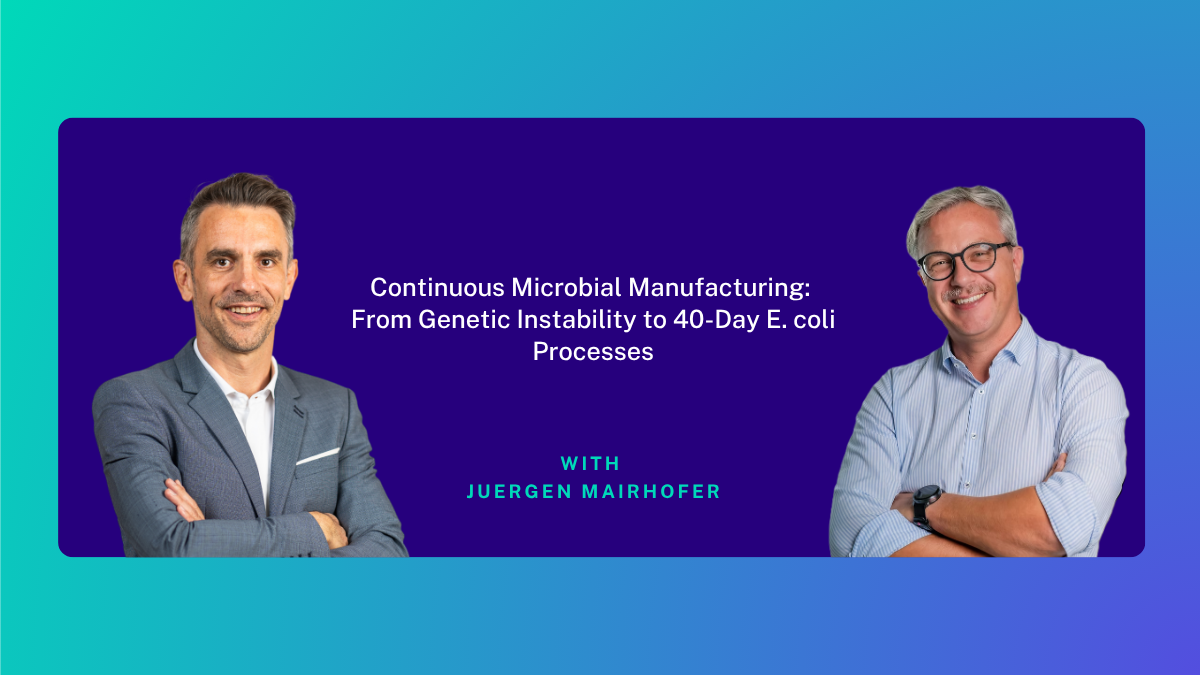
What if continuous microbial manufacturing wasn’t a pipe dream, but a reality quietly reshaping the foundations of bioprocessing?
Stuck in the cycle of fed-batch fermentation, the industry has long treated genetic drift and instability as unavoidable limitations—especially with E. coli. But what if the root of these headaches lies not in the hardware or facility layout, but deep within the biology itself?
Today's guest on Smart Biotech Scientist Podcast with David Brühlmann is Juergen Mairhofer, CEO of enGenes Biotech GmbH. Juergen is a scientist with a rare dual fluency in molecular biology and bioprocess engineering.
Key Topics Discussed
- Traditional CDMOs prioritize capacity utilization and risk reduction, often limiting true innovation.
- Innovation-driven CDMOs gain competitive advantage through proprietary technologies and differentiated business models.
- Juergen Mairhofer’s entrepreneurial path was shaped by hands-on scientific curiosity and dissatisfaction with big pharma structures.
- Bridging molecular biology and bioprocess engineering enables scalable, iterative innovation in strain and process design.
- A novel E. coli system improves productivity by decoupling growth from protein expression and enhancing genetic stability.
- The platform is best suited for non-glycosylated products like recombinant proteins, plasmid DNA, and metabolites.
- Continuous bioprocessing with E. coli offers major gains in efficiency, scalability, and cost versus traditional fed-batch methods.
- Key challenges include genetic instability, sterility, and system integration, requiring advanced monitoring and automation.
Episode Highlights
- Why the commodity CDMO model struggles with innovation—and how enGenes Biotech’s model aligns business incentives with process improvement [02:37]
- Juergen Mairhofer's early experiences blending molecular biology and bioprocess engineering, and how a “DIY” mentality led to entrepreneurship [04:42]
- Reflections on creativity, hard work, and building resilience in biotech innovation [06:22]
- Strategy behind developing a proprietary E. coli strain that decouples protein production from cell growth [10:01]
- The benefits of continuous manufacturing: running 30+ day E. coli processes, and how this compares to mammalian (CHO) systems [13:57]
- How enGenes Biotech integrates upstream and downstream operations for fully end-to-end continuous production [17:50]
- Economic and operational advantages: reducing facility footprint, lowering CAPEX/OPEX, and the necessity for innovation in global competition [19:25]
- Specific technical challenges: managing genetic drift, sterility, equipment, and process modeling in continuous systems [21:10]
In Their Words
The solution to the problem is the genetic stability. Because with this high replication rate of microbial cells, you always have this genetic drift. And this is already pronounced in a simple fed-batch process. But when you start to do that in a continuous manner, the process has to be terminated within a few days. Because if you use a classic cell line, the cells will mutate so quickly and there will be no productivity within 4 to 5 days.
Continuous Microbial Manufacturing: From Genetic Instability to 40-Day E. coli Processes - Part 1
David Brühlmann [00:00:31]:
What if the biggest bottleneck in bioprocessing isn't your downstream equipment or your facility design, but the production host itself? Today I'm joined by Juergen Mairhofer, who is the CEO of enGenes Biotech, who has spent over a decade engineering smarter microbial platforms and pioneering continuous manufacturing using microbial cells for recombinant proteins and plasmid DNA. In this conversation, we dig into what it actually takes to move from batch thinking to continuous reality. Let's dive in.
Welcome, Juergen, to the Smart Biotech Scientist. It's good to have you on today.
Juergen Mairhofer [00:02:25]:
Great, David, to be with you today, and I'm really looking forward to this very nice conversation.
David Brühlmann [00:02:30]:
Juergen, share something that you believe about bioprocess development that most people disagree with.
Juergen Mairhofer [00:02:37]:
That most people disagree with. I don't want to be provocative here, but I think that the commodity CDMO model rewards utilization over innovation, and that's why it's becoming unsustainable. So what we know is that CDMOs optimize for utilization of their existing steel tanks and not really for the productivity of the process. I think the problem that we are seeing in the industry and the traditional business model they are driving rewards risk minimization and capital utilization on their end, and they are not really willing to innovate.
When you make money by selling fermentation time, you have zero incentive to make processes faster and more efficient. I think this is the core problem or the root cause of the problem. And when you look into documents like a recent report from Roland Berger, the data in there shows that CDMOs with the right business models, really focused on innovation, can avoid significant price pressure. This is exactly the point.
So the commodity model is under severe pressure, while innovation-focused players thrive. And we at enGenes Biotech deliberately didn't build enGenes as a traditional CDMO.
So our model is based on real process development using proprietary technologies and then out-licensing these technologies. So enGenes makes money when the process gets better, not when it gets longer.
So this is the basic principle, and this aligns our interests with those of our customers. So we are the innovation partner that CDMOs and pharma companies are in need of in these difficult times.
David Brühlmann [00:04:24]:
Before we dive a bit further into your CDMO model and what exactly you're doing in process development, draw us into your story, Juergen. What sparked your interest in biotechnology and what were some pivotal moments leading to your current CEO role?
Juergen Mairhofer [00:04:42]:
So what are the pivotal moments? I think the pivotal moment was when I started my master's thesis here at the University of Natural Resources and Life Sciences, Vienna (BOKU), where I did host cell engineering, so classical molecular biology, and where for the first time in my life I could be creative in a way without other people judging my creativity.
Because if you do painting or something like that, everyone can say, okay, this doesn't look like a dog. But if you pipette small volumes in an Eppendorf tube and you have to wait for four weeks until you get a dataset out, in between nobody can judge whether the creative process is good, bad, or whatever.
So with my supervisor at that time, I learned that creativity is something really amazing. And being raised in a home where everything was macro, because my father is a car mechanic, things were judged immediately because you can just do things right or you can do things wrong. But with molecular biology, you have to try and you have to learn whether things work out.
And this is where the creative process started. Being at that time, I think 24, I think it was the first time in my life I learned what creativity can really bring to the table.
And there was no judgment in academia. So we were able to try things out and see if things worked out. And we were following a lot of weird ideas at that time point because this was the time when synthetic biology was born more or less. So starting around 2002, I think, with the first publications. And I ended up in a very dynamic field and I really appreciated that. So being able to be creative, I think this was the spark.
And then having the opportunity to do a PhD together with a big pharma company - my PhD project was funded by Boehringer Ingelheim at that time -, and getting also an idea of how big industry works.
Then being able to do two more additional postdoc positions, for example with the Austrian Centre of Industrial Biotechnology (ACIB), I also got more and more insights into how the industry works. And at the end of the day, I realized that the big pharma industry is not the place where I want to grow old.
So I come from a sort of DIY perspective. I grew up in the countryside in the 1990s, where nothing was going on, so it was very boring. When we wanted to have fun, we had to build our stuff on our own.
And I think with that mentality, I was able to develop the mindset to start thinking about founding my own company. And I think that's the point where everything started. So being passionate about being creative, building stuff on my own, and then also having the guts and coming from a hard-work mentality to really dig into a topic and make it work. So I think this is what got me into founding my own company.
David Brühlmann [00:07:39]:
Yeah, I love the way you're looking at pharma, looking at creativity where a lot of people see regulatory constraints. It's a pretty good way to look at it. And then on top of that, your entrepreneurial mindset and also hard work. And I think that's definitely a sweet spot. So tell us a bit more about what you're doing now with your company, how you are translating scientific innovation into scalable bioprocesses and more?
Juergen Mairhofer [00:08:09]:
As I started to explain, I was always working at the intersection of molecular biology and bioprocess engineering. So this was quite new in the early 2000s. It was the field of synthetic biology coming up, and at that time people were used to working in silos.
So there were people doing molecular biology, and then there were the bioprocessing people, and within the bioprocessing community there were the upstream people and the downstream people, and none of them were really able to communicate with each other because they had different mindsets and they spoke different technical languages.
And the funny thing was that within my PhD project, it was located directly at that intersection. Meaning we had to engineer a strain, to build a new Escherichia coli (E. coli) strain with a lot of genetic features to be able to perform certain tasks.
And I brought that strain to another working group at the university doing upstream processing. And I think I was one of the first people who was a molecular biologist and then also running fermenters at that time. So that was quite unusual. I had to really work hard so that these people would take me seriously.
But at some point they started to understand that this knowledge has a lot of value because it's like an iterative cycle. This is what I implemented here at the university, saying: Okay, we have to engineer the strain to meet the requirements of a bioprocess, and then we have to look at how the strain behaves in a real bioreactor, not in a shaker flask.
And then once we have learned that, we have to go back and improve the strain, and we have to run this cycle iteratively several times until we have an output that meets our requirements. So this is how I learned to work with the tools I had at that time, and this was fundamental, I think, to founding enGenes Biotech. Because all the work we are doing is based on a proprietary E. coli host strain that I invented together with colleagues.
So what we are capable of doing is that we can decouple protein production from cell growth. At a dedicated time point in the bioprocess, we can stop cell division and at the same time switch on the protein production process, which is using an orthogonal transcription system.
So in that case, T7 RNA polymerase, which then massively overtranscribes the gene of interest. And by having this non-dividing cell population, we can fill the cells with recombinant protein, or we can even secrete the protein to the extracellular space.
At the same time, this also genetically stabilizes the manufacturing system. Because one of the big drawbacks of using bacteria is that they have a very rapid growth rate. So they have a very high turnover. Every 20 minutes you generate progeny, you have an exponential growth function. And due to that fast growth, the genetics of the cells drift, because you always generate variability within your population.
At some point you end up with a cell that no longer has the plasmid where your gene of interest is located, or it has a mutation in some intracellular function. This cell can then overproliferate in your bioreactor and stall your production type. By stopping cell division, you can derail that process. So you're derailing adaptive evolution, and thereby we were able to come up with a very stable and robust manufacturing system that we finally commercialized within enGenes Biotech. And this is where the story started about 12 years ago.
David Brühlmann [00:11:33]:
What kind of products are particularly well suited to produce in your specific strain?
Juergen Mairhofer [00:11:39]:
Everything that you can produce using E. coli, so that is non-glycosylated, we are happy to take over this challenge because we believe that the non-growth-associated production is most of the time beneficial over the growth-associated production.
Because growth-associated production has these drawbacks that I already addressed, namely that the cells try to escape from the burden of producing whatever — let's say recombinant protein, plasmid DNA, or a small metabolite — it doesn't really matter. They want to escape because their objective function is to generate progeny as fast as possible, and they have absolutely no interest in serving the bioprocess engineer.
On the other hand, you have to come up with a smart solution to get the cells to the point where they have to do what you want them to do and to reduce the degrees of freedom that they have. And by playing this trick that we are implementing on the molecular biology level, we block the RNA polymerase of E. coli, so the cell can no longer produce its own messenger RNAs (mRNAs). And therefore it cannot ramp up a stress response, because the stress response is always meant to escape the metabolic burden you exert on the cell by forcing it to overproduce your biomolecule of interest.
David Brühlmann [00:12:57]:
And if I may put it simply, basically your cell line gets you a much higher titer, correct? Because you have more energy available for your protein of interest.
Juergen Mairhofer [00:13:08]:
Absolutely. So all the metabolic resources are channeled into production of the protein of interest, or replication of a plasmid, or production of a bioconjugate. And this allows us to come up with very high-titer processes, and at the same time processes that are very scalable, because we don't have this process variability that can happen through plasmid loss or accumulating mutations.
So also in the scale-up process, the processes we develop are much more robust and stable. And I think this is the big advantage of the technology that we are using.
David Brühlmann [00:13:45]:
And what is now the ratio between traditional fed-batch processes and continuous processes in your programs? Because I know you're big on continuous, but what is the current ratio?
Juergen Mairhofer [00:13:57]:
I mean, the current ratio, to be honest, is that we have been developing microbial continuous processes, and we are the first movers in that field. So I don't know of any other company that has successfully accomplished running an E. coli process fully continuous for the amount of time — days — that we have achieved. So we are currently talking about 40 days. So I think we are the first mover here.
We are currently trying to scale up our process on our own. Right now it's running at the 1-liter scale, already very productive with a small footprint. But at the end of the day, we are looking to scale that up to the 100-liter scale producing bioreagents.
So this is what we are currently looking into, and we are looking for partners who are willing to adapt this process scheme for biopharmaceuticals, for example. So insulin would be an amazing case, because this is something that needs to be produced at massive scale. At the same time, the costs have to be low.
What we are struggling with at the end of the day is what you mentioned earlier — the industry is very risk-averse and conservative. For mammalian cell culture, continuous processing is taking off at the moment. So we see that there is a lot of interest in that. Very few companies are able to master it, but some of them are. But for microbial bioprocessing, I think we are just at the beginning. So this is something we have to push forward now. We see that it is getting traction, but it needs someone who is willing to adopt it and to further develop it together with us.
David Brühlmann [00:15:33]:
What is the reason that E. coli is lagging behind? Because as you said, several companies are mastering continuous processing with CHO, but what is more complex — either on the technical side, or perhaps there are economic factors in E. coli processes that explain that?
Juergen Mairhofer [00:15:48]:
The solution to the problem is, as I have explained before, genetic stability. Because with this high replication rate of microbial cells, you always have this genetic drift. And this is already pronounced in a simple fed-batch process. But when you start to do that in a continuous manner, the process has to be terminated within a few days.
Because if you use a classic cell line, the cells will mutate so quickly that there will be no productivity within 4 to 5 days. That's what we've been seeing by using the classical E. coli BL21 strain, for example, in head-to-head comparison with our technology.
So this effect is really pronounced in continuous mode, and I think the tools haven't been available to tackle that. But now with our technology, we have a genetically stabilized host cell, and we have a proprietary approach to how we do things. Because we do not run the continuous process just in one vessel — a chemostat. We run it in two connected chemostats.
This adds a bit of complexity, but at the same time it solves the problem of genetic stability. In the first vessel we grow our cells, so that is where biomass production is going on. Then we pump our cells into a second vessel where we decouple protein production from cell growth. We stop cell division in the second vessel, thereby genetically stabilizing the system, and then the production goes on in the second vessel. And we are in a fully steady-state condition. So everything that goes in on one side is equal to what goes out on the other side.
And by applying that trick, we end up with a productive process for up to one month. So this is the solution to a complex problem, and I think people have been struggling a lot to solve that. But the solution is now out there. Whenever somebody has an interest in doing that, we can start straight away.
David Brühlmann [00:17:39]:
With now 30 days in continuous mode with E. coli, how do you run the DSP (downstream processing)? Is that continuous, or are there several batches followed by each other?
Juergen Mairhofer [00:17:50]:
The project we have been working on with a larger consortium here in India is a fully end-to-end continuous process. So the upstream is continuous, then the primary recovery. In that case, we have our product — a Protein A ligand — in the supernatant. So we have to separate the biomass from the supernatant. This is done by continuous dynamic filtration.
Then we end up with a clear permeate where our product is located. And this is then captured by a multi-column chromatography approach where we have four columns that are run in series. So every time two columns are loaded, one is eluted, and the fourth column is regenerated. And by assembling all these continuous unit operations, we came up with a very intensified process.
All the learnings we have from changing our mindset in that project to a fully continuous approach can be injected directly into the classical things we are doing in fed-batch mode, because the learnings in process intensification can also be applied to the classical fed-batch principle. So it's about how to do things in the most efficient way.
Because what is very important in continuous production is that you have a robust setup, since you cannot tolerate failure. Everything has to be very robust and very effective, otherwise you cannot master such an endeavor.
David Brühlmann [00:19:11]:
What are the main advantages of a continuous process with E. coli? Many of the listeners are familiar with continuous processes with CHO cells. Are you seeing similar advantages or are they very different?
Juergen Mairhofer [00:19:25]:
I think it's quite similar because what are the main advantages? You want to produce more with less, meaning less facility footprint, less capital expenditure (CAPEX). So you want to invest in a small facility, not build a 10-cubic-meter stainless steel facility. You probably want to build a single-use facility that you can fit into a ballroom concept or something like that.
And you want to have less operational expenditure (OPEX). Meaning if it's fully automated and digitalized, you can also save costs on the level of personnel. I mean, the process that we had up and running required only one person available who was looking at the process from a meta perspective, also being able to send out SMS alerts if things were going wrong or if there was a process deviation.
You can really start to think on a different level. Not having 120 people running around like crazy, but trying to have a process that runs with a small footprint and a low headcount. I think this is what we have to do to innovate and to stay competitive in the race that we are seeing at the moment on a global level. If we are not willing to innovate, we will become irrelevant. I think this is absolutely the problem we are facing.
David Brühlmann [00:20:45]:
Yeah, this is a good point, and I would like to touch upon innovation a bit later. I just want to ask a question about what can go wrong with an E. coli continuous process, because even with CHO, it's no easy endeavor in certain cases to run a process for 30, 45, or even longer days. What are the main reasons or issues you have observed that can go wrong?
Juergen Mairhofer [00:21:10]:
The main issues that can go wrong: genetic stability first and foremost. That is, I think, the major obstacle, as already elaborated.
This is something we had to learn and improve stepwise. Genetic stability on different levels:
- genetic stability at the level of the genome,
- genetic stability at the level of the plasmids you are using,
- genetic stability at the level of the expression system, and shielding the T7 RNA polymerase so that it is not hit by mutations, for example when you are using an orthogonal transcription system like we do.
Then other issues like sterility can also be a concern. We haven't seen a lot of contamination because we are very good at working aseptically, but if you want to have something running for more than two weeks, it can become a problem at some point.
Especially when you think about single-use equipment, where the systems are most of the time validated only for about 10 days or something like that. So this is still an open question — whether you can reliably run single-use equipment for extended periods.
Another topic is leachables. Is there a leaching issue, especially in microbial processes where you might use ammonia? Is this more pronounced compared to CHO processes? That is a question to be addressed in the future. Then there is also the complexity of connecting multiple unit operations continuously. This can create challenges because if something changes in the upstream, it can have a major impact on the downstream.
We solved that by building models around our process, implementing hybrid or mechanistic models. One of the nice things I can mention here is that we are able to determine the product yield every 15 minutes online. We have an HPLC standing next to our continuous process that measures the titer and then injects that data point into a mechanistic model. This mechanistic model counts, for example, the cycles on the multi-column chromatography, so we know how the columns age.
Based on this knowledge, we can then call the optimal purification method determined by the mechanistic model to purify the protein at the current concentration in the supernatant. These are the feedback loops that you can implement to make your life easier.
And then, as I mentioned earlier, through automation you can solve many problems on the fly. For example, if readings show that the back pressure is increasing on the filtration device, the system can send a warning message to someone near the system to check it and counteract the issue early. That way you avoid something like a burst connection due to rising back pressure.
David Brühlmann [00:24:13]:
This wraps up part one of our conversation. From growth-decoupled production to the real engineering challenges behind continuous microbial manufacturing, Juergen is giving us a masterclass in rethinking how we scale bioprocesses. And we're just getting started.
In Part 2, we shift gears into the business side — CDMOs, geopolitics, and the founder's journey. If you're enjoying this episode, leave a review on Apple Podcasts or your favorite platform. It truly helps other scientist like you discover the show.
For additional bioprocessing tips, visit us at www.smartbiotechscientist.com. Stay tuned for more inspiring biotech insights in our next episode. Until then, let's continue to smarten up biotech.
Disclaimer: This transcript was generated with the assistance of artificial intelligence. While efforts have been made to ensure accuracy, it may contain errors, omissions, or misinterpretations. The text has been lightly edited and optimized for readability and flow. Please do not rely on it as a verbatim record.
Next Step
Book a free consultation to help you get started on any questions you may have about bioprocess development: https://bruehlmann-consulting.com/call
About Juergen Mairhofer

Juergen Mairhofer is co-founder of enGenes Biotech and a biotechnology expert specializing in microbial cell design and bioprocess engineering. He previously worked as a Research Associate at BOKU University in Vienna and as a PostDoc at ACIB, focusing on recombinant protein production and strain engineering.

Juergen holds a PhD in Biotechnology and has authored multiple scientific publications and book chapters. His work centers on translating advanced genetic technologies into scalable industrial solutions.

Connect with Juergen Mairhofer on LinkedIn.
Further Listening
If you’re interested in exploring more breakthroughs in continuous bioprocessing and the future of biotech manufacturing, check out these past episodes from the Smart Biotech Scientist Podcast:
Episodes 85 - 86: Bioprocess 4.0: Integrated Continuous Biomanufacturing with Massimo Morbidelli
Episodes 153 - 154: The Future of Bioprocessing: Industry 4.0, Digital Twins, and Continuous Manufacturing Strategies with Tiago Matos
Episode 155: From Process Bottlenecks to Seamless Production: How Continuous Bioprocessing Changes Everything
Episode 156: The Hidden Economics of Continuous Processing That Most Biotech Companies Overlook
Episodes 181 - 182: Innovating Continuous Bioprocessing with Vibrating Membrane Filtration with Jarno Robin
Episodes 209 - 210: From Batch to Continuous: Building Innovation Culture in Conservative Biotech Environments with Irina Ramos
David Brühlmann is a strategic advisor who helps C-level biotech leaders reduce development and manufacturing costs to make life-saving therapies accessible to more patients worldwide.
He is also a biotech technology innovation coach, technology transfer leader, and host of the Smart Biotech Scientist podcast—the go-to podcast for biotech scientists who want to master biopharma CMC development and biomanufacturing.
Hear It From The Horse’s Mouth
Want to listen to the full interview? Go to Smart Biotech Scientist Podcast.
Want to hear more? Do visit the podcast page and check out other episodes.
Do you wish to simplify your biologics drug development project? Contact Us

